
Cue Biopharma: Immuno-STAT Platform Progress, Partnership Milestones, and the Road to Clinical Validation
Cue Biopharma’s modular Immuno-STAT platform aspires to change the paradigm in precision immunotherapy, but the company’s near-term trajectory depends on successful clinical advancement, effective collaborations, and prudent management of ongoing losses.
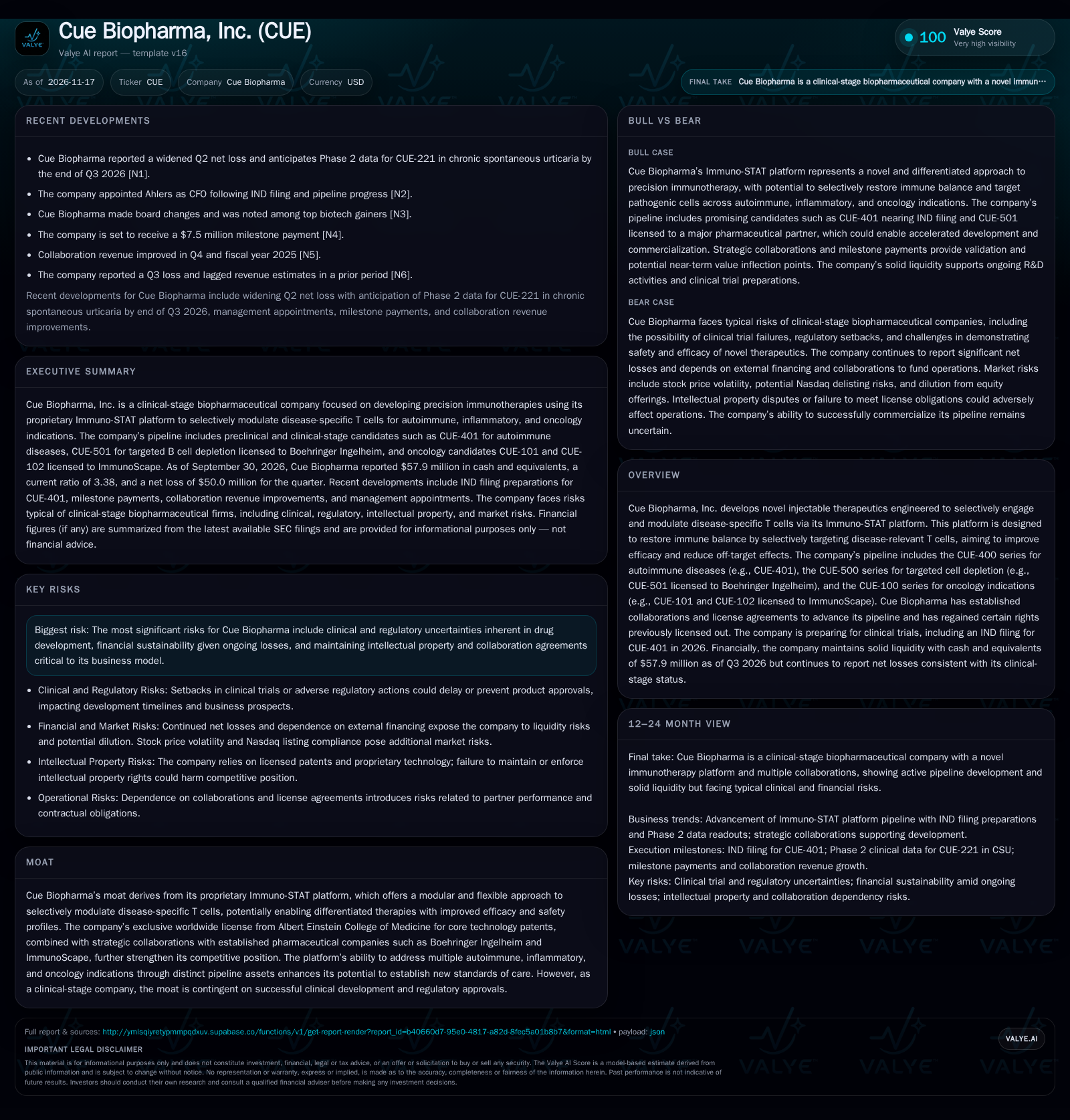
Cue Biopharma is advancing its Immuno-STAT platform with a preclinical lead candidate (CUE-401) nearing IND filing for autoimmune diseases and maintains reported liquidity position with $57.9 million in cash. Recent milestones include a $7.5 million payment and active partnerships with Boehringer Ingelheim and ImmunoScape. However, sustained net losses and clinical execution risks remain central to the investment case. The upcoming IND for CUE-401 and data readouts for CUE-221 will be pivotal for pipeline credibility and future funding scenarios. [S1] [S2] [N1] [N4]
Cue Biopharma is at a pivotal juncture as its Immuno-STAT platform edges closer to clinical validation, with CUE-401 on track for an IND filing in the coming months and key partnered programs generating milestone payments. The company’s strategic approach—leveraging partnerships and retaining a modular technology base—provides optionality across autoimmune, oncology, and cell depletion indications. However, persistent net losses and reliance on external capital underscore the importance of clinical readouts and ongoing collaboration success. The next year will test whether Cue’s platform can deliver both scientific and commercial inflection points.
What’s Changing Now: Pipeline Milestones, Cash Position, and Partnership Progress
Cue Biopharma’s clinical and operational landscape is defined by several recent developments: the company holds $57.9 million in cash and equivalents as of September 30, 2026, with a current ratio of 3.38 and cash ratio of 2.94, supporting near-term liquidity [S2]. Its preclinical autoimmune candidate, CUE-401, is approaching IND filing in Q2 2026, representing a major step toward clinical validation of the Immuno-STAT platform [S1]. The company is also set to receive a $7.5 million milestone payment, likely tied to progress in its partnered CUE-501 program with Boehringer Ingelheim [N4]. Meanwhile, Cue continues to report substantial net losses, with a Q3 2026 net loss of $50.0 million [S2]. These facts frame a business transitioning from pure research to clinical risk, while actively leveraging partnerships to fund and validate its technology.
Revenue Model and Cost Dynamics in a Platform Biotech
Cue Biopharma’s economics are typical of a clinical-stage platform biotech: revenue is primarily derived from milestone and collaboration payments rather than product sales, while expenses are dominated by R&D and G&A. The Immuno-STAT platform’s modularity enables the company to pursue multiple indications, but each new program requires substantial preclinical and clinical investment. The company’s cash burn—evidenced by a $50 million quarterly net loss—reflects both the breadth of its pipeline and the resource intensity of moving candidates toward the clinic [S2].
If the Immuno-STAT platform delivers early clinical success, Cue’s business model could shift toward larger, backloaded milestone receipts, potential royalties from out-licensed assets (such as CUE-501 and the CUE-100 series), and eventually commercial revenue from wholly or co-developed products. However, until pivotal clinical milestones are achieved, the business remains structurally loss-making and reliant on periodic capital raises or new licensing deals to sustain operations. The company’s existing royalty-bearing license agreement with Albert Einstein College of Medicine also introduces future obligations that will scale with commercial success [S1]. Operating leverage is possible if later-stage assets succeed, but fixed costs are likely to remain high until pipeline attrition clarifies future focus areas.
Platform Differentiation vs. Crowded Immunotherapy Landscape
Cue Biopharma’s competitive position is grounded in the Immuno-STAT platform’s promise of precision T cell engagement—a mechanism intended to improve efficacy and safety over conventional immunomodulators. This approach could provide a differentiated value proposition if clinical data confirm selective modulation with minimal off-target effects. However, the competitive field is crowded: established immunotherapy players, large pharma with autoimmune and oncology franchises, and a wave of next-generation cell therapy and bispecific antibody developers all vie for similar disease targets.
Strategic collaborations with Boehringer Ingelheim and ImmunoScape lend external validation and may accelerate development timelines, but also introduce dependency on partner execution and contractual terms [S1]. The modularity of Immuno-STAT theoretically supports rapid adaptation to new indications, yet real competitive advantage will depend on proof of clinical benefit, intellectual property defense (given technology licensing from Albert Einstein College of Medicine), and the ability to attract further partners or acquirers in a sector where platform stories are abundant but late-stage winners are rare.
How Platform Validation and Partnered Success Could Unlock Value
A favorable scenario for Cue Biopharma would see CUE-401’s IND filing in Q2 2026 followed by rapid enrollment and positive early safety and biomarker data, validating the core Immuno-STAT technology. Simultaneously, continued progress in partnered programs—such as additional milestones from Boehringer Ingelheim for CUE-501 or ImmunoScape for the CUE-100 series—could generate non-dilutive funding and reinforce the platform’s credibility with both investors and potential new collaborators [N4].
This scenario would be confirmed by: (1) timely IND acceptance and initiation of clinical trials for CUE-401, (2) favorable interim or top-line data in the first-in-human studies, (3) additional milestone or option payments from partners, and (4) public announcements of new or expanded collaborations. If these occur, Cue could secure a funding bridge to pivotal studies, improve its negotiating leverage for future deals, and potentially become a takeout candidate if larger players seek access to its platform.
Clinical Progress and Cash Burn Define the Next Phase
The most plausible trajectory for Cue Biopharma is one of measured pipeline advancement, punctuated by periodic milestone receipts and continued capital needs. CUE-401 is likely to enter clinical testing in 2026, but initial data will be preliminary, and the path to late-stage validation remains long and uncertain. Collaboration payments (such as the recent $7.5 million milestone) may help offset cash burn, but the company will probably require additional financing within the next 12–24 months unless a major out-licensing event occurs [N4] [S2].
This scenario would be confirmed by: (1) achievement of planned IND and early clinical milestones on schedule but without major clinical breakthroughs, (2) a steady cadence of milestone and option payments, and (3) further equity or debt financing to fund ongoing R&D. If disclosed, metrics such as cash runway projections, R&D expense trends, and partnership updates would further clarify this trajectory.
Clinical Setbacks or Collaboration Disruptions Could Force Strategic Retrenchment
A negative outcome would be triggered by delays or negative results in the CUE-401 IND process, missed clinical endpoints in partnered or in-house programs, or loss of strategic partnerships due to shifting partner priorities or unmet milestones. Such setbacks would increase the likelihood of dilutive financing, strategic program cuts, or even Nasdaq delisting risk, especially given the company’s history of net losses and prior stock split to regain compliance [S1] [S2].
This scenario would be confirmed by: (1) clinical holds, adverse safety signals, or failure to enroll in new trials, (2) public announcements of terminated or paused partnerships, (3) absence of milestone payments or collaboration revenue, and (4) public warnings regarding cash runway or going-concern risk. If these events materialize, Cue may be forced to narrow its pipeline, cut costs, or seek a strategic transaction from a position of weakness.
Milestones and Metrics That Will Determine Immuno-STAT’s Commercial Future
The timing and regulatory outcome of the CUE-401 IND filing for autoimmune indications in Q2 2026 will be crucial for platform validation.
Interim or top-line clinical data from CUE-221 and other pipeline assets (if disclosed) will provide the first proof-of-concept signals.
Frequency and size of milestone and option payments from Boehringer Ingelheim, ImmunoScape, and other partners will indicate external confidence and non-dilutive funding capacity.
Cash runway projections and management’s guidance on funding needs (if provided) will clarify the urgency and scale of future capital raises.
Updates on R&D expense trends and pipeline prioritization will signal management’s approach to capital allocation under uncertainty.
Any new or expanded strategic collaborations, out-licensing deals, or partnership terminations will directly impact Cue’s business model and leverage.
Nasdaq compliance status and any potential warnings regarding listing standards or going-concern risk would be material for investor confidence.
Disclaimer: This is research-only, informational analysis and not investment advice. It may include AI-generated interpretation and general industry context. Always verify important details using primary sources.

Comments