
Actinium Pharmaceuticals: Radiopharmaceutical Innovation Meets Clinical and Commercial Crossroads
Actinium Pharmaceuticals is advancing a differentiated pipeline of targeted radiotherapies for oncology, with multiple first-in-class candidates progressing through clinical stages, internal manufacturing capabilities on the horizon, and a substantial patent estate. The company’s future hinges on the clinical, regulatory, and commercial outcomes of its late-stage programs, particularly as it seeks partnerships and faces capital-raising and execution risks typical of clinical-stage biotechs.
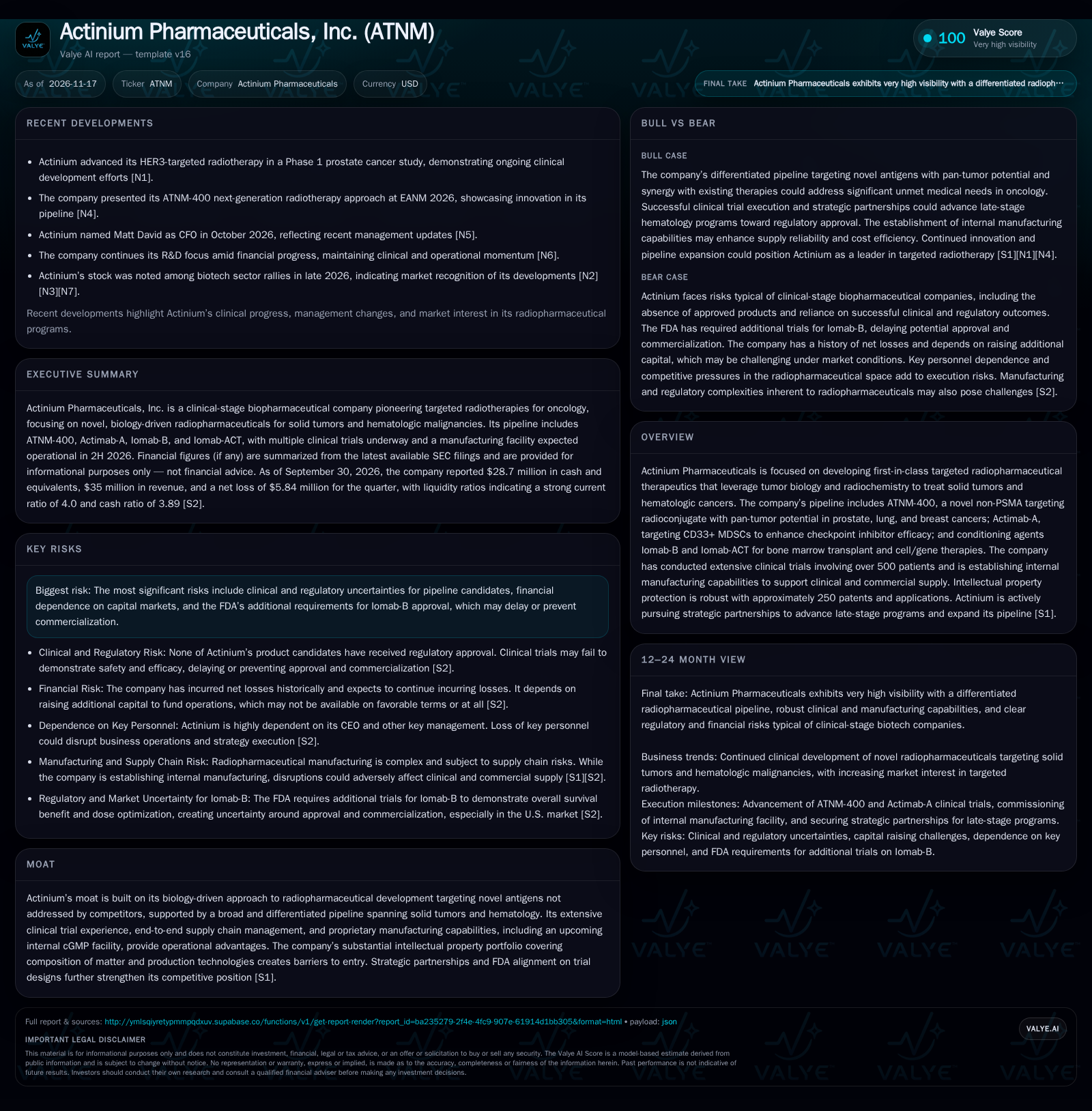
Actinium Pharmaceuticals is a clinical-stage biopharma innovator in targeted radiotherapies, with a pan-tumor pipeline, robust intellectual property, and an internal manufacturing facility expected in late 2026. The company’s financial results are currently buoyed by a $35 million commercialization agreement, but future trajectory depends on clinical trial success, regulatory approvals, and the ability to secure strategic partnerships and additional capital. Execution risks remain high, especially for late-stage programs and manufacturing scale-up. [S1] [S2]
Actinium Pharmaceuticals, Inc. is at a pivotal stage as it seeks to translate its differentiated, biology-driven radiopharmaceutical pipeline into commercial reality. The company’s innovative approach—targeting both solid tumors and hematologic malignancies—has produced multiple clinical-stage assets, extensive IP protection, and an expanding operational footprint with in-house manufacturing expected soon. However, Actinium remains highly dependent on successful clinical and regulatory outcomes, strategic partnerships, and continued access to capital, with execution and exclusivity risks shaping the investment calculus. The coming 12–24 months will be critical in defining whether Actinium’s scientific promise can be matched by commercial traction and sustainable growth.
Recent Milestones Shape Actinium’s Strategic Trajectory
As of September 30, 2026, Actinium Pharmaceuticals reported $35 million in revenue—primarily attributable to a commercialization agreement—alongside $28.7 million in cash and a net loss of $5.84 million for the quarter. Notably, this period’s net income of $16.5 million for the first nine months was a one-off, driven by the revenue recognition event, rather than ongoing product sales. The company is not yet profitable on a recurring basis and expects to continue incurring losses [S2].
Clinical progress continues across the pipeline: ATNM-400, a HER3-targeted radiotherapy, advanced in a Phase 1 prostate cancer study, and presentations at EANM 2026 highlighted innovation in Actinium’s approach [N1] [N4]. Internally, the company is building a cGMP manufacturing facility slated for operational status in the second half of 2026, aiming to support both clinical and future commercial supply [S1].
The company’s intellectual property position is robust, with approximately 250 issued and pending patents spanning composition of matter, methods of use, and manufacturing processes. However, some key patents may expire soon, potentially impacting future market exclusivity [S1] [S2].
Economics of Radiopharmaceutical Development: Scale, Cost, and Revenue Potential
Actinium’s business model is fundamentally tied to the successful clinical development and eventual commercialization of its targeted radiotherapies. Currently, the company’s revenue profile is non-recurring, driven by milestone payments from commercialization agreements rather than product sales. This underscores the pre-commercial nature of the business and its dependence on external funding and partnership capital [S2].
If clinical and regulatory milestones are achieved, Actinium’s future revenue mix could shift toward recurring product sales, especially for high-value oncology indications. Radiopharmaceuticals, by nature, often command premium pricing due to their complexity and the high unmet need in targeted cancer populations. However, manufacturing scale-up and supply chain reliability are critical cost drivers. The upcoming internal cGMP facility could enable margin expansion by reducing reliance on third-party manufacturing and improving supply flexibility, but it also introduces significant upfront capital and ongoing operational expenses [S1].
Operating leverage may emerge if Actinium can transition from R&D-heavy operations to commercial sales, but this is highly contingent on regulatory approval and market uptake. The company’s broad IP portfolio may allow for premium pricing and limited competition in the near term, but patent expirations and the entry of generic or biosimilar competitors could compress margins over time.
Differentiation and Barriers in a Crowded Oncology Ecosystem
Actinium’s strategy is to carve out a leadership position in radiopharmaceutical oncology by focusing on novel antigens (e.g., HER3 for ATNM-400, CD33 for Actimab-A, CD45 for Iomab-B and Iomab-ACT) that are not widely targeted by current competitors [S1]. This biology-driven approach, along with combination strategies (e.g., Actimab-A with PD-1 inhibitors), aims to address resistance mechanisms and unlock synergy with existing immunotherapies.
The company’s competitive moat is reinforced by an extensive patent estate and end-to-end supply chain control, which includes isotope sourcing and internal manufacturing. These capabilities are not easily replicated by smaller or less integrated players, potentially allowing Actinium to maintain a first-mover advantage if clinical efficacy is demonstrated.
However, the radiopharmaceutical space is attracting increased investment from large pharma and biotech peers, some of whom possess greater financial resources, commercial infrastructure, and established relationships with treatment centers. Platform competitors, as well as companies with broader oncology portfolios, could outpace Actinium in commercialization or pursue similar antigen targets. Additionally, the expiration of key patents may erode exclusivity and invite generic competition, especially if Actinium’s clinical timelines extend.
Breakthroughs in Clinical Validation Unlock Commercial and Strategic Value
The most favorable scenario for Actinium involves successful late-stage clinical trial outcomes for ATNM-400, Actimab-A, and Iomab-ACT, leading to regulatory approvals and rapid market adoption. If the company can demonstrate clear efficacy—especially in indications with high unmet need such as mCRPC, NSCLC, or conditioning for bone marrow transplants—Actinium could become a partner of choice for larger pharma or secure lucrative licensing and commercialization deals.
Commercial success may be amplified by the operational launch of its internal cGMP facility, enabling control over drug supply and potentially improving COGS (cost of goods sold) and gross margins. Strategic partnerships could provide non-dilutive funding and global reach, accelerating pivotal trials and product launches. The IP estate may support premium pricing and deter fast-follower competition, at least until key patents expire.
Evidence supporting this scenario would include positive Phase 2/3 data, partnership announcements with established oncology players, manufacturing facility commissioning on time and budget, and regulatory submission/approval milestones—particularly for Iomab-B and ATNM-400.
Clinical Progress Amid Capital Constraints and Execution Hurdles
A more measured outcome envisions Actinium making incremental clinical progress—such as advancing existing studies, reporting interim data, and securing FDA alignment—but facing elongated timelines for pivotal trials and commercial launches. In this scenario, the company continues to rely on milestone and partnership revenue, and may require additional equity or debt financing to bridge to approval and launch.
Manufacturing facility ramp-up could encounter delays or cost overruns, and some pipeline candidates may advance more slowly than anticipated due to regulatory or recruitment challenges. The ongoing need to raise capital—especially if market conditions tighten—could dilute existing shareholders or constrain program scope.
This scenario is confirmed if clinical data are mixed or delayed, partnership deals are smaller than expected, or additional capital raises are necessary to sustain operations. Progress would be steady but not transformative, with Actinium remaining a late-stage, pre-commercial biotech for an extended period.
Pipeline Setbacks and Financial Headwinds Threaten Continuity
The adverse scenario involves clinical trial failures or inconclusive results for one or more of Actinium’s lead candidates, particularly in pivotal studies required for FDA approval. Regulatory setbacks—such as additional trial requirements for Iomab-B—could further delay or derail commercialization efforts, straining both financial and operational resources.
If key patents expire before products reach the market, or if competitors introduce similar therapies, Actinium could lose prospective exclusivity and pricing power. Manufacturing problems, such as delays in commissioning the cGMP facility or supply chain disruptions, could exacerbate operational risk.
Liquidity would become a central concern if milestone payments dry up and access to new capital is constrained by poor clinical results or adverse market conditions. The company could be forced to curtail R&D, pursue asset sales, or seek a strategic exit under less favorable terms. Confirmation of this scenario would include trial discontinuations, significant delays, inability to raise capital, or layoffs and program terminations.
Milestones and Metrics That Will Define Actinium’s Next Chapter
Progression of pivotal clinical trials for ATNM-400, Actimab-A, and Iomab-ACT, including the timing and quality of interim and final data releases.
Regulatory feedback and alignment with the FDA, particularly regarding additional trial requirements for Iomab-B and pathway clarity for other pipeline assets.
Commissioning timeline and operational ramp-up of the internal cGMP manufacturing facility, as delays or cost overruns would materially affect supply and margins.
Strategic partnership announcements, including the size, structure, and non-dilutive funding potential of any deals with established oncology or pharma players.
Disclosure of recurring product revenue versus milestone or partnership revenue, as a shift toward recurring sales would indicate commercial traction.
Patent expiry timelines and updates on efforts to extend or supplement exclusivity for lead assets, especially for molecules or methods central to the pipeline.
Management continuity and additions, particularly in clinical, regulatory, and manufacturing leadership roles, as execution risk is heightened by personnel turnover.
Disclaimer: This is research-only, informational analysis and not investment advice. It may include AI-generated interpretation and general industry context. Always verify important details using primary sources.

Comments