
LiveOne’s Multi-Stream Strategy: Podcast Expansion, OEM Exposure, and Monetization Hurdles
LiveOne, Inc. integrates live music streaming, podcasting, and merchandise to monetize superfans, but faces mounting financial pressures, customer concentration risk with Tesla, and a need to turn diversified reach into durable, profitable growth.
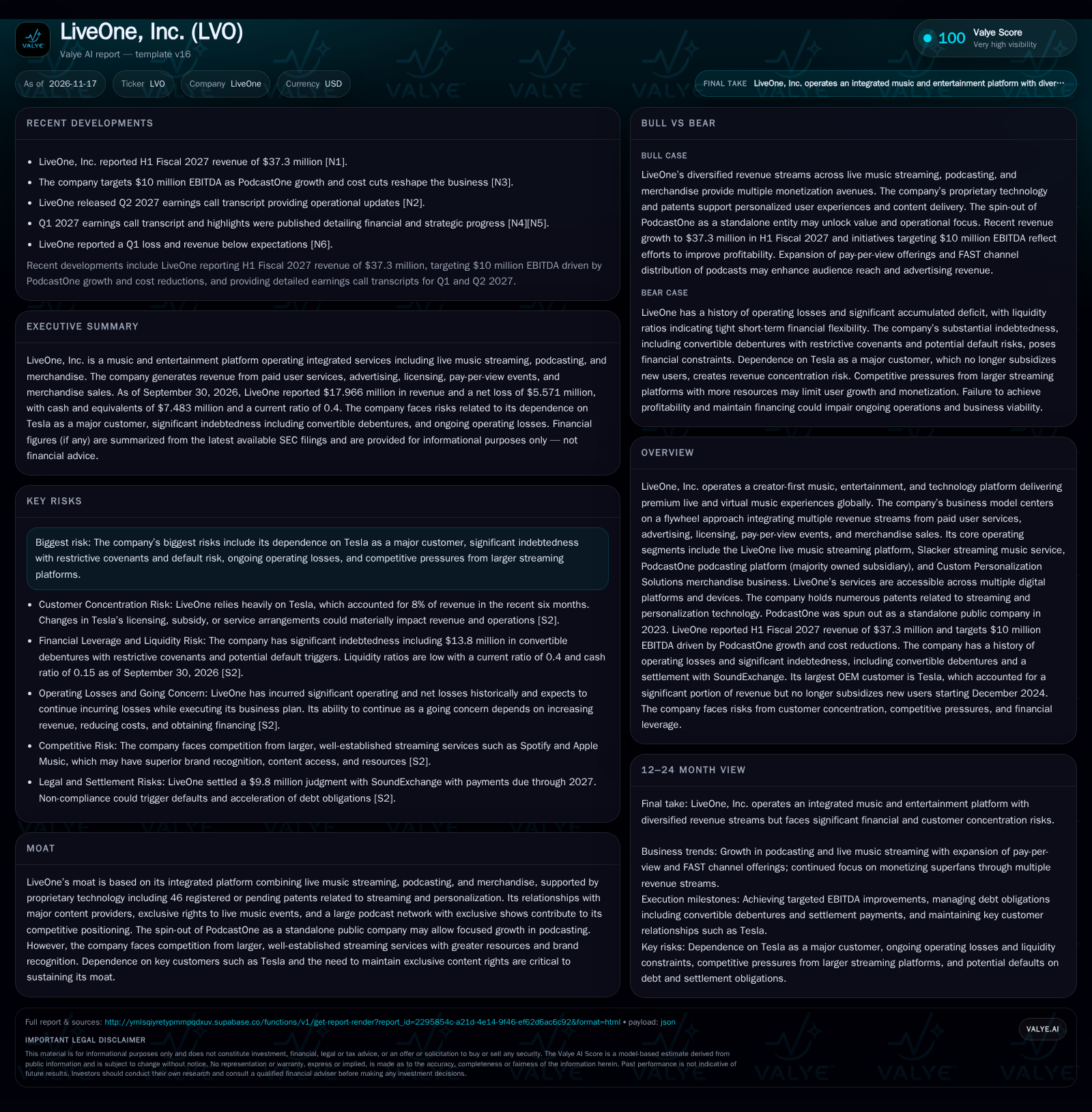
LiveOne reported H1 Fiscal 2027 revenue of $37.3 million, targets $10 million EBITDA on podcast growth and cost cuts, and remains heavily exposed to Tesla as an OEM customer.
LiveOne, Inc. aims to carve out a defensible niche in the crowded digital entertainment landscape, integrating live music streaming, podcasting, and merchandise sales across multiple platforms. The company has built a multi-pronged flywheel targeting superfans and boasts a robust portfolio of streaming patents and exclusive content. However, its financial profile is under acute pressure, with ongoing operating losses, high leverage, and a heavy dependence on Tesla as a revenue source. As competitive dynamics in streaming intensify and OEM revenue risk rises, LiveOne’s path to profitability hinges on its ability to grow and monetize its podcasting platform, expand direct-to-consumer offerings, and manage its capital structure.
Tesla’s Evolving Impact, PodcastOne Priorities, and Financial Challenges at LiveOne
LiveOne reported H1 Fiscal 2027 revenue of $37.3 million, reflecting continued traction across its integrated streaming and content businesses, but the company posted a net loss of $5.571 million for the most recent quarter, underscoring persistent profitability challenges [N1] [S2]. Tesla remains LiveOne’s largest OEM partner, accounting for 8% of consolidated revenue for the six months ended September 30, 2026; however, Tesla has ceased subsidizing music services for new users as of December 2024, though it continues to pay for legacy subscribers [S2]. This transition increases future revenue uncertainty and intensifies LiveOne’s customer concentration risk. On the balance sheet, LiveOne held $7.483 million in cash and equivalents against $49.797 million in current liabilities as of September 30, 2026 (current ratio 0.4), with $13.8 million in convertible debentures and a $9.8 million settlement obligation payable through February 2027 [S2]. The company is targeting $10 million EBITDA, with PodcastOne growth and cost reduction as the main levers [N3].
Revenue Growth Dynamics Underpinning LiveOne’s Path to Profitability
LiveOne’s business model is built on a multi-revenue flywheel: paid user subscriptions for live and on-demand streaming, advertising and sponsorships across music and podcasting, licensing revenues (notably from OEMs like Tesla), pay-per-view event offerings, and merchandise sales through its Custom Personalization Solutions unit [S1]. This diversity theoretically reduces reliance on any one stream, but in practice, a significant portion of revenue is still concentrated in a few major relationships—most notably Tesla. The company’s operating leverage potential lies in scaling digital content (especially podcasting and streaming, where incremental distribution costs are low) and cross-selling merchandise to engaged superfans.
However, the economics of each stream vary. Subscription and OEM licensing revenues may offer more predictability, but are vulnerable to contract changes and margin pressures. Advertising and sponsorships are cyclical and dependent on audience scale and engagement. Merchandise and pay-per-view add incremental margin but require continued investment in content and rights acquisition. Fixed costs in content production, platform technology, and rights management remain substantial. [S2]
Evaluating LiveOne’s Platform and Patent Assets Against Major Streaming Competitors
LiveOne’s integrated approach—combining live music, on-demand streaming, podcasting, and merchandise—offers a differentiated value proposition aimed at capturing superfans and cross-selling across content verticals. The company owns 46 registered or pending patents related to streaming and personalization, which could underpin unique user experiences or licensing opportunities [S1]. However, the competitive landscape is dominated by well-capitalized streaming incumbents (such as Spotify, Apple Music, Amazon, and YouTube), each with massive content libraries, global reach, and deep pockets for content acquisition and marketing.
PodcastOne’s scale—200 exclusive shows and 228 million downloads annually—gives LiveOne a potential edge in podcasting, especially if cross-platform synergies are realized. Yet, customer switching costs are limited in streaming and podcasting, absent exclusive, must-have content. Large platforms have been aggressively expanding into live events, exclusive podcasts, and artist partnerships, eroding differentiation. LiveOne’s dependence on OEM contracts (especially Tesla) further exposes it to competitive displacement or unfavorable renegotiation. Ultimately, the company’s ability to defend pricing, retain users, and secure premium advertising rates will depend on its capacity to deliver unique, high-engagement content and experiences not easily replicated by larger rivals.
Potential Gains from PodcastOne Expansion and Enhanced Superfan Monetization Versus OEM Pressures
In a favorable scenario, LiveOne successfully accelerates PodcastOne’s growth, expanding both audience and advertiser demand. The platform’s exclusive content and ability to syndicate across FAST channels could drive robust digital ad revenue and attract premium sponsors. Cost discipline—especially in content acquisition and platform operations—enables EBITDA margin expansion, helping the company reach its $10 million target [N3]. Merchandise and pay-per-view events, if effectively cross-sold to superfans, could provide high-margin incremental revenue.
This outcome would be confirmed by sustained double-digit growth in podcast downloads and ad revenue, stabilization or growth in direct-to-consumer streaming subscriptions, and evidence that the loss of new Tesla subsidies is offset by gains elsewhere. Further, meaningful progress in debt reduction or successful refinancing would signal improved potential financial flexibility. The scenario could be challenged if podcast growth stalls, advertising markets weaken, or cost savings are not realized as forecast.
Superfan Base Strengthens Amid Ongoing Margin and OEM Uncertainties
The most plausible trajectory is that LiveOne sees modest growth in podcasting and digital content engagement but faces continued margin pressure and slow progress toward profitability. Tesla’s phase-out of new user subsidies results in a partial revenue headwind, and while legacy users provide a buffer, the company is challenged to fully replace lost OEM revenue with direct-to-consumer or advertising gains. Cost-cutting efforts help narrow losses but are not sufficient to reach targeted EBITDA without outsized podcast growth.
Evidence for this scenario would include stable or gradually increasing podcast metrics, incremental improvement in adjusted EBITDA, and a measured reduction in operating losses. Confirmation would also come from maintaining key OEM and content relationships, avoiding covenant breaches or settlement defaults, but without dramatic improvement in liquidity or leverage. A reversal—such as a large new OEM contract, a material jump in podcast monetization, or rapid user churn—would move the company away from this base case.
Financial Strains from Debt, Revenue Concentration, and OEM Challenges Risk Destabilizing LiveOne
In a negative scenario, the loss of new Tesla subsidies accelerates revenue decline from OEM channels, and LiveOne struggles to replace this with organic user or advertiser growth.
This scenario would be confirmed by declining quarterly revenue, rising net losses, negative operating cash flow, or evidence of user churn in core streaming and podcast platforms. Signs of default on the SoundExchange settlement or convertible debenture covenants, or an inability to refinance maturing debt, would further validate a downside thesis. Conversely, any major capital raise or new anchor customer could forestall this outcome.
Factors Influencing LiveOne’s Ability to Achieve Lasting Profitability
Quarterly trends in podcast downloads, ad revenue, and engagement, especially for PodcastOne and the FAST channel, if disclosed, would help test whether the platform is scaling as needed.
OEM revenue concentration—specifically the pace of decline in Tesla-related revenue and the company’s ability to add or diversify large licensing partners.
Gross margin evolution across streaming, podcasting, and merchandise, as improved product mix or content cost discipline is necessary for EBITDA progress.
Progress on debt reduction, refinancing, or covenant relief—especially regarding the $13.8 million in convertible debentures and SoundExchange settlement obligations.
Churn and retention rates for direct-to-consumer streaming and podcast users, if disclosed, would clarify the company’s ability to defend its user base amid heightened competition.
Operating cash flow trends, as persistent negative cash flow may necessitate urgent capital raises or debt restructuring.
Any new exclusive content deals, major advertising partnerships, or platform integrations that could materially shift user acquisition or monetization dynamics.
Updates on cost reduction initiatives and their impact on adjusted EBITDA, as these are central to management’s profitability targets.
Disclaimer: This is research-only, informational analysis and not investment advice. It may include AI-generated interpretation and general industry context. Always verify important details using primary sources.

Comments