
ENDRA Life Sciences: Liver Imaging Ambitions, Regulatory Crossroads, and the Merger Variable
ENDRA Life Sciences advances its proprietary TAEUS ultrasound imaging for liver diagnostics, boasting MRI-level precision and strong clinical consistency. With European CE mark approval secured and U.S. FDA de novo review underway, the company’s prospects hinge on regulatory outcomes, the potential merger with Noble Africa, and execution across clinical, commercial, and operational fronts.
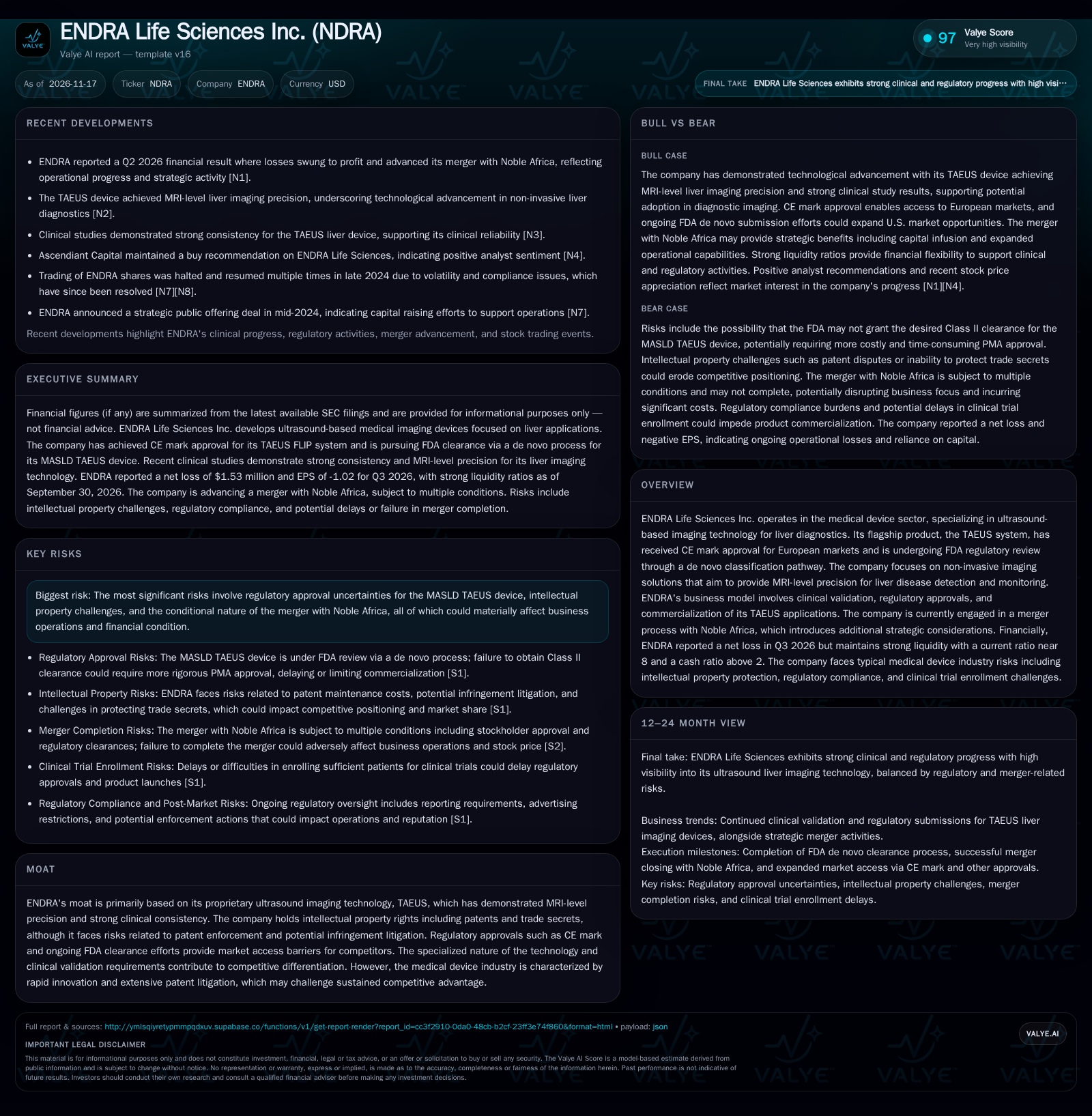
ENDRA Life Sciences has established technical and clinical credibility for its TAEUS liver imaging system, supported by CE mark approval and promising clinical results, while pursuing pivotal FDA clearance. Despite reported liquidity position, ongoing net losses and dependence on regulatory and merger milestones create a high-stakes environment for commercialization and long-term value creation. [S2] [N2] [N3]
ENDRA Life Sciences is at a pivotal juncture, with its TAEUS ultrasound imaging technology demonstrating MRI-level precision and strong clinical reliability for liver diagnostics. While the company’s CE mark approval opens European opportunities, the U.S. market remains gated by an ongoing FDA de novo review—a key determinant of future growth. ENDRA’s value proposition will ultimately be tested by its ability to navigate regulatory hurdles, protect its intellectual property, and translate its technical promise into commercial traction. [S2] [N2] [N3]
Regulatory Momentum, Financial Position, and Strategic Merger: The Current Picture
ENDRA’s TAEUS device has achieved MRI-level liver imaging precision and demonstrated strong consistency in clinical studies, underscoring advanced technical validation and supporting potential clinical adoption. [N2] [N3] The company holds CE mark approval for its TAEUS FLIP system, granting access to European markets, while U.S. commercialization efforts depend on securing FDA de novo clearance for the MASLD (Metabolic dysfunction-Associated Steatotic Liver Disease) TAEUS device. This regulatory process is still ongoing, and failure to obtain Class II clearance could result in a significantly more rigorous and protracted PMA pathway. [S1]
Financially, as of September 30, 2026, ENDRA reported a net loss of $1,528,528 for the quarter, with a current ratio of 7.95 and a cash ratio of 2.39, indicating a reported liquidity position on paper. [S2] However, the company’s business model remains pre-commercial in the U.S., and recurring operating losses highlight reliance on external capital or strategic transactions.
Strategically, ENDRA is advancing a merger with Noble Africa, subject to multiple closing conditions including stockholder and regulatory approvals. The outcome of this transaction could meaningfully alter the company’s operating profile and available resources. [S2]
How ENDRA’s Model Could Convert Validation into Revenue
ENDRA’s commercial thesis centers on converting its proprietary TAEUS technology—validated by MRI-level imaging precision and strong clinical reliability—into a reimbursed, non-invasive diagnostic solution for liver disease. The immediate revenue opportunity lies in hardware sales or leases to hospitals and imaging centers, potentially augmented by recurring revenue from software upgrades, disposables, or service contracts if the business model allows. However, the commercial structure is not fully established: if the company pursues a capital sale model, initial adoption may be lumpy and tied to budget cycles; if a recurring or pay-per-use structure is feasible, revenue visibility could improve but would depend on establishing a critical installed base.
Pricing power and volume growth will be shaped by the device’s comparative effectiveness, integration with existing imaging workflows, and the availability of reimbursement codes—particularly in the U.S. Operating leverage could materialize as fixed R&D and regulatory costs are amortized over a growing installed base, but the company’s current cost structure is dominated by R&D, regulatory, and intellectual property expenses. [S2]
Capital needs remain significant: ongoing clinical validation, regulatory submissions, and eventual market deployment require sustained investment, especially given the lag between regulatory clearance and commercial break-even. The company reported cash and liquidity metrics for the period; these figures do not by themselves establish operating runway, investment capacity, financial flexibility, or financing capacity.
Differentiation and Defensibility in a Crowded Imaging Landscape
ENDRA’s core competitive proposition is its ability to deliver MRI-level liver imaging precision through a non-invasive, ultrasound-based platform—potentially at lower cost and greater convenience than MRI itself. This could position TAEUS as an attractive substitute for liver fat quantification and disease monitoring, especially in regions with limited MRI access or high patient throughput requirements.
However, the medical imaging space is characterized by rapid innovation and entrenched competitors, including large imaging OEMs and emerging ultrasound and elastography platforms. Competitive threats may come from both established modalities (MRI, CT, transient elastography) and novel non-invasive diagnostic technologies. ENDRA’s defensibility depends on its intellectual property portfolio, speed of regulatory approvals, and ability to achieve clinical guideline inclusion or reimbursement status.
The company faces ongoing IP risks, including patent maintenance costs and potential infringement litigation, which could erode its differentiation or delay commercialization. [S1] Regulatory approvals (CE mark, FDA clearance) create initial barriers to entry, but post-market surveillance and compliance costs are ongoing.
What a Breakout Commercialization Cycle Would Look Like
A favorable scenario for ENDRA would involve timely FDA de novo clearance for the MASLD TAEUS device, validating its Class II risk profile and enabling rapid U.S. commercialization. Coupled with existing CE mark approval, this could unlock multi-geography market access and accelerate adoption among hepatology and radiology practices seeking non-invasive, cost-effective liver diagnostics.
Early hospital and imaging center adoption—driven by strong clinical data, workflow compatibility, and attractive economics—could establish TAEUS as a reference standard for NAFLD/MASLD assessment. If the company can successfully navigate reimbursement pathways and demonstrate real-world clinical utility, recurring revenue streams from disposables, software, or service contracts may follow.
Successful completion of the Noble Africa merger could provide additional capital and operational support, further fueling commercialization and pipeline development. Evidence confirming this scenario would include FDA clearance, initial commercial sales, positive reimbursement decisions, and merger close announcements.
Likely Trajectory: Regulatory, Commercial, and Merger Uncertainties Prolong the Timeline
The most plausible course for ENDRA involves a protracted regulatory review for the MASLD TAEUS device, with the possibility of additional data requests or delays typical of novel diagnostic technologies. CE mark access may yield limited European sales, but meaningful adoption is unlikely without parallel U.S. progress and reimbursement traction.
Operating losses are likely to persist as R&D, regulatory, and IP costs remain elevated, and sales and marketing activities are intentionally constrained until U.S. regulatory clarity is achieved. The merger with Noble Africa may close, providing capital and strategic resources, but integration and focus risks could arise. Alternatively, failure to close would force ENDRA to seek alternative funding or partnership options.
This scenario would be confirmed by extended timelines for FDA decisions, muted revenue growth, continued negative EPS, and merger status updates reflecting ongoing negotiations or incremental progress.
Adverse Outcomes: Regulatory Setbacks and Strategic Disruption
ENDRA’s downside risks are anchored in regulatory and executional setbacks. If the FDA denies de novo clearance and directs the MASLD TAEUS device to a more stringent PMA pathway, commercialization would face multi-year delays and sharply higher costs, potentially exhausting current liquidity before revenue inflection. [S1]
Intellectual property litigation, failure to defend key patents, or adverse regulatory findings could erode competitive positioning or even block market entry in key geographies. Clinical trial enrollment challenges, negative or inconclusive study results, or slow adoption in early-access markets could undermine the commercial thesis.
The merger with Noble Africa may fail to close, depriving ENDRA of anticipated capital and operational synergies and forcing the company to seek dilutive financing or strategic alternatives. This scenario would be confirmed by regulatory rejections, legal disputes, further delays in clinical or commercial milestones, or public disclosures of funding shortfalls.
Milestones That Could Reshape ENDRA’s Prospects in Liver Imaging
FDA de novo clearance status for the MASLD TAEUS device: Approval, additional data requests, or rejection would each materially affect commercialization timing and strategy.
Volume and value of initial TAEUS system sales or installations in CE mark geographies, if disclosed, would provide insight into early market acceptance and pricing power.
Progress updates and closing status for the Noble Africa merger, including regulatory and stockholder approvals, as these will determine available resources and strategic direction.
Patent litigation or IP defense outcomes, especially regarding core TAEUS technology or trade secrets, would directly impact competitive positioning.
Clinical trial enrollment rates and publication of additional real-world or peer-reviewed data on TAEUS’s efficacy and workflow integration.
Reimbursement decisions or inclusion of TAEUS in clinical guidelines for NAFLD/MASLD, which would enable broader adoption and support recurring revenue models.
Updates on post-market surveillance or regulatory compliance findings in CE mark or future FDA-cleared markets.
Disclaimer: This is research-only, informational analysis and not investment advice. It may include AI-generated interpretation and general industry context. Always verify important details using primary sources.

Comments