
Permianville Royalty Trust: Navigating Regulatory Pressures and Commodity Volatility in a Passive Oil & Gas Income Model
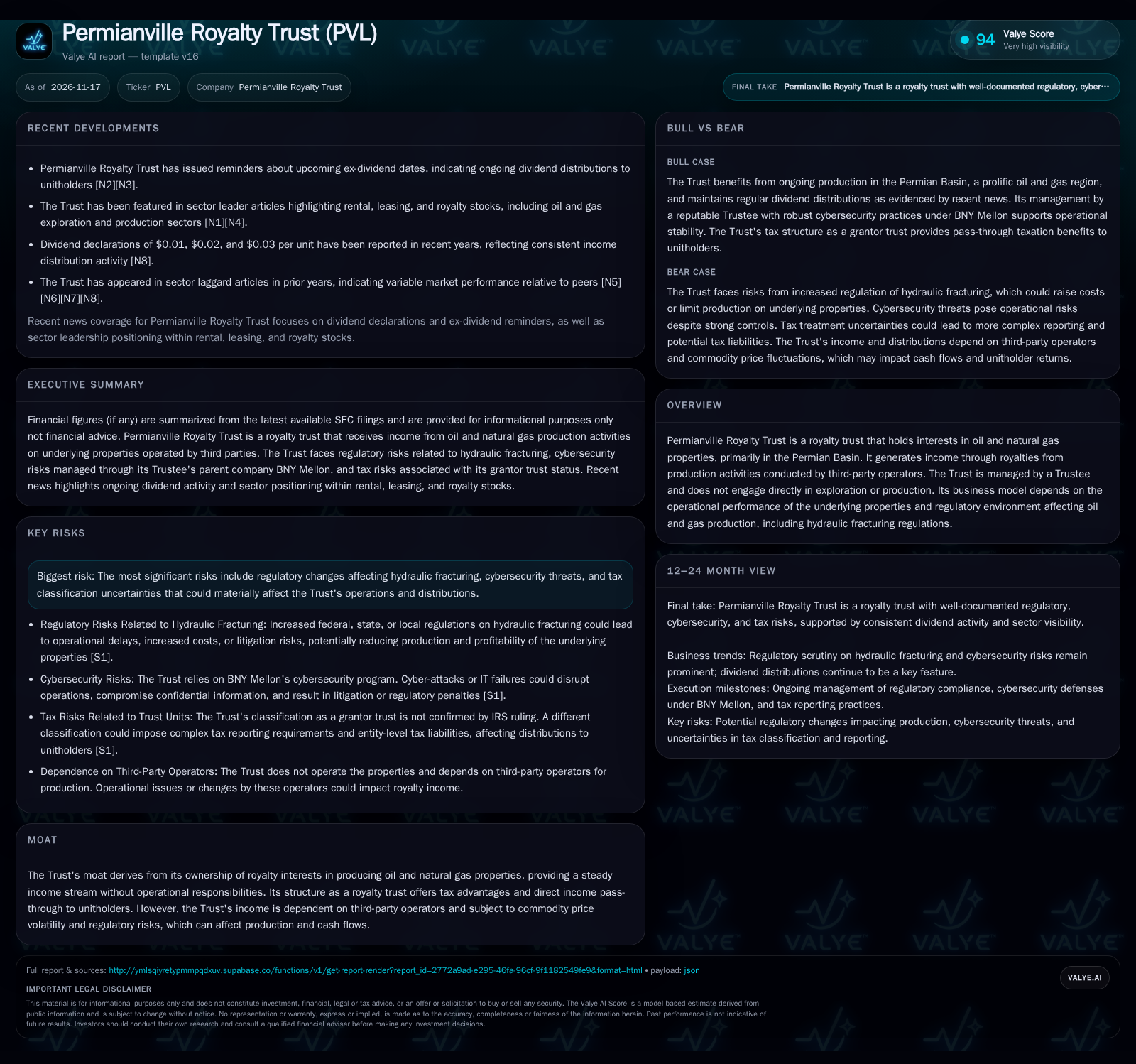
Permianville Royalty Trust continues to generate income through royalty interests in Permian Basin oil and gas properties, maintaining regular distributions despite regulatory, operational, and tax-related uncertainties. The Trust’s structure exposes it to commodity price swings and third-party operator performance, while its hands-off model offers both resilience and vulnerability in a shifting energy landscape.
Permianville Royalty Trust receives royalty income from oil and gas production by third-party operators in the Permian Basin. The cited source reports dividend-related activity; that disclosure alone does not establish dividend-policy continuity, management confidence, or a material constraint on capital flexibility. Its model enables steady pass-through income but leaves it exposed to market and regulatory shocks beyond its control. [S1] [S2] [N2] [N3]
Permianville Royalty Trust stands as a pure-play royalty trust in the oil and gas sector, collecting income from third-party production activities in the prolific Permian Basin. With no operational responsibilities or direct exposure to drilling costs, the Trust offers investors pass-through income, primarily in the form of regular dividends. However, this model is double-edged: while it insulates the Trust from some operational risks, it also leaves it dependent on operator performance, commodity price swings, and regulatory developments—particularly those targeting hydraulic fracturing. As regulatory scrutiny and tax uncertainties persist, the Trust’s future distributions and valuation remain closely linked to external forces it cannot control. [S1] [S2] [N2] [N3]
Recent Dividend Activity and Regulatory Backdrop Define Near-Term Reality
The cited source reports dividend-related activity; that disclosure alone does not establish dividend-policy continuity, management confidence, or a material constraint on capital flexibility. [N2] [N3] The Trust’s market presence in sector leader and laggard articles over the past year underscores its variable performance relative to other oil, gas, and royalty entities. [N1] [N4] [N5] [N6] [N7] [N8] Importantly, there have been no material changes to risk factors since the 2025 Annual Report, and regulatory risks related to hydraulic fracturing remain prominent. [S2] The Trust’s units traded around $1.85 as of March 2026. [S1]
These facts matter because the Trust's income and valuation are closely tied to commodity prices and ongoing production volumes—both of which are shaped by operator actions and regulatory conditions. The cited source reports dividend-related activity; that disclosure alone does not establish dividend-policy continuity, management confidence, or a material constraint on capital flexibility.
Passive Royalty Model: Income Mechanics, Leverage, and Sensitivities
Permianville Royalty Trust’s economics are fundamentally driven by its royalty interests in oil and natural gas properties. The Trust does not bear operating costs or capital expenditures for drilling or production, nor does it control operational tempo; instead, it receives a predetermined share of production revenue from third-party operators. This structure creates a high-margin, low-overhead model with limited operating leverage but significant exposure to volume and price fluctuations.
Revenue is a function of (a) production volume from the underlying wells, (b) commodity prices for oil and gas, and (c) the royalty percentage stipulated in the Trust’s agreements. Because the Trust lacks control over reinvestment, property development, or hedging strategies, it cannot smooth income volatility or directly influence future production. Distributions to unitholders are typically made monthly and reflect net royalty income after deducting expenses, taxes, and (if applicable) reserve withholdings.
The Trust’s capital needs are minimal, as it does not fund drilling or development. However, this also means it has no mechanism to fund property improvements or offset production declines, making it a naturally depleting asset unless operators invest in new drilling or enhanced recovery. The pass-through tax structure benefits unitholders by avoiding double taxation, but introduces complexity if tax status changes.
Royalty Trust Advantages and the Limits of Operator Dependence
Permianville’s core advantage lies in its ownership of royalty interests in established oil and gas fields, particularly in the Permian Basin—a region known for relatively low-cost, prolific production. The Trust’s structure offers investors direct commodity exposure and regular income without operational risk, distinguishing it from upstream MLPs or E&P companies that face higher fixed costs and capital requirements.
However, this model is inherently passive: the Trust relies entirely on third-party operators and a Sponsor to maintain and optimize production. Competitive differentiation is therefore limited to the quality and longevity of the underlying assets and the reliability of the operators. If operators shift capital allocation or face regulatory hurdles, the Trust’s income can decline abruptly.
The broader royalty trust sector is small and mature, with peer competition focused more on asset quality and payout stability than on innovation or market share. Substitution risk comes from alternative income-generating vehicles (such as energy MLPs, high-yield bonds, or REITs) and from the secular trend toward renewables, which could erode long-term demand for fossil fuels.
Production Upside and Regulatory Stability Could Sustain or Boost Distributions
A favorable scenario would see stable or rising commodity prices and continued investment by third-party operators in the Permian Basin properties. If regulatory pressures on hydraulic fracturing remain static or ease, operators could maintain or even increase production volumes, driving higher royalty income for the Trust. The Trust’s minimal overhead would allow nearly all incremental revenue to flow through to unitholders as increased distributions.
Confirmation of this scenario would come from sustained or rising monthly distribution announcements, operator updates indicating new drilling or enhanced recovery activity, and an absence of tightening regulatory headlines. An uptick in sector leader mentions, coupled with strong oil and gas price trends, would also support the case.
Passive Exposure to Commodity and Policy Volatility Defines Expected Outcomes
The most probable path is continued variability in monthly distributions, closely tracking commodity price swings and operator production choices. Regulatory scrutiny of hydraulic fracturing will likely persist, but without immediate drastic changes, leaving the Trust exposed to incremental compliance costs or operational delays imposed on its operators.
Distributions are expected to fluctuate—potentially declining modestly over time as the underlying wells mature, unless offset by operator-led reinvestment. The Trust remains a vehicle for direct commodity price exposure and income, but with little capacity to influence its own destiny.
Tighter Regulation or Operator Retrenchment Could Trigger Distribution Decline
A negative scenario could unfold if federal or state authorities impose stricter hydraulic fracturing regulations, increasing costs or limiting production on the Trust’s underlying properties. Operators may curtail drilling or shut in wells, reducing royalty flows. Alternatively, a sharp decline in oil and gas prices could incentivize operators to idle marginal wells, further compressing Trust income.
Tax risk remains a secondary but real threat: if the IRS reclassifies the Trust’s status, the resulting tax complexity and potential entity-level liabilities could reduce net distributable income. This scenario would be confirmed by sudden distribution cuts, a spike in regulatory or legal disclosures, or news of operator pullbacks in the Permian Basin.
Benchmarks for Assessing Permianville’s Resilience and Risk
Monthly distribution per unit trends—sustained or rising payouts would support the bullish case, while sharp declines would indicate stress.
Operator-reported production volumes and capital spending on the underlying properties, if disclosed, as a leading indicator of future royalty flows.
Any regulatory developments or proposed legislation affecting hydraulic fracturing in the Permian Basin, especially at the federal or Texas state level.
Commodity price movements for oil and natural gas, as these directly determine the Trust’s top-line royalty income.
IRS or legal communications regarding the Trust’s tax status or reporting methodology, which could signal looming tax risk.
Changes in operator ownership or financial health, as operator retrenchment could impair production and thus royalty streams.
Sector-relative performance in royalty trust and oil & gas income portfolios, offering context on whether PVL is lagging or leading its peer group.
Disclaimer: This is research-only, informational analysis and not investment advice. It may include AI-generated interpretation and general industry context. Always verify important details using primary sources.

Comments