
Energys Group Ltd: Acquisitions and Expansion Efforts Reshape the Energy Efficiency Playbook
Energys Group Ltd is aggressively expanding its footprint in the energy efficiency sector through targeted acquisitions in lighting and solar technologies and a strategic move into the US market. The company's evolving business model, moderate profitability, and recent capital raises highlight both its growth ambitions and the operational, integration, and technological risks it faces.
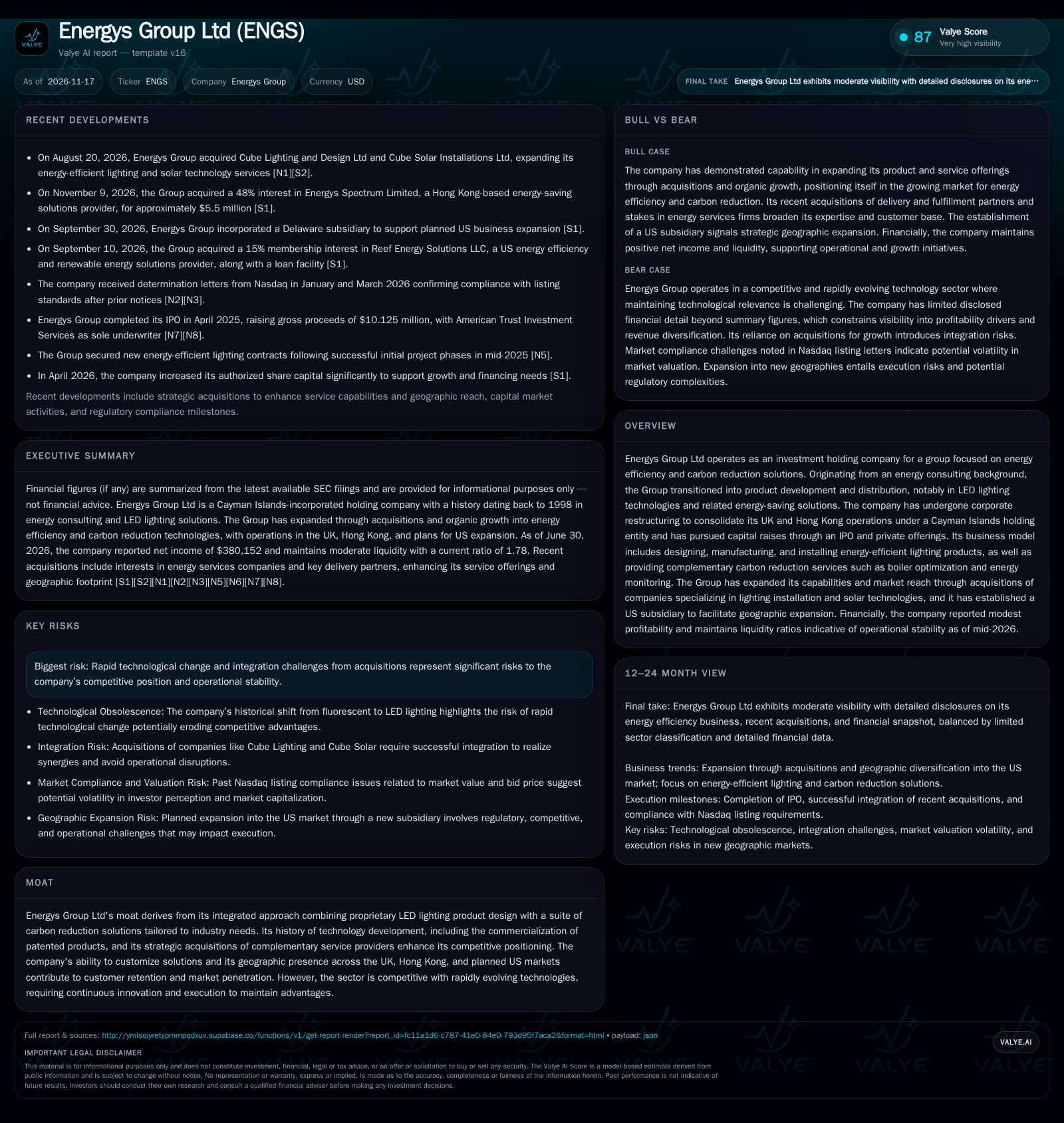
Energys Group Ltd is consolidating its position as a provider of LED lighting and carbon reduction solutions by acquiring key partners in the UK and Hong Kong, establishing a US subsidiary, and maintaining moderate profitability. The company’s expansion strategy could unlock scale and product synergies, but success hinges on effective integration, technology adaptation, and execution in new markets. [S1] [S2] [N1] [N2] [N3] [N5] [N7] [N8]
Energys Group Ltd is attempting to transform from a regional energy consulting and LED lighting business into a diversified, international provider of energy efficiency and carbon reduction solutions. Through a series of acquisitions in lighting and solar technology and the establishment of a US subsidiary, the company is betting on scale and geographic reach to drive growth. The core challenge is whether the company can convert its expanded capabilities into sustainable margins and competitive advantage in a sector prone to rapid technological and regulatory change.
Recent Acquisitions and US Expansion Signal Strategic Shift
Energys Group Ltd has executed a series of acquisitions and strategic moves since mid-2026 that materially alter its business profile. In August 2026, the company acquired Cube Lighting and Design Ltd and Cube Solar Installations Ltd, expanding its reach in energy-efficient lighting and solar installation services. These acquisitions deepen its vertical integration and capability set within the UK. In November 2026, Energys Group also acquired a 48% interest in Energys Spectrum Limited, a Hong Kong-based provider of customized energy-saving solutions, further strengthening its Asian footprint. [S1] [N1]
On the US front, Energys Group established a Delaware subsidiary in September 2026 and acquired a 15% membership interest in Reef Energy Solutions LLC, a US energy efficiency and renewables provider. This signals a concerted push into the US market, a major arena for energy transition investments. These moves come after the company’s April 2025 Nasdaq IPO, which raised $10.125 million, and a subsequent increase in authorized share capital in April 2026, both aimed at fueling expansion. [S1] [N7] [N8]
The company has also recently confirmed compliance with Nasdaq listing standards after prior notices, suggesting a period of improved market standing but also highlighting past valuation volatility. [S1] [N2] [N3]
How Energys Group’s Model Could Scale—And Where Margin Pressure Lurks
Energys Group’s business model is anchored in the design, sale, and installation of energy-efficient LED lighting products, augmented by a suite of carbon reduction services such as boiler optimization, valve wrap, low-carbon heating, and energy monitoring. Revenue is likely generated through a blend of project-based contracts, product sales, and, potentially, recurring service agreements—though the report does not specify the revenue mix or contract structure. The recent acquisitions of installation and fulfillment partners suggest a move toward more vertically integrated, turnkey solutions, which could increase project scope and average contract value.
The company’s economics may hinge on its ability to bundle product sales with high-margin services, leveraging technology and integration to differentiate from commoditized lighting suppliers. However, the sector is characterized by intense price competition, rapid technological change, and significant customer bargaining power, especially for large commercial or institutional clients. Fixed costs could rise with geographic and capability expansion, but if Energys Group achieves sufficient scale, it could benefit from operating leverage, especially if it transitions a portion of its business to recurring, service-based revenues.
Capital needs are significant: the company has raised funds through its IPO and private offerings, and it increased its authorized share capital in 2026 to support further growth. This suggests ongoing requirements for working capital and investment in technology, integration, and market development.
Integrated Solutions and Geographic Reach: Sources of Advantage and Exposure
Energys Group’s competitive posture rests on its ability to offer integrated, customized energy efficiency solutions—combining proprietary LED lighting products with a broader suite of carbon reduction services. The acquisitions of Cube Lighting, Cube Solar, and Energys Spectrum bring in-house installation, delivery, and region-specific expertise, potentially enabling tighter quality control, faster deployment, and more holistic solutions for clients.
However, the energy efficiency sector is crowded with established multinational players, regional specialists, and a growing number of technology-driven entrants. Advantages such as product breadth, solution customization, and local presence can be quickly eroded without ongoing innovation and strong execution. The company’s expansion into the US—one of the most competitive and regulated energy markets—exposes it to new rivals and regulatory hurdles.
Switching frictions for customers in this industry tend to be moderate; while installation of lighting or heating solutions can create some lock-in, the underlying technologies are often standardized and subject to frequent upgrades. Energys Group’s ability to develop proprietary, differentiated offerings—and to translate acquisitions into defensible synergies—will be critical to sustaining any moat.
If Integration and US Expansion Deliver Scale, Margins Could Improve Significantly
The most favorable outcome for Energys Group hinges on successful integration of its recent acquisitions and effective execution in the US market. If the company can combine its expanded delivery capabilities with proprietary technology and a broader service suite, it could win larger, higher-margin contracts—particularly with commercial and institutional clients seeking comprehensive energy solutions.
Evidence that would confirm this scenario includes a marked increase in contract wins with larger average deal sizes, improved gross margins, and growing contributions from recurring service revenues, if disclosed. Expansion of the US business—demonstrated by new customer relationships or partnerships and positive revenue growth from the US subsidiary—would also validate the scalability of the model.
A virtuous cycle could emerge if Energys Group leverages its scale to negotiate better procurement terms, invest in R&D, and further differentiate its offerings. This would likely be reflected in operating leverage, with revenue growth outpacing fixed cost increases, and in rising profitability metrics over time.
Incremental Growth and Margin Stability Amid Integration and Execution Challenges
The most plausible near-term outcome is a period of incremental growth, with Energys Group integrating recent acquisitions and cautiously expanding its US operations. Revenue may trend upward as new capabilities and market presence open doors to additional contracts, but integration costs, organizational complexity, and competitive pricing pressure could limit margin expansion.
Confirming evidence would include steady, if modest, revenue growth, stable or slightly improving gross margins, and the absence of major operational disruptions or write-downs related to acquisitions.
Risks in this scenario include delays in realizing acquisition synergies, slower-than-expected US traction, and ongoing exposure to competitive pricing. However, if the company maintains moderate profitability and liquidity while integrating new businesses, it could build a foundation for more robust growth in subsequent years.
Integration Failures and US Market Headwinds Could Undermine Financial Stability
A negative scenario would unfold if Energys Group struggles to integrate its acquisitions, leading to operational disruptions, unforeseen costs, or the loss of key personnel and customers. If the company’s expanded delivery network fails to generate expected synergies or if technology integration proves more complex than anticipated, margins could compress and cash burn could accelerate.
The US expansion could also falter if regulatory hurdles, local competition, or execution missteps prevent meaningful revenue generation. Signs of this scenario would include stagnant or declining revenue, falling gross margins, impairment charges or restructuring costs tied to acquisitions, and potential breaches of Nasdaq listing requirements if financial performance deteriorates.
In such a case, Energys Group could face renewed market valuation volatility, greater reliance on dilutive capital raises, and diminished capacity to invest in product development or market expansion—potentially eroding its competitive position in a fast-moving sector.
What Will Determine Whether Energys Group’s Expansion Pays Off?
Revenue growth and gross margin trends following the integration of Cube Lighting, Cube Solar, and Energys Spectrum—particularly any improvements in contract size, mix, or profitability, if disclosed.
Progress and financial contribution from the US subsidiary and the Reef Energy Solutions partnership, especially evidence of new contracts or meaningful US revenue traction.
Integration costs and one-off charges related to recent acquisitions; updates on whether synergies are being realized as planned would help test the thesis.
Recurring versus project-based revenue mix, if disclosed, to assess the company’s ability to build a more predictable, service-oriented business model.
R&D and new product development spending, if reported, as a signal of ongoing innovation and ability to stay ahead of technology shifts.
Nasdaq compliance updates or new notices, which could signal renewed market valuation or financial performance issues.
Capital raising activity, including private offerings or warrant exercises, which may indicate ongoing reliance on external funding versus internally generated cash flow.
Disclaimer: This is research-only, informational analysis and not investment advice. It may include AI-generated interpretation and general industry context. Always verify important details using primary sources.

Comments