
Cactus Acquisition Corp. 1 Ltd: SPAC Extension, Tembo Deal Progress, and the Post-Delisting Challenge
Cactus Acquisition Corp. 1 Ltd remains in pursuit of a business combination with Tembo e-LV B.V., but confronts low liquidity, significant governance hurdles, and the persistent consequences of its Nasdaq delisting. The next twelve months will test whether sponsor control and regulatory navigation can overcome dilution, target appeal, and operational readiness concerns.
Cactus Acquisition Corp. 1 Ltd, now trading OTC after its Nasdaq delisting, is advancing a business combination with Tembo e-LV B.V., targeting completion before its November 2027 deadline. The company's ability to close the Tembo deal and regain exchange listing will likely determine its long-term relevance and shareholder value trajectory. [S2]
Cactus Acquisition Corp. 1 Ltd exemplifies the high-wire act of late-stage SPACs: it is a publicly traded shell with minimal cash, a looming liquidation deadline, and no revenue-generating business. Yet, its ongoing pursuit of a business combination with Tembo e-LV B.V.—despite having been delisted from Nasdaq and now trading OTC—positions it at a critical juncture. The company must navigate regulatory review, governance remediation, and market skepticism, all while its liquidity and appeal to acquisition targets remain under pressure. Whether Cactus can consummate the Tembo deal and regain an exchange listing will likely define its fate—and the value ultimately delivered to shareholders. [S2]
Where Cactus Stands: Working Capital Deficit, Tembo Deal Progress, and OTC Status
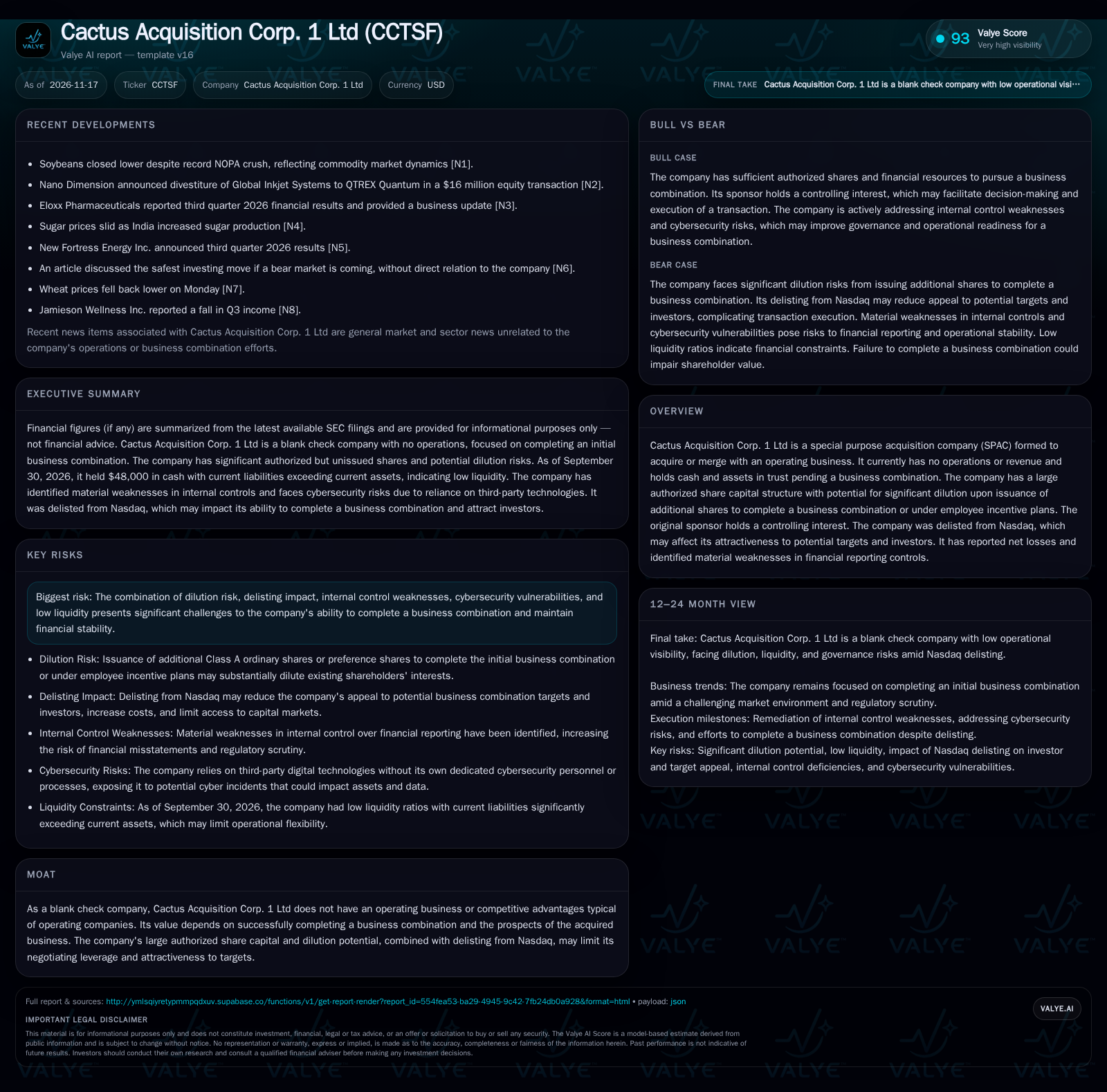
As of September 30, 2026, Cactus Acquisition Corp. The company reported a current ratio of 0.04 for the period. The company continues to incur net losses, reporting a $123,000 loss for the quarter. These deficits highlight acute liquidity constraints, raising questions about the company's capacity to cover ongoing expenses without additional capital or deal progress. [S2]
Despite these headwinds, Cactus is advancing a business combination with Tembo e-LV B.V., a Netherlands-based private company focused on energy renewables. The SPAC confidentially submitted a Form F-4 registration to the SEC in December 2025 and is in the process of amending the filing in response to regulatory comments, targeting deal closure before its November 2, 2027 mandatory liquidation date. [S2]
The company was delisted from Nasdaq in November 2024, with its securities now trading OTC under the symbol CCTSF. This shift reduces the liquidity and visibility of its shares, potentially deterring both acquisition targets and new investors, and could complicate the up-listing ambitions tied to the Tembo transaction. [S2]
SPAC Economics: Dilution, Sponsor Control, and Capital Constraints
As a SPAC, Cactus Acquisition Corp. 1 Ltd does not generate operating revenue and relies on trust proceeds and sponsor funding to cover administrative and deal expenses. Its business model is singular: complete a business combination before the liquidation deadline, at which point the fate of the trust assets and any remaining value is determined by the outcome of the deal or, in the event of failure, returned to public shareholders.
The company’s large authorized but unissued share capital—up to 500 million Class A ordinary shares and 5 million preference shares—provides flexibility to structure a business combination but also introduces significant dilution risk for existing shareholders, particularly if new shares are issued at a discount to facilitate the Tembo deal or to cover redemptions and incentives. The sole Class B ordinary share, controlled by the sponsor, will convert on a one-for-one basis upon completion, reinforcing sponsor influence over the process and post-merger governance. [S2]
The company reported cash and liquidity metrics for the period; these figures do not by themselves establish operating runway, investment capacity, financial flexibility, or financing capacity. This dependency could weaken its negotiating leverage with both targets and potential financing partners, especially given the post-delisting context.
Target Appeal and Structural Disadvantages in a Crowded SPAC Market
Cactus faces a highly competitive SPAC environment, with many blank check companies chasing a shrinking pool of attractive targets—particularly in the energy renewables sector, which has seen both increased interest and heightened regulatory scrutiny post-2021. The company’s delisting from Nasdaq places it at a disadvantage relative to SPACs that remain listed on major exchanges, as acquisition targets often prefer partners with liquid, exchange-traded equity and straightforward access to institutional capital.
Sponsor continuity and control could enable more decisive deal execution but may also deter prospective targets or PIPE investors concerned about governance transparency, especially if the sponsor group is perceived as transient or opportunistic. Furthermore, significant dilution risk and the potential for post-deal overhang may make Cactus’s equity less attractive as acquisition currency.
The company’s ability to up-list post-merger is critical to restoring its appeal, but this is contingent on successful completion of the Tembo deal, regulatory clearance, and remediation of existing control and reporting weaknesses. Until then, Cactus’s structural disadvantages—low liquidity, OTC trading status, and material governance risks—limit its competitive position in the SPAC market.
How a Successful Tembo Deal Could Transform Cactus’s Trajectory
If Cactus completes the business combination with Tembo e-LV B.V. before its liquidation deadline and secures up-listing on Nasdaq, the combined company could benefit from renewed investor attention, improved liquidity, and access to capital markets. A successful deal could validate the sponsor’s strategy and provide a platform for future growth in the energy renewables sector, particularly if Tembo brings differentiated technology or commercial momentum.
This scenario would require: (1) regulatory approval of the amended Form F-4; (2) sufficient capital to cover redemptions and transaction costs, potentially through PIPE financing; (3) remediation of material weaknesses in internal controls; and (4) a credible plan for post-merger governance and operational integration.
Evidence supporting this upside would include: public SEC approval of the registration statement, announcement of definitive deal terms with Tembo, PIPE or other financing commitments, up-listing application progress, and disclosure of improved governance and risk controls. Falsification would occur if the deal collapses, required financing cannot be secured, or the company fails to regain exchange listing.
Managing Through Uncertainty: Delays, Sponsor Support, and the Search for a Viable Path
The most plausible scenario is one of continued delays and incremental progress, as Cactus and Tembo work through regulatory review, SEC comments, and the challenge of securing sufficient capital for deal completion. Sponsor support may bridge short-term funding gaps, but persistent material weaknesses in internal controls and OTC status could deter PIPE investors or increase the cost of capital.
In this scenario, the company may secure further extensions and continue working toward the mandatory liquidation deadline, but the risk of shareholder redemptions, deal renegotiation, or further delays remains high. The up-listing ambition is likely to be deferred until after the business combination, and the company’s negotiating leverage remains weak unless Tembo perceives unique value in the SPAC structure.
Confirmation would come from regular public updates on regulatory progress, extension approvals, and evidence of sponsor loans or bridge financing. Falsification would be signaled by public withdrawal of the Tembo deal, expiration of extensions, or an inability to secure necessary funding for ongoing operations.
Deal Failure, Liquidation Risk, and Value Erosion for Public Shareholders
If Cactus fails to close the Tembo business combination before the November 2027 deadline—or cannot secure sufficient capital to cover redemptions and transaction costs—the company will likely be forced into liquidation. In this event, public shareholders may receive only the pro rata value of the trust account, net of any permitted expenses, which could be less than anticipated if costs escalate or redemptions are high.
Failure to remediate material weaknesses in financial controls or to restore an exchange listing could also increase the risk of regulatory scrutiny, shareholder litigation, or further value erosion, particularly if the trust account is drawn down to cover extraordinary expenses.
Downside confirmation would include missed SEC filing deadlines, public withdrawal or collapse of the Tembo deal, sponsor exit, or announcements of intended liquidation. Falsification would require evidence of new financing, successful regulatory milestones, or a credible path to deal closure and up-listing.
Milestones That Will Clarify Cactus’s Fate in the SPAC Arena
Progress on the amended Form F-4 registration statement with the SEC, including approval or further comment cycles.
Public disclosure of definitive business combination terms with Tembo e-LV B.V., including valuation, capital structure, and sponsor economics.
Evidence of new capital commitments, such as PIPE financing, sponsor loans, or bridge funding to cover transaction costs and redemptions.
Remediation of material weaknesses in internal control over financial reporting, as confirmed by auditor statements or management updates.
Shareholder extension approvals and updates to the mandatory liquidation deadline.
Application and progress toward up-listing on Nasdaq or another major exchange after deal completion.
If disclosed, the level of shareholder redemptions relative to trust assets at the time of the business combination.
Any public updates regarding changes in sponsor control, governance structure, or related-party transactions.
Disclaimer: This is research-only, informational analysis and not investment advice. It may include AI-generated interpretation and general industry context. Always verify important details using primary sources.

Comments