
B-Scada, Inc.: High Liquidity, Opaque Operations, and the Challenge of Evaluating Value
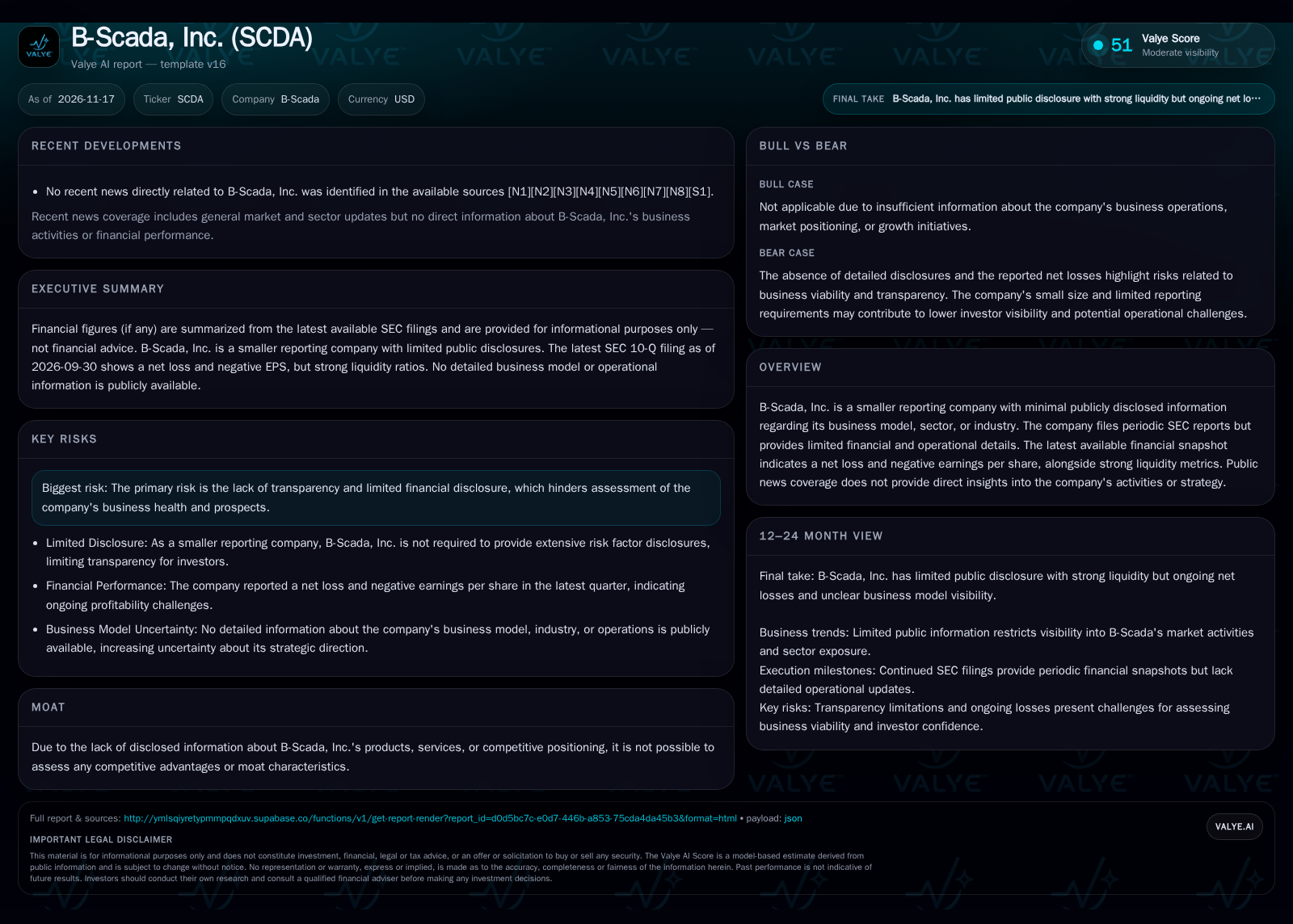
B-Scada, Inc. presents a classic conundrum for investors: reported liquidity position contrasted with ongoing net losses and virtually no public insight into its business model, operations, or sector exposure. The absence of disclosure creates material uncertainty around viability, growth prospects, and potential catalysts.
B-Scada, Inc. demonstrates unusually high liquidity relative to its size, but the lack of operational and revenue transparency makes it difficult to assess the sustainability or strategic direction of its business. Ongoing net losses and minimal disclosure amplify risks around execution, competitive standing, and long-term value.
B-Scada, Inc. typifies the risks and ambiguities inherent to microcap and minimally-reporting public companies. While its latest SEC filing reveals exceptionally high liquidity and low current liabilities, the company continues to post net losses and provides no public detail on its business model, commercial activities, or strategic direction.
Liquidity Outpaces Disclosure: The Company’s Present Financial Posture
As of September 30, 2026, B-Scada, Inc. reported a net loss of $33,887 for the quarter and negative earnings per share of -$0.01, reinforcing a pattern of unprofitable operations [S1]. The company’s balance sheet stands out for its current assets of $140,531 against current liabilities of just $7,351, producing both a current ratio of 19.12 and a cash ratio of 148.34—exceptionally high figures by any public-company standard [S1]. However, no recent revenue, customer, or operational data is disclosed in SEC filings or public news. The company’s classification as a smaller reporting company means it is not required to provide extensive risk or business disclosures, leaving investors with little more than a snapshot of liquidity and losses to inform any view of its underlying business health or prospects.
The exceptionally high liquidity ratios, while superficially reassuring, may also mask underlying operational inefficiencies or strategic inertia. The company reported cash and liquidity metrics for the period; these figures do not by themselves establish operating runway, investment capacity, financial flexibility, or financing capacity. If the cash is not being deployed toward growth initiatives or cost-effective operations, it risks becoming a drag on returns through opportunity costs or inflationary erosion. Moreover, the minimal current liabilities might indicate a conservative balance sheet stance, but without insight into long-term obligations or off-balance-sheet liabilities, the true financial risk profile remains uncertain. This opacity complicates any assessment of whether the liquidity is a buffer for strategic flexibility or a symptom of stagnant business activity.
How Value Creation Mechanics Remain Hidden—and Why That Matters
B-Scada’s underlying business model, sector, and sources of revenue are not disclosed in current filings, making it impossible to analyze with precision how (or if) the company generates value. In principle, the company could operate in software, hardware, or services—each with fundamentally different economics. For example, a SaaS model would suggest recurring revenue potential and high gross margins, while a hardware or project-based business would imply lumpier, more capital-intensive cash flows. The lack of revenue data and operational detail means there is no visibility into pricing power, customer concentration, cost structure, or operating leverage. The only clear fact is that the company is incurring ongoing net losses, indicating that current operations—whatever their nature—are not profitable. The reported liquidity position suggests that B-Scada either raised capital in the past or is minimizing outflows, but without insight into burn rate, capital requirements, or reinvestment needs, investors cannot judge whether the company is preserving capital for a strategic pivot or simply running down its cash position.
Understanding the capital intensity and scalability of B-Scada’s business model is critical to evaluating its long-term viability. The company reported profitability for the period. Additionally, the absence of disclosed cost structure details prevents analysis of fixed versus variable costs, which is essential to gauge how losses might evolve with scale. Without these insights, investors cannot ascertain whether the company’s financial trajectory is one of controlled growth or unmanaged cash burn.
Competitive Landscape: Navigating in the Dark
With no information on B-Scada’s products, services, or target markets, it is impossible to assess its competitive position directly. In the absence of disclosure, it is plausible the company operates in a niche technology, industrial, or software segment, but this remains speculative. If B-Scada were in a commoditized or rapidly evolving sector, the lack of scale and ongoing losses could signal severe competitive disadvantage. Conversely, if the company holds proprietary technology or serves a niche with high switching costs, the limited transparency could obscure latent value. The absence of public operational milestones, customer wins, or product updates also means there is no evidence of differentiation, network effects, or barriers to entry. As a result, the company’s ability to defend margins, retain customers, or adapt to competitive threats remains entirely opaque.
Competitive positioning also depends heavily on the company’s ability to adapt to market trends and technological shifts, which remains unobservable in the absence of disclosure. If B-Scada operates in a rapidly innovating sector, the lack of visible product development or customer engagement could signal vulnerability to obsolescence or displacement by more agile competitors. Alternatively, if the company occupies a stable niche with high barriers to entry, its competitive moat might be stronger than apparent, but this would typically be accompanied by at least some disclosure of proprietary assets or strategic partnerships. The inability to evaluate customer retention rates, pricing strategies, or channel dynamics further clouds the picture, making it difficult to predict whether the company can sustain or improve its market position over time.
Potential for a Hidden Asset or Strategic Pivot
For this scenario to materialize, the company would need to deploy its cash into a business line with a credible path to profitability—such as launching a new SaaS platform, licensing proprietary technology, or securing a transformative customer contract. Evidence that would support this outcome includes a sudden increase in disclosed revenues, new product announcements, or the emergence of strategic partnerships in future filings. Falsification would come from continued net losses, depletion of liquidity without operational progress, or the absence of any new business disclosures over subsequent quarters.
Prolonged Opacity and Incremental Erosion of Value
The most plausible scenario, given the current facts, is that B-Scada continues to report net losses and minimal operational detail, gradually eroding its liquidity cushion over time. Without clear revenue streams or operational milestones, the company may persist as a minimally active public entity, using its high liquidity to meet ongoing administrative or legacy obligations rather than investing in growth or transformation. Confirmation of this scenario would be continued filings showing net losses with little to no revenue, unchanged business descriptions, and persistent absence of newsworthy developments. Falsification would require a step change in transparency, such as detailed business updates or a material improvement in financial performance.
Liquidity Drain Without Strategic Progress
The adverse scenario is that B-Scada’s cash position is gradually exhausted due to persistent losses and the absence of revenue-generating activities, ultimately leading to financial distress, delisting, or a forced wind-down. This could occur if the company has no viable business plan or if management is unable or unwilling to deploy capital into productive uses. Failure to file required SEC reports or the announcement of restructuring activities would also reinforce the downside view.
What Could Reveal B-Scada’s True Trajectory in the Next Year
Disclosure of material revenue figures in future SEC filings would help test whether the company is generating or ramping up commercial activity.
Announcement of new products, service offerings, or technology partnerships—if disclosed—would indicate a strategic pivot or operational progress.
Quarterly trends in net income (or loss) and changes in the cash balance would reveal whether the company is burning cash or moving toward profitability.
Filing of detailed business descriptions, segment reporting, or management commentary would provide critical insight into the company’s sector and strategy.
Evidence of customer contracts, backlog, or recurring revenue—if disclosed—would help assess business model sustainability.
Any change in auditor language regarding going-concern risk or liquidity sufficiency would be a concrete warning sign.
If the company initiates or completes a capital raise, acquisition, or asset sale, it would clarify management’s intent and capital allocation priorities.
Disclaimer: This is research-only, informational analysis and not investment advice. It may include AI-generated interpretation and general industry context. Always verify important details using primary sources.

Comments