
XBP Global Holdings: AI Workflow Ambition Confronts Liquidity and Integration Headwinds
XBP Global Holdings is a multinational technology and services firm focused on AI-enabled workflow automation for enterprise and regulated sectors.
XBP Global Holdings is a multinational technology and services firm focused on AI-enabled workflow automation for enterprise and regulated sectors. The critical question is whether XBP can realize the operating leverage and stickiness implied by its platform model before capital or execution setbacks force retrenchment or restructuring.
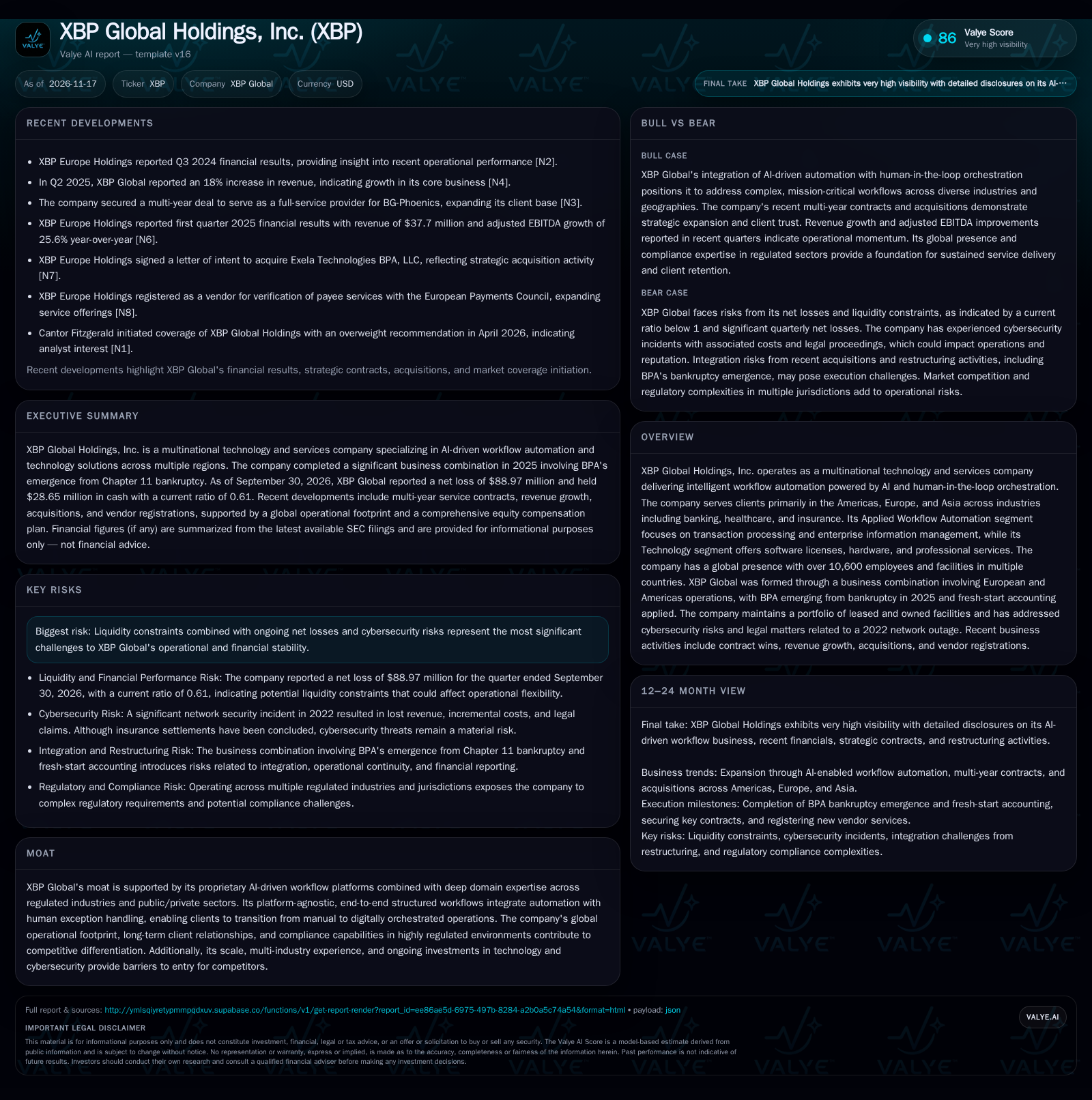
XBP Global Holdings, Inc. is navigating a critical juncture: it commands global reach in AI-enabled workflow automation for regulated and enterprise sectors, and has recently expanded its service portfolio and secured new multi-year contracts. However, the company’s operational progress is shadowed by persistent net losses, a reported current ratio, and the lingering complexity of post-bankruptcy integration.
Recent Financial Strains and Strategic Expansion Moves
As of September 30, 2026, XBP Global reported a net loss of $88.97 million for the quarter, with basic and diluted EPS at -$7.30. The company’s balance sheet showed $28.65 million in cash and equivalents, current assets of $193.8 million, and current liabilities of $316.4 million, resulting in a current ratio of 0.61 and a cash ratio of 0.09 [S2]. These figures highlight significant liquidity pressure and ongoing operational losses.
Despite these challenges, XBP Global has moved to expand its commercial footprint: it secured a multi-year deal with BG-Phoenics to serve as a full-service provider [N3], and registered as a vendor for verification of payee services with the European Payments Council, signaling entry into adjacent compliance-driven offerings [N8]. The company also completed a complex business combination involving BPA’s emergence from Chapter 11 bankruptcy in July 2025, applying fresh-start accounting [S1]. These moves reflect both ambition and the integration risks that now define the company’s near-term outlook.
Workflow Automation Economics: Revenue Mix, Cost Structure, and Margin Pathways
XBP Global’s value proposition centers on automating complex, mission-critical workflows for clients in regulated sectors using AI-driven platforms augmented by human exception handling. The Applied Workflow Automation segment is positioned to generate revenue through outcome-based service contracts, where pricing could be tied to transaction volume, process completion, or cost savings realized by clients. The Technology segment supplements this with recurring software licenses, hardware sales, and professional services. If executed well, this model can produce attractive operating leverage: incremental automation and client onboarding could drive higher margin flows as fixed costs are spread over a growing base.
However, the company’s persistent net losses and reported current ratio suggest that the operating leverage implied by scale and technology adoption has yet to materialize. Integration of acquired businesses, post-bankruptcy restructuring, and the need to invest in compliance and cybersecurity all weigh on cost structure. The company reported cash and liquidity metrics for the period; these figures do not by themselves establish operating runway, investment capacity, financial flexibility, or financing capacity.
A critical factor influencing XBP Global’s pathway to profitability is the scalability of its AI workflow automation platform in conjunction with human oversight. The interplay between automation efficiency gains and the necessary manual interventions to ensure compliance and quality control creates a complex cost dynamic. If the company can refine this balance by increasing automation accuracy and reducing exception rates, it could lower variable costs per transaction and improve margins. Conversely, failure to optimize this synergy may perpetuate high labor costs and limit the scalability benefits typically associated with software-driven business models.
Furthermore, the company’s cost structure is likely affected by ongoing investments in cybersecurity and regulatory compliance, which are non-negotiable in regulated industries. These investments, while essential, may introduce fixed or semi-fixed costs that could dampen margin expansion in the near term. The degree to which XBP Global can leverage its technology to automate compliance-related tasks—such as audit trails, reporting, and risk assessments—will be pivotal. Success here would enable the company to convert compliance from a cost center into a competitive differentiator, potentially unlocking higher pricing power and client stickiness.
Defending a Niche in AI-Enabled Compliance and Workflow Services
XBP Global’s competitive thesis rests on its hybrid of proprietary AI workflow platforms and deep compliance expertise across regulated industries, such as banking, healthcare, and insurance. These sectors value reliability, data security, and regulatory conformity—areas where switching costs and vendor lock-in can be high if solutions are deeply embedded in clients’ operations.
The company’s global scale, with 10,600 employees across 20 countries, and a blend of owned and leased operational facilities, should, in theory, support both delivery flexibility and local compliance responsiveness [S1]. However, the competitive landscape is crowded: large IT services firms, pure-play automation software vendors, and niche compliance specialists all vie for the same digital transformation budgets. The risk is that larger, better-capitalized peers could outspend XBP on innovation, or that fast-moving startups could undercut it on price or agility. Meanwhile, post-acquisition integration and a recent history of restructuring may put XBP on the back foot in client retention and new business development until operational stability is re-established.
XBP Global’s competitive positioning also depends on its ability to integrate and standardize disparate acquired technologies and workflows into a cohesive platform offering. Effective integration can reduce operational redundancies and create a unified client experience, enhancing perceived value and reducing churn. However, integration complexity may lead to prolonged internal resource allocation and distract from innovation efforts, which competitors might exploit. The company’s capacity to maintain agility in product development while managing scale and complexity will influence its ability to defend market share against both large incumbents and nimble startups.
In addition, the company’s geographic footprint presents both opportunities and challenges. Operating in multiple jurisdictions allows access to diverse regulated markets and client segments, potentially smoothing revenue volatility. Yet, it also requires nuanced understanding of local regulatory environments and tailored compliance capabilities, which can increase operational costs and complicate service delivery. XBP Global’s success in leveraging local expertise while maintaining global platform consistency will be a key determinant of its competitive resilience and long-term growth prospects.
If Operating Leverage and Recurring Revenue Take Hold
The bull case for XBP Global is that its investments in AI-driven workflow automation and human-in-the-loop orchestration yield tangible operating leverage. As new multi-year contracts ramp, recurring software license fees and volume-driven service revenues could begin to outpace fixed costs, driving margin inflection. Expansion into adjacent compliance services—such as verification of payee in Europe—could deepen client relationships, increase revenue per client, and reinforce switching costs.
Confirmation of this scenario would come from sequential improvement in gross and operating margins, positive cash flow from operations, and a rising proportion of revenue from long-term contracts or recurring software/services. Additional evidence would include new contract wins with blue-chip or highly regulated enterprises, disclosure of multi-year revenue visibility, and a reduction in integration and restructuring expenses as the business stabilizes.
Navigating Post-Restructuring Uncertainty While Chasing Growth
The most plausible near-term outcome is that XBP Global continues to expand its service offerings and client base, but faces choppy financial performance as it absorbs integration costs, invests in compliance and cybersecurity, and works to convert pipeline contracts into profitable, recurring revenue. Revenue growth may be offset by high SG&A and restructuring expenses, keeping margins under pressure.
Evidence for this base case would be continued volatility in quarterly earnings, with occasional contract wins and new service launches but no sustained improvement in current ratio or cash flow. If disclosed, a stable or improving client retention rate and gradual reduction in restructuring charges would be positive signs, but persistent net losses and liquidity concerns would remain central risks.
Liquidity Constraints and Integration Missteps Forcing Retrenchment
Failure to achieve timely integration of acquired businesses or to control post-bankruptcy restructuring costs could lead to missed client deliverables, erosion of reputation, and possible client defections.
Loss of key client contracts or legal proceedings related to operational failures would further validate the downside case.
Milestones That Will Determine Whether XBP Global Can Deliver on Its Automation Thesis
Quarterly operating and gross margin trends—improvement would support the case for operating leverage; stagnation or decline would suggest continued cost pressures.
Cash flow from operations—positive and growing cash flow would indicate that the business model is converting revenue into liquidity, critical given current balance-sheet constraints.
Disclosure of recurring revenue mix—if disclosed, a rising share of revenue from multi-year contracts or software licenses would confirm progress toward a stickier, higher-margin model.
Integration and restructuring expenses—continued high charges would signal ongoing disruption; declining charges would indicate stabilization.
Client retention and renewal rates—a useful metric if disclosed; high retention would support the moat and recurring revenue thesis.
New contract wins in regulated sectors—evidence of continued client trust and market relevance, especially if wins are with large or high-profile enterprises.
Cybersecurity incident disclosures or insurance costs—a recurrence or escalation would increase risk and cost, while stability would suggest improved resilience.
Any new financing events, asset sales, or restructuring announcements—would signal acute liquidity needs or strategic retrenchment.
Disclaimer: This is research-only, informational analysis and not investment advice. It may include AI-generated interpretation and general industry context. Always verify important details using primary sources.

Comments