
Terra Innovatum’s SOLO Microreactor: Analyst Optimism Meets Commercialization Hurdles in Advanced Energy
With reported liquidity position and net income, Terra Innovatum approaches a pivotal 2027 launch for its SOLO microreactor in Illinois. The company’s financial strength, analyst optimism, and technology promise must be weighed against execution risk, limited disclosure, and the hurdles of scaling novel energy hardware.
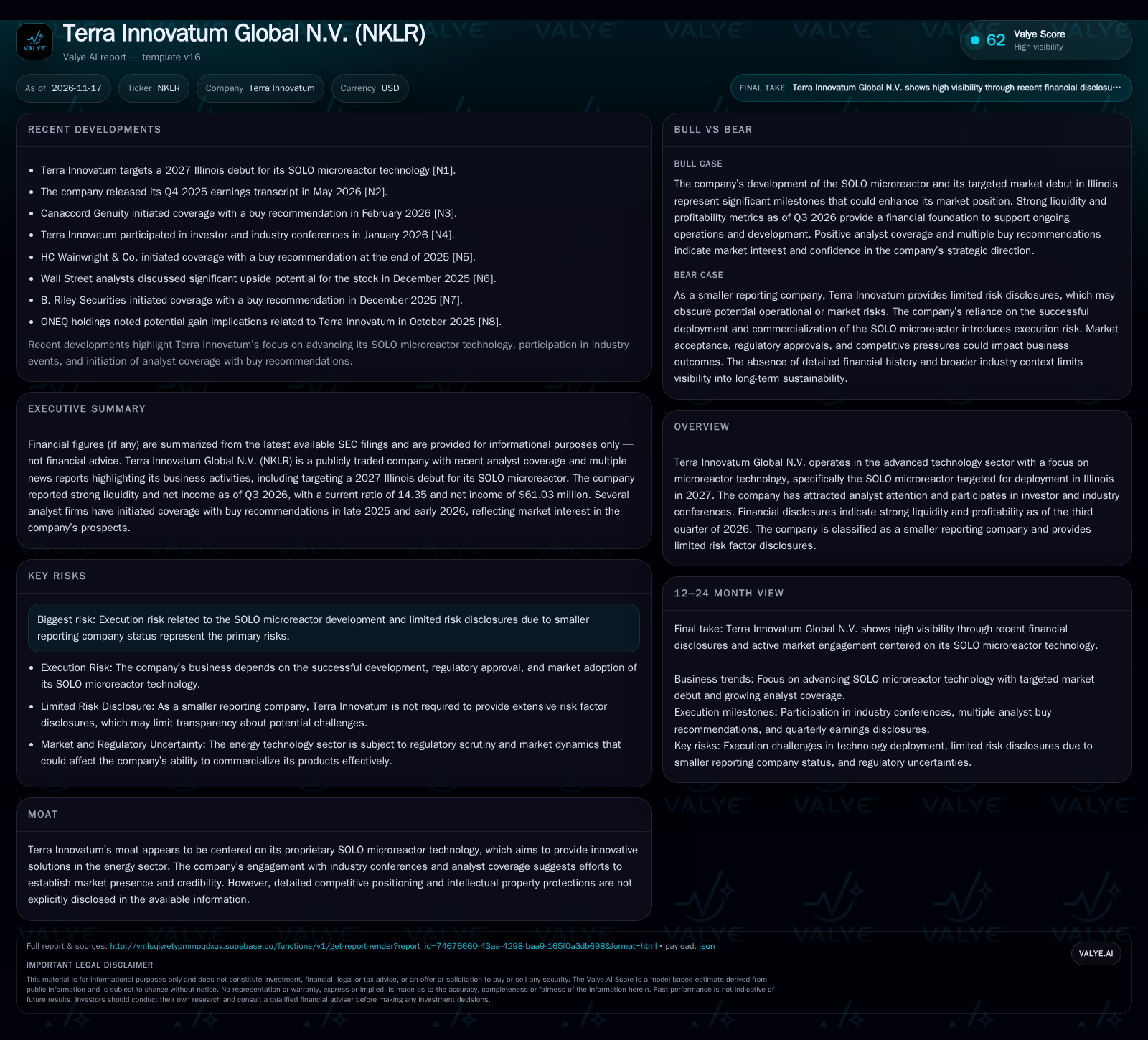
Terra Innovatum Global N.V. enters late 2026 with $82.37 million in cash, a 14.35 current ratio, and positive net income, all as it targets a 2027 Illinois debut for its SOLO microreactor technology. Multiple analysts have initiated buy coverage, reflecting market enthusiasm. However, as a smaller reporting company, Terra Innovatum offers limited transparency into its risk profile and must still prove that its microreactor can achieve commercial, regulatory, and operational milestones at scale. The next 12-24 months will hinge on execution, partnerships, and early customer or regulatory traction.
Terra Innovatum Global N.V. stands at a turning point: flush with cash, profitable in recent quarters, and buoyed by analyst optimism, the company is preparing for a 2027 Illinois debut of its SOLO microreactor technology. This next-generation energy solution promises both disruptive potential and substantial execution risk. With limited risk disclosures and unproven commercial mechanics, investors face a classic innovation paradox: strong near-term financials and market excitement, but significant uncertainty about whether Terra Innovatum can translate technological promise into sustainable, large-scale business results.
Financial Position and Recent Technology Breakthroughs Set the Stage
As of September 30, 2026, Terra Innovatum reported $82.37 million in cash and cash equivalents, with current assets of $90.32 million against current liabilities of just $6.29 million, yielding a current ratio of 14.35 and a cash ratio of 13.09 [S2]. Net income for the quarter was $61.03 million, with earnings per share of $0.55 [S2]. These figures signal a company with significant financial resources and recent profitability heading into a critical product milestone.
The company’s most immediate catalyst is the targeted 2027 Illinois launch of its proprietary SOLO microreactor, representing a major step toward commercializing advanced energy technology [N1]. The company reported cash and liquidity metrics for the period; these figures do not by themselves establish operating runway, investment capacity, financial flexibility, or financing capacity.
Microreactor Commercialization’s Potential Impact on Terra Innovatum’s Economics
The core of Terra Innovatum’s business thesis centers around its SOLO microreactor: a compact, potentially modular energy solution aimed at markets requiring reliable, decentralized power. The exact commercial model—whether direct sales, leasing, power purchase agreements, or government contracts—has not been disclosed, so the company’s future revenue mix and margin structure remain undefined.
If the company pursues a hardware-plus-service model, initial deployments could be capital intensive but pave the way for recurring service, maintenance, or fuel supply revenue. Operating leverage would likely be high: fixed engineering, regulatory, and manufacturing costs could be amortized over a growing installed base if adoption accelerates. Conversely, if adoption lags or regulatory hurdles delay scale-up, fixed costs could pressure margins and cash flow.
Technology Edge, Regulatory Strategy, and Market Entry Define Competitive Standing
Terra Innovatum’s potential moat lies in the proprietary SOLO microreactor design, aiming to address energy reliability, safety, and deployment flexibility. If the technology can deliver on promises of rapid deployment, modularity, and cost-effectiveness, it could compete favorably against both traditional grid solutions and other advanced microreactor contenders.
However, the competitive landscape is crowded: established nuclear companies, advanced reactor startups, and even distributed renewables all vie for decarbonization and reliability budgets. Regulatory approval is a major barrier—incumbents have deep experience navigating complex permitting, while newcomers often face delays. Intellectual property protection and the ability to lock in early anchor customers (such as government agencies or critical infrastructure operators) will be critical to fending off fast followers or better-funded rivals.
Switching costs in energy infrastructure are high, but so are customer demands for long-term reliability and regulatory certainty. The company’s ability to articulate clear safety, cost, and operational advantages will shape its competitive trajectory.
Network Effects and Funding Opportunities from Commercial Validation
A favorable outcome for Terra Innovatum would see the 2027 Illinois SOLO microreactor launch proceed on schedule, with successful regulatory approval and first-of-a-kind deployment. Early operational success—measured by safety, uptime, and customer satisfaction—could catalyze follow-on orders from both public and private sector customers.
In this scenario, positive demonstration data and reference deployments would help Terra Innovatum attract strategic partners, government incentives, or project financing, reducing the need for dilutive equity raises. As the installed base grows, operating leverage could expand margins, while recurring service agreements or long-term fuel supply contracts enhance visibility.
Evidence supporting this scenario would include publicized regulatory milestones, signed deployment agreements, early customer testimonials, or announced follow-on projects. Falsification would come from delays, technical setbacks, or an inability to secure regulatory or customer buy-in.
Sustained Investment and Gradual Scaling Mark the Expected Progression
The most plausible trajectory is a mix of technical progress and continued investment: Terra Innovatum advances the SOLO microreactor toward its 2027 Illinois debut, spending heavily on engineering, regulatory engagement, and pre-commercial activities. Some regulatory milestones are achieved, but commercial adoption remains modest as potential customers and partners await proven operational data.
Revenue in this scenario could be lumpy, with limited initial sales or pilot project income offset by ongoing R&D and manufacturing outlays. The company may need to seek additional capital—through equity, partnerships, or non-dilutive grants—to fund the gap between demonstration and commercial scale. Analyst optimism persists as long as milestone progress is visible, but the stock could be volatile as the market weighs execution risks.
Confirmation would come from steady operational updates, regulatory filings, and evidence of pilot deployments. Falsification would include missed milestones, cost overruns, or management’s inability to secure bridge financing if needed.
Delays in Execution and Regulation Threaten Terra Innovatum’s Market Lead
An adverse scenario centers on the classic hazards of commercializing advanced energy hardware: technical challenges, regulatory delays, cost overruns, or failure to secure early customers. If the SOLO microreactor’s Illinois debut slips beyond 2027, or if regulators require additional data or redesigns, Terra Innovatum’s cash could be depleted before meaningful revenue arrives.
Competitors—either larger incumbents or agile startups—may capitalize on these delays to capture anchor customers, regulatory mindshare, or government support. Investor sentiment could sour if positive analyst coverage proves premature or if the company is forced to raise capital on unfavorable terms.
Downside confirmation would include publicized project delays, regulatory setbacks, negative operational data, or evidence that peer companies are securing key contracts or regulatory approvals first.
Upcoming Milestones That Will Reveal Terra Innovatum’s Commercial Path
Progress toward regulatory approval for the SOLO microreactor in Illinois: public filings, safety reviews, or announced milestones would be critical signals.
Updates on customer acquisition: signed agreements, letters of intent, or pilot project announcements would help gauge early market traction.
Disclosure of commercial model: details on whether SOLO will be sold, leased, or offered via power purchase agreements would clarify long-term economics.
R&D and capital expenditure trends: rising spend versus cash burn rates would indicate the pace and sustainability of pre-commercial investment.
Evidence of follow-on orders or partnerships: repeat business or strategic alliances would support the case for network effects and scale.
Management communications around timeline and deliverables: regular, transparent updates would help reduce the information gap created by limited formal risk disclosure.
Competitive activity: announcements from peer microreactor companies or industry incumbents could signal shifting market dynamics or regulatory benchmarks.
Disclaimer: This is research-only, informational analysis and not investment advice. It may include AI-generated interpretation and general industry context. Always verify important details using primary sources.

Comments