
Jupiter Neurosciences: Clinical Progress, Licensing Leverage, and the Strain of Capital Scarcity
Jupiter Neurosciences has advanced its lead Parkinson’s program and secured a high-profile licensing term sheet, but a deepening liquidity crunch and heavy milestone obligations create a precarious path for operations and value realization.
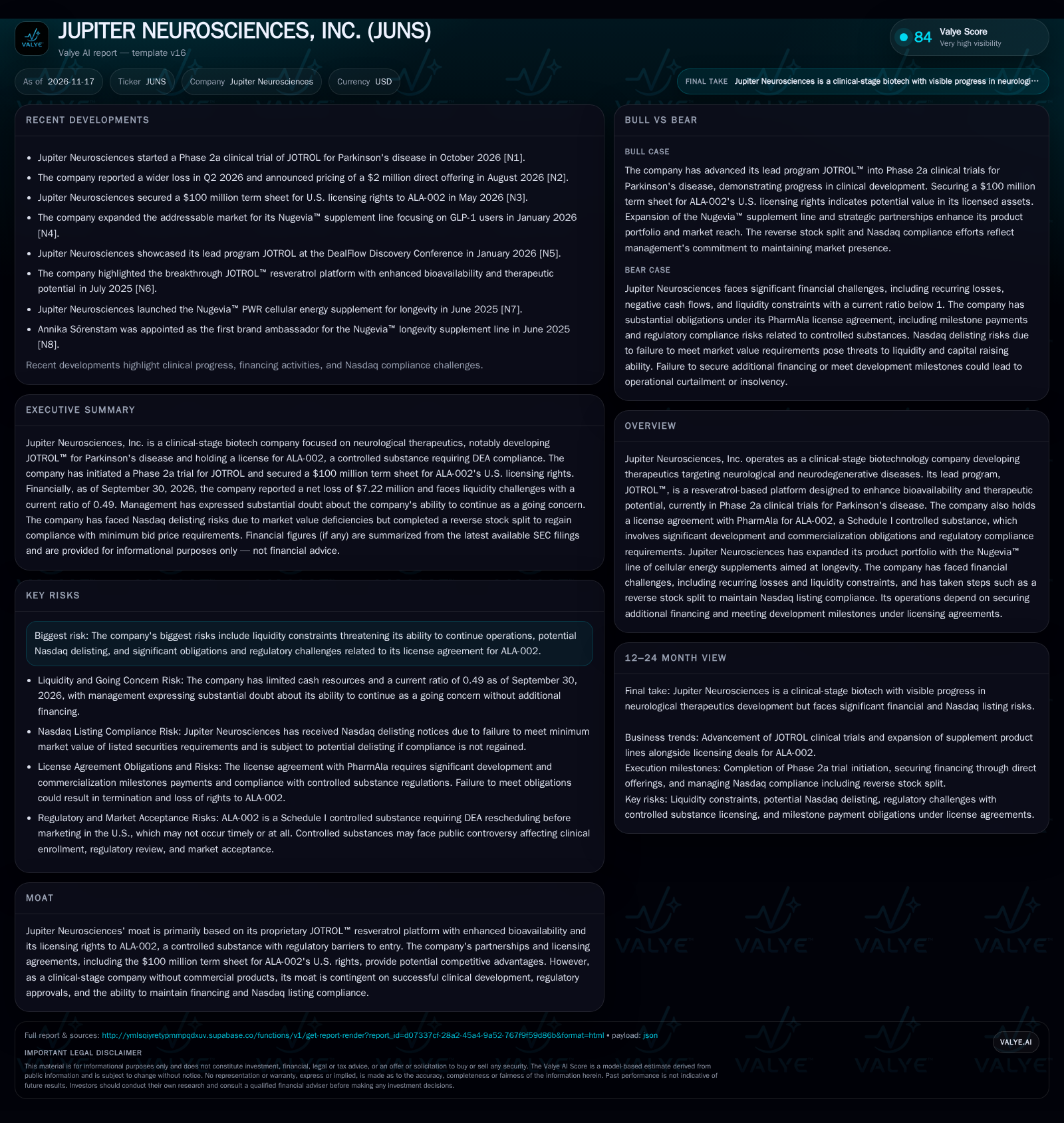
Jupiter Neurosciences is advancing JOTROL™ in a Phase 2a Parkinson’s trial and holds a $100 million term sheet for ALA-002 licensing rights. Management has raised doubts about the company’s ability to continue as a going concern without new financing, making capital access and development milestones critical to any future upside. [S2] [N1] [N3]
Jupiter Neurosciences, a clinical-stage biotech, is actively developing JOTROL™—a resveratrol-based candidate for neurodegenerative diseases—while leveraging a high-value licensing term sheet for ALA-002. Despite visible clinical progress and product portfolio expansion, the company faces an acute liquidity crisis, with management openly questioning its ability to continue as a going concern. The coming quarters will test whether Jupiter can translate its pipeline and licensing assets into sustainable operations—or whether capital scarcity and heavy contractual obligations will force strategic retrenchment or worse.
Clinical Advancement and Capital Strain Define Jupiter’s Present State
Jupiter Neurosciences initiated a Phase 2a clinical trial of JOTROL™ in Parkinson’s disease in October 2026, marking a crucial step toward clinical validation of its lead asset. The company also secured a $100 million term sheet for U.S. licensing rights to ALA-002, suggesting external parties see value in its controlled-substance pipeline. However, as of September 30, 2026, Jupiter’s current assets stood at only $1.26 million against $2.59 million in current liabilities, resulting in a current ratio of 0.49. These facts underscore a business at the intersection of scientific progress and existential financial risk. [N1] [N3] [S2]
How Jupiter’s Model Hinges on Clinical Milestones, Licensing, and Funding Cycles
Jupiter’s economics are driven by a high-risk, high-reward biotech model: significant upfront R&D costs, lumpy and uncertain licensing revenue, and a reliance on external capital. The company’s lead asset, JOTROL™, if successful in Phase 2a and subsequent trials, could eventually command premium pricing in the neurodegenerative market, where even modest efficacy can justify substantial per-patient revenues. However, at this stage, the company generates no material product revenue and remains dependent on external financing and potential milestone payments from licensing deals.
The $100 million term sheet for ALA-002 U.S. rights, if converted into binding agreements and subsequent cash flows, could transform the company’s funding mix and provide non-dilutive capital. Yet, the PharmAla license imposes up to $23.3 million in development milestone payments and $73.3 million in commercialization milestones, plus royalties, implying that even successful partnerships will require Jupiter to secure significant near-term financing to avoid losing rights. Fixed costs are high relative to current liquidity, and the absence of recurring revenue means negative operating leverage persists until a product is approved or a major licensing transaction closes. [S2]
In parallel, the Nugevia™ supplement line offers a lower-risk, potentially faster-to-market revenue stream, but competition is intense and margins may be modest relative to pharmaceutical products. Without clinical or commercial breakthroughs, continued cash burn and dilution are likely.
Barriers, Partnerships, and the Challenges of Biotech Differentiation
Jupiter’s competitive position rests on two pillars: proprietary technology (JOTROL™’s enhanced resveratrol bioavailability) and access to tightly regulated assets (ALA-002, a Schedule I controlled substance). The latter provides a regulatory barrier that could limit competition but also imposes significant hurdles in terms of DEA registration and potential public controversy, which may delay or derail market entry.
In the pharmaceutical development landscape, Jupiter faces both large pharmaceutical companies with established neurodegeneration franchises and a crowded field of clinical-stage biotechs targeting similar indications. Success for JOTROL™ would hinge on demonstrating clear clinical advantages—such as superior efficacy, safety, or convenience—over existing and pipeline therapies. If the company can leverage its licensing assets to attract partners with greater commercial reach and financial firepower, it could secure funding and accelerate market access, but this is contingent on clearing both clinical and regulatory milestones.
The consumer supplement market (Nugevia™) is less regulated but far more crowded, with less defensible intellectual property and lower switching costs for customers. Celebrity endorsement may generate brand awareness, but sustained differentiation would likely depend on scientific claims and regulatory clarity.
A Path to Value Creation: Clinical Success, License Monetization, and Strategic Capital
In a favorable scenario, Jupiter demonstrates positive Phase 2a data for JOTROL™ in Parkinson’s disease, catalyzing partnering interest or non-dilutive financing, and triggers early milestone payments under existing or new licensing agreements. If the $100 million term sheet for ALA-002 is converted into a binding agreement with front-loaded payments, this could fund ongoing trials and reduce insolvency risk. Simultaneously, accelerated regulatory progress with ALA-002—such as DEA rescheduling—would open the door to clinical development and commercial partnerships.
The Nugevia™ line could achieve traction in the growing longevity and wellness market, especially if supported by credible clinical data and effective marketing. If Jupiter’s Nasdaq compliance is maintained and new equity or debt offerings are successfully placed, the company could extend its runway to reach pivotal inflection points.
Evidence supporting this scenario would include successful conversion of the term sheet to cash flow, positive clinical readouts, new strategic partnerships, or robust supplement sales growth. Conversely, delays in trial enrollment, inability to finalize licensing agreements, or further liquidity deterioration would falsify the upside narrative. [N1] [N3] [S2]
Stretched Operations and Episodic Progress Amid Persistent Financial Constraints
The most plausible path is that Jupiter continues to advance JOTROL™ through early-stage clinical trials while operating under severe capital constraints. The company may secure small-scale equity or convertible debt financings—potentially at dilutive terms—to extend its runway just long enough to reach interim trial readouts or licensing milestones. The PharmAla license obligations and regulatory hurdles for ALA-002 likely remain unresolved in the near term, with milestone payments deferred until meaningful progress is achieved.
Supplement sales from Nugevia™ may contribute only marginally to cash flows, unable to offset core R&D expenses. Nasdaq compliance is maintained through periodic interventions (reverse splits, appeals), but market value deficiencies continue to threaten delisting. The going-concern qualification persists unless a major partnership, sale, or favorable clinical result dramatically alters the cash position.
Confirmation of this scenario would come from continued incremental clinical progress, ongoing but limited financings, and persistent warnings about liquidity and going-concern status. Falsification would require either a transformative capital infusion or a sudden operational halt due to insolvency. [S2]
What Failure Looks Like: Missed Milestones, Lost Rights, and Delisting
In an adverse chain of events, Jupiter fails to secure new funding and is unable to meet its milestone payment obligations under the PharmAla license. This could trigger termination of rights to ALA-002, eroding a central pillar of the company’s asset base. Ongoing net losses and negative cash flow exhaust remaining liquidity, forcing operational cutbacks, furloughs, or even bankruptcy protection.
If Nasdaq delisting occurs due to persistent market value or bid-price deficiencies, Jupiter would lose access to a key capital-raising platform and likely see further erosion in investor confidence. Clinical programs could stall or be discontinued, and the company may be forced to liquidate or sell assets at distressed valuations.
Evidence confirming this scenario would include missed milestone deadlines, loss of licensing rights, failed or severely dilutive financing attempts, and actual delisting notices. Falsification would require clear demonstration of renewed financing or a major asset monetization event. [S2]
Milestones and Market Events That Will Reveal Jupiter’s Trajectory
Progress and top-line data readouts from the Phase 2a JOTROL™ trial in Parkinson’s disease, including enrollment pace and efficacy signals, if disclosed.
Conversion of the $100 million ALA-002 term sheet into a binding agreement, with emphasis on upfront cash payments, milestone structure, and counterparty credibility.
Ability to secure additional financing—either equity, debt, or licensing payments—before existing cash is exhausted, as evidenced by new offerings or partnership announcements.
Updates on Nasdaq listing status, including any further delisting notices, appeals, or compliance actions.
Actual milestone payments made or deferred under the PharmAla license agreement, and any changes to development timelines or obligations.
Trends in Nugevia™ supplement sales, especially following product launches, new endorsements, or market expansion initiatives, if disclosed.
Management disclosures regarding going-concern status and any changes in auditor or regulatory posture.
Disclaimer: This is research-only, informational analysis and not investment advice. It may include AI-generated interpretation and general industry context. Always verify important details using primary sources.

Comments