
Modular Medical: Can Pivot’s Simplicity Break Through Insulin Pump Barriers Before Capital Runs Out?
Modular Medical launches its next-generation Pivot insulin patch pump into a crowded and entrenched diabetes device market, aiming to convert millions using daily injections.
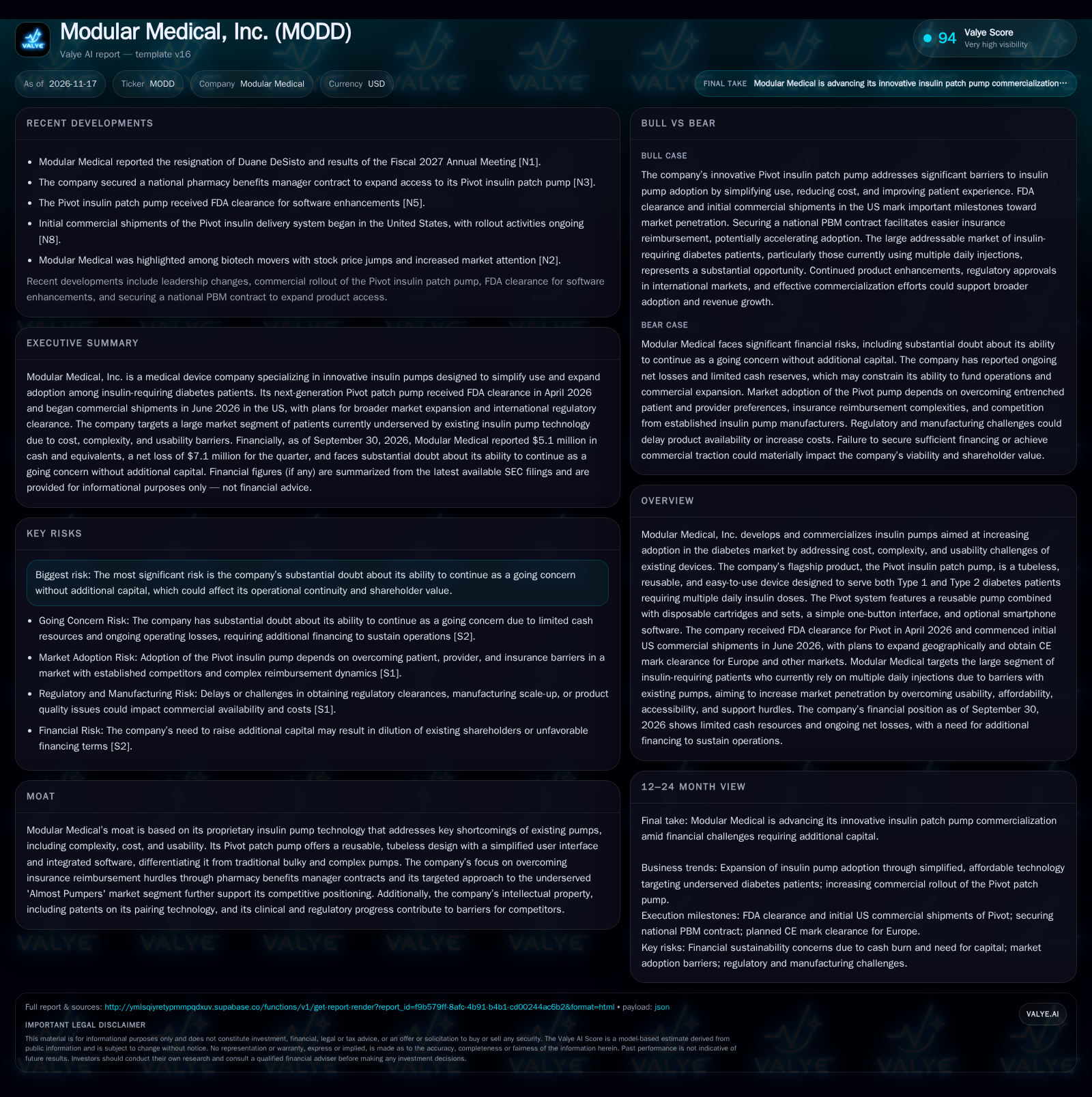
Modular Medical’s Pivot insulin patch pump, targeting both Type 1 and Type 2 diabetes patients, began US commercial rollout after FDA clearance and a national PBM contract win. The company’s business model depends on rapid market penetration among users deterred by complexity and cost of legacy pumps. The race is on between commercial momentum and capital constraints. [S1] [S2] [N3] [N8]
Modular Medical, Inc. is at a pivotal moment as it brings its FDA-cleared Pivot insulin patch pump to the US market, targeting a vast but historically hard-to-convert segment of diabetes patients who avoid traditional pumps. With an innovative, simplified device design and a national PBM contract to improve insurance access, Modular Medical’s commercial strategy is to expand beyond the niche of motivated pump users. But the company’s limited cash runway and ongoing losses mean that sustained market traction—and timely financing—are urgent imperatives. The coming quarters will reveal whether Pivot’s user-friendly approach can drive adoption fast enough to outpace financial headwinds.
Recent Launch, Expanded Access, and Financial Pressure Define the Moment
The company reported cash and liquidity metrics for the period; these figures do not by themselves establish operating runway, investment capacity, financial flexibility, or financing capacity. [S1] [S2] [N3] [N8]
These facts matter because they set up a high-stakes race between commercial adoption and financial sustainability. The PBM contract is especially significant, as insurance coverage is often the gating factor for patient uptake in the US diabetes device market. Meanwhile, the cash and loss figures indicate that without rapid revenue ramp or near-term financing, operational continuity is at risk.
Business Model Dynamics: Volume-Driven, Disposable-Heavy, and Capital Dependent
Modular Medical’s economics will likely hinge on a razor/razor-blade model: the Pivot system pairs a reusable pump (with a 90-day life) with 3-day disposable cartridges and infusion sets [S1]. This structure is designed to generate recurring revenue from disposables after an initial device sale, but only if a critical mass of patients adopt—and stick with—the system.
Pricing and reimbursement will be decisive. In the US, PBM contracts can enable favorable patient access and insurance billing, but price points must balance affordability (to convert injection users) against the gross margin required to fund R&D, support, and scaling. The company’s focus on simplifying use and reducing cost aims to expand the addressable market, but success depends on both payer acceptance and patient willingness to switch.
Fixed costs include R&D, regulatory, and manufacturing scale-up, while variable costs are tied to device and disposable production. Modular Medical’s current losses and cash needs reflect the capital-intensive nature of medical device commercialization, especially in a market where education, sales support, and post-market surveillance are essential. If volume can scale, operating leverage could improve, but the window to reach that scale is limited by the current cash position [S2].
Breaking Through Entrenched Competition and Behavioral Barriers
Modular Medical enters a landscape dominated by established insulin pump manufacturers with deep distribution, long-standing provider relationships, and robust reimbursement infrastructure. Its competitive thesis is that legacy pumps remain too complex, expensive, or intimidating for many patients—especially the large 'Almost Pumpers' cohort who rely on multiple daily injections despite being eligible for pump therapy [S1].
The Pivot’s differentiators are its tubeless, slim design, simple interface, and optional phone integration—features intended to lower the activation energy for new users. However, switching costs are not just financial; they also include behavioral inertia, provider training, and insurance navigation. The national PBM contract may help level the insurance playing field, but trust and familiarity with established brands remain formidable hurdles.
Potential substitutes include both traditional pumps and increasingly advanced smart pens and continuous glucose monitoring systems, which may offer improved convenience for some segments. Modular Medical’s moat will depend on sustained device reliability, patient experience, and its ability to educate and support new users at scale.
If Pivot Converts the ‘Almost Pumpers’: Rapid Share Gains and Reimbursement Momentum
The favorable scenario is predicated on Pivot’s simplicity and affordability driving rapid adoption among patients currently using multiple daily injections. The PBM contract could enable broad insurance coverage and pharmacy distribution, lowering out-of-pocket costs and streamlining prescribing.
A virtuous cycle could emerge: early user traction leads to positive provider and patient word-of-mouth, which in turn accelerates payer adoption and further expands access. As volumes ramp, fixed costs are leveraged and recurring disposable revenue scales, enabling reinvestment in product enhancements and international expansion (such as CE mark pursuit in Europe) [S1].
Evidence that would confirm this scenario includes: consistent month-over-month growth in new patient starts, positive feedback from providers and patients (if disclosed), rapid geographic expansion, additional PBM or payer contracts, and signs that disposables revenue is becoming a significant share of sales.
Gradual Uptake Amid Capital Constraints and Market Friction
The most plausible scenario is a measured pace of adoption, with Pivot gaining traction in select US geographies and among a subset of injection users, but encountering typical medical device market frictions—provider conservatism, patient inertia, and the slow churn of insurance adoption.
Revenue grows, but not fast enough to eliminate the need for further capital raises in the next 12-18 months. The company may secure additional financing, likely diluting current shareholders but preserving operational runway. International expansion is deferred or proceeds cautiously, contingent on US momentum and CE mark progress.
Evidence supporting this scenario would include: modest but steady increases in patient starts, incremental payer wins, periodic financing announcements, and controlled growth in operating expenses. Falsifying evidence would be either a sharp drop-off in adoption metrics or a breakthrough in either direction (rapid scale or operational retrenchment).
When Cash Runs Out Before Adoption Scales: Stalled Rollout or Forced Restructuring
In the adverse scenario, Pivot fails to achieve broad adoption—either due to entrenched competition, persistent reimbursement barriers, or insufficient patient/provider enthusiasm for switching from injections. Revenue growth lags, and cash resources dwindle before the company can secure additional financing on acceptable terms.
This could force Modular Medical to pause or scale back commercial activities, delay international expansion, or accept highly dilutive financing that undermines shareholder value. In a worst-case, going concern risk materializes in the form of operational shutdown, asset sales, or bankruptcy proceedings [S2].
Evidence for this scenario includes: flat or declining patient uptake, lack of new payer or PBM contracts, increasing accounts payable or deferred expenses, and explicit warnings from management about cash constraints or financing difficulties.
Milestones and Metrics That Will Shape Modular Medical’s Pivot Story
Monthly or quarterly new patient starts for the Pivot system—if disclosed—would provide direct evidence of adoption velocity.
Growth in recurring revenue from disposables versus initial device sales would indicate whether the business model is achieving scale and stickiness.
Updates on additional PBM or private payer contracts, and any expansion of insurance coverage or access.
Progress toward CE mark clearance for Pivot and any reported international distribution agreements.
Operating expense trends relative to revenue growth, which will signal whether the company is achieving leverage or burning cash faster than expected.
Any disclosures about patient or provider satisfaction, complaints, or device returns—early indicators of product-market fit and support burden.
Announcements of new financing, stock offerings, or debt arrangements, which will determine the ability to sustain operations and execute the commercial plan.
Board or management changes that could affect execution continuity or strategic direction.
Disclaimer: This is research-only, informational analysis and not investment advice. It may include AI-generated interpretation and general industry context. Always verify important details using primary sources.

Comments