
1847 Holdings LLC: Acquisition Platform Confronts Acute Liquidity Pressures and Strategic Inflection
The company’s ability to raise capital, manage debt, and unlock value from its diversified portfolio will determine whether its operational model can withstand near-term financial headwinds.
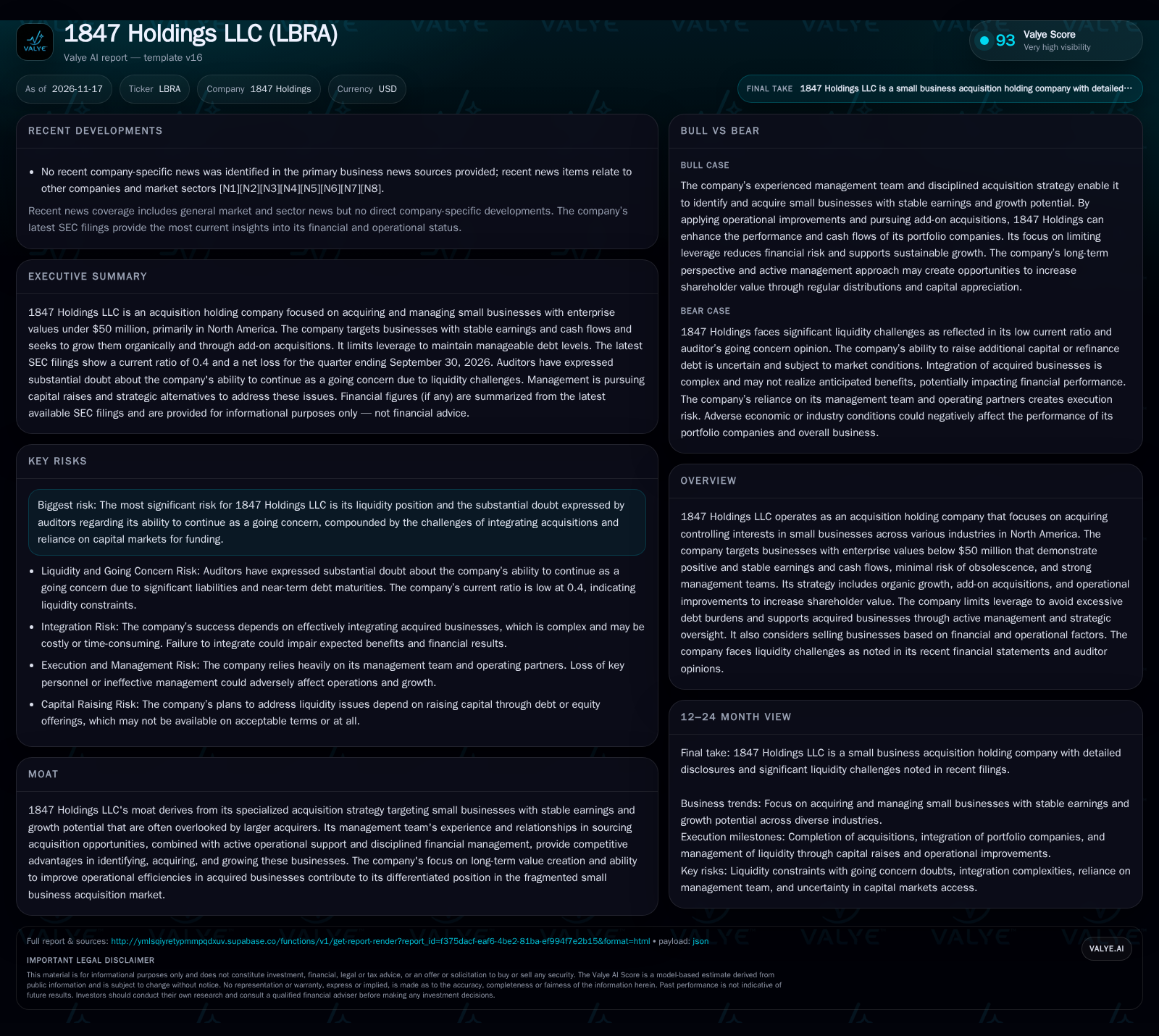
1847 Holdings LLC operates as an acquisition holding company targeting small businesses with stable earnings in North America. Management is pursuing capital raises and strategic alternatives, but the success of these efforts will be critical to the company’s survival and ability to execute its acquisition strategy. [S2]
1847 Holdings LLC has built its identity around acquiring and managing small, stable businesses overlooked by larger private equity and corporate buyers. Its disciplined approach—targeting companies with resilient cash flows, avoiding excessive leverage, and focusing on operational improvements—offers a plausible value-creation model in fragmented markets. However, as of late 2026, the company is confronting its most acute liquidity crisis to date, with a current ratio of just 0.4 and auditors expressing substantial doubt about its ability to continue as a going concern. The coming quarters will test whether 1847 Holdings can tap the capital markets or unlock value from its portfolio quickly enough to avoid forced asset sales or a restructuring scenario.
Liquidity Crisis and Going Concern Warning Shape Immediate Outlook
1847 Holdings LLC’s most recent financials reveal a company under acute financial strain: as of September 30, 2026, it reported cash and equivalents of just $211,270, current assets of $28.2 million, and current liabilities of $70.9 million, resulting in a current ratio of 0.4 and a cash ratio of zero. Revenue for the quarter was $1.74 million, but the company posted a net loss of $1.14 million and basic EPS of -$0.02. Most notably, auditors issued a going concern opinion as of December 31, 2025, citing substantial doubt about the company’s ability to continue given significant liabilities and near-term debt maturities. Management is actively seeking to raise capital, refinance debt, and explore strategic alternatives, but as of the latest filings, the company’s survival is in question. [S2]
Acquisition-Driven Model and Financial Leverage: The Double-Edged Sword
1847 Holdings’ business model centers on acquiring controlling interests in small businesses (enterprise value under $50 million) that generate stable earnings and cash flows. The company seeks to add value through operational improvements, active management, and organic or add-on growth, while maintaining a disciplined leverage policy—targeting a debt/EBITDA ratio not exceeding 1.25x at the subsidiary level. This approach is designed to limit financial risk and preserve flexibility, but the holding company itself is now facing a mismatch between its liabilities and liquid resources.
The economics of this model depend on sourcing attractively priced acquisitions, improving subsidiary performance, and realizing value either through ongoing cash flows or eventual divestitures. If the company can achieve margin expansion and cash flow growth at the portfolio level, operating leverage could drive higher returns on equity. However, the current liquidity crunch indicates that overhead costs, interest expenses, or underperforming subsidiaries may be eroding group-level profitability. The need to raise external capital—through debt, equity, or asset sales—introduces dilution risk and could disrupt the compounding effect that makes acquisition platforms attractive when well-capitalized.
Sourcing Edge in Underserved Markets, but Funding Constraints Limit Advantage
1847 Holdings positions itself in the lower middle market, targeting businesses too small for most private equity funds or strategic buyers. This niche can offer less competitive auctions and more favorable pricing, particularly for companies with strong management teams and stable cash flows. The holding company’s willingness to acquire across industries and its hands-on operational approach may provide an edge in identifying and improving overlooked assets.
However, the fragmented nature of this market means competition comes from independent sponsors, family offices, and smaller private equity funds. These competitors may have more flexible capital, stronger banking relationships, or be less encumbered by holding company-level debt. The current liquidity stress at 1847 Holdings could erode its reputation as a reliable buyer, making it harder to win deals or retain key management talent at subsidiaries. Without access to fresh capital, the company’s sourcing and integration advantage may become moot—especially if forced asset sales or distressed financings signal weakness to sellers and partners.
Successful Capital Raise or Asset Sale Could Reset the Platform
The path to recovery for 1847 Holdings likely hinges on its ability to raise new capital—through debt refinancing, equity issuance, or the sale of non-core assets. If management can secure sufficient funding before upcoming debt maturities, the company could stabilize its liquidity, restore vendor and seller confidence, and resume its acquisition and operational improvement strategy. A successful capital raise would also provide breathing room to selectively divest underperforming subsidiaries at fair value rather than under duress.
Confirmation of this scenario would come from announced capital infusions, new financing agreements, or asset sale proceeds that materially improve the current ratio and extinguish near-term debt. If the company can also demonstrate improved portfolio-level cash flow and margin performance in subsequent quarters, it would suggest the operational model remains viable. Falsification would occur if capital markets remain closed, forcing distressed sales or a restructuring process that wipes out equity holders.
Liquidity Management and Cost Reductions Buy Time, but Growth Stalls
The most plausible near-term scenario is that 1847 Holdings manages to buy time through incremental cost reductions, modest capital raises, and refinancing negotiations, but remains under financial duress. Growth ambitions are curtailed as the company prioritizes liquidity over new acquisitions, and operational improvements at portfolio companies are focused on cash preservation rather than expansion.
Evidence for this scenario would include continued going concern language in filings, limited or no new acquisitions, and ongoing efforts to trim overhead or restructure debt. The company may avoid outright insolvency but risks becoming a stagnant platform, unable to participate in attractive transactions or invest meaningfully in its subsidiaries. Falsification would occur if the company either secures a transformative capital injection (upside) or is forced into bankruptcy or distressed asset sales (downside).
Forced Asset Sales or Restructuring Trigger Value Destruction
If 1847 Holdings is unable to raise capital or refinance debt before maturities come due, the company may be forced to sell subsidiaries at distressed prices, eroding shareholder value and potentially triggering a downward spiral. Fire-sale divestitures could further damage relationships with remaining management teams and diminish the value of the platform’s sourcing and operational expertise.
Should these measures prove insufficient, a formal restructuring or bankruptcy filing could follow, likely resulting in significant dilution or elimination of existing equity holders. Confirmation of this scenario would come from asset sales at steep discounts, missed debt payments, or public disclosure of restructuring negotiations. Falsification would require clear evidence of improved liquidity and stabilized operations—such as a successful capital raise or a material reduction in liabilities.
Milestones That Will Determine Whether 1847 Holdings Can Survive and Rebuild
Disclosure of any new debt or equity financings, including terms and amounts, to assess whether the company can address its near-term liquidity needs.
Updates on asset sales or divestitures, including proceeds and impact on the current ratio and debt maturity profile.
Quarterly changes in current ratio and cash levels, which would signal progress or deterioration in liquidity management.
Portfolio company performance: revenue, EBITDA, and cash flow trends at the subsidiary level (if disclosed) to gauge operational improvement or stress.
Evidence of cost reductions or restructuring at the holding company and portfolio levels to assess management’s ability to preserve cash.
Changes in auditor language regarding going concern status, which would indicate improved or worsening confidence in the company’s viability.
Announcements of new acquisitions or expansion initiatives—if and when liquidity stabilizes—to test whether the platform can return to growth mode.
Management turnover or changes in subsidiary leadership, which could signal execution challenges or instability within the portfolio.
Disclaimer: This is research-only, informational analysis and not investment advice. It may include AI-generated interpretation and general industry context. Always verify important details using primary sources.

Comments