
Ocean Thermal Energy Corp: Proprietary OTEC Ambition Confronts Capital and Commercialization Barriers
With a vision to deliver base-load, fossil-fuel-free power from ocean temperature differentials, Ocean Thermal Energy Corp pursues first-mover status in OTEC and related systems. Yet extreme balance-sheet strain and the absence of completed projects raise questions about near-term viability and the pathway from technical promise to commercial reality.
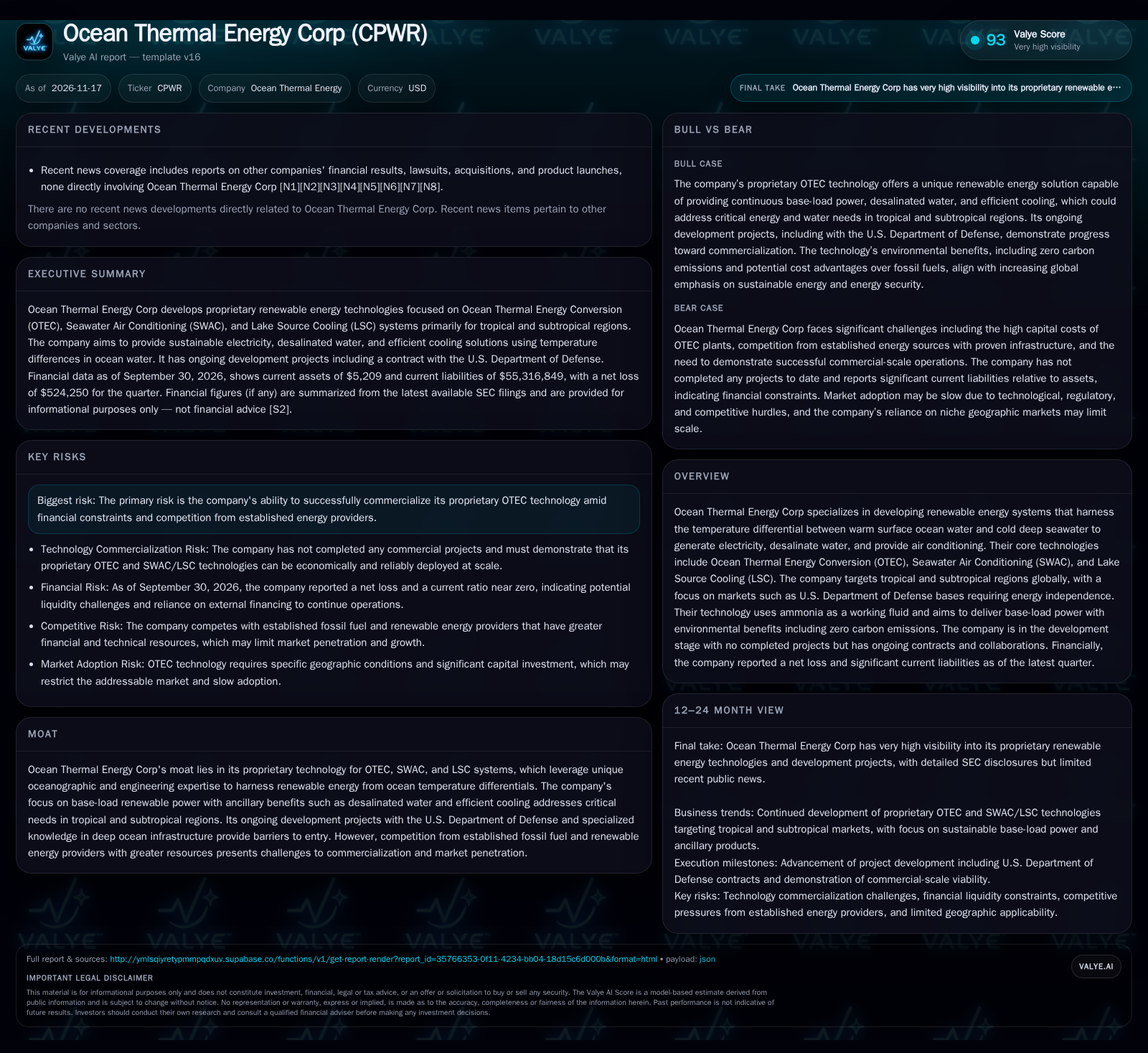
Ocean Thermal Energy Corp is developing proprietary Ocean Thermal Energy Conversion (OTEC) and related renewable solutions for tropical markets, targeting stable, zero-emissions power and ancillary products like desalinated water. Despite advanced development efforts, including a U.S. The thesis hinges on whether it can overcome capital and execution hurdles to commercialize its technology before financial constraints force retrenchment or dilution. [S1] [S2]
Ocean Thermal Energy Corp aspires to pioneer a new category of base-load renewable power by harnessing the thermal gradient between warm surface and cold deep seawater. Its proprietary OTEC, SWAC, and LSC systems could, in theory, deliver continuous, emissions-free electricity, potable water, and efficient cooling to tropical and subtropical markets—an offering with strong environmental and strategic appeal. However, the company’s precarious financial position, lack of completed projects, and competition from both entrenched and emerging energy providers frame a high-stakes commercialization challenge. Whether Ocean Thermal Energy can bridge the gap from technical vision to sustainable business remains uncertain—and its acute balance-sheet pressures make the next phase decisive. [S1] [S2]
Development-Stage Technology Meets Acute Financial Strain
Ocean Thermal Energy Corp is currently developing proprietary Ocean Thermal Energy Conversion (OTEC), Seawater Air Conditioning (SWAC), and Lake Source Cooling (LSC) systems, with a focus on delivering renewable base-load power and ancillary benefits like desalinated water and efficient cooling for tropical and subtropical regions. The company has not yet completed any commercial projects, though it is advancing development for clients including a U.S. Department of Defense facility in the South Pacific. As of September 30, 2026, Ocean Thermal Energy reported current assets of just $5,209 against current liabilities of $55.3 million, and a quarterly net loss of $524,250. The company reported cash and liquidity metrics for the period; these figures do not by themselves establish operating runway, investment capacity, financial flexibility, or financing capacity. These facts highlight a business at a critical juncture: technical ambition is high, but financial runway and commercial proof remain severely limited. [S1] [S2]
OTEC Commercialization Economics: Scale, Capital Intensity, and the Challenge of Recurring Value
The economic promise of Ocean Thermal Energy’s core technology lies in OTEC’s ability to deliver continuous, base-load electricity by exploiting the natural temperature differential between surface and deep ocean water. If successfully deployed at scale, OTEC plants could provide electricity at up to 40% lower cost than fossil-fuel alternatives in certain island or remote markets, while also producing desalinated water and supporting efficient air conditioning via SWAC and LSC. However, these systems are capital-intensive, requiring substantial upfront investment in deep-ocean infrastructure, specialized heat exchangers, and ammonia-based closed-loop cycles. Operating leverage could be significant if fixed capital is amortized over long-lived, high-uptime assets, but the lack of completed projects means there is no established track record for actual cost, uptime, or maintenance economics.
Revenue models could plausibly include long-term power purchase agreements (PPAs) with utilities or government entities, water sales, and contracts for cooling infrastructure. However, the company’s current financials—no revenue and large net losses—underscore the long gap between development expenditure and any potential recurring cash flow. Given the company’s current balance sheet, it is likely dependent on external financing, grants, or strategic partnerships to fund capex, cover operating deficits, and reach commercial scale. Without a first-of-kind project to validate performance, cost, and customer willingness to pay, the path to sustainable margins and positive cash flow remains speculative. [S1] [S2]
Barriers, Substitutes, and the Fight for Relevance in the Energy Transition
Ocean Thermal Energy’s moat is rooted in its proprietary expertise in OTEC, SWAC, and LSC engineering, targeting geographies where conventional renewables or fossil fuels are costly or logistically difficult. The ability to provide base-load, emissions-free power and water in remote or energy-insecure markets could create defensible customer relationships if the technology proves out. However, the company faces formidable competition from established fossil-fuel generators, solar and wind developers, modular nuclear solutions, and other early-stage OTEC/SWAC players—many of which have greater financial, technical, and execution resources.
Switching costs for customers could be high due to the infrastructure commitment required, but this also raises the bar for winning initial contracts and financing. Incumbent providers benefit from scale, reliability, and regulatory familiarity, while solar, wind, and battery storage continue to decline in cost and improve in flexibility. OTEC’s unique value proposition—reliable base-load power with ancillary water and cooling—may be compelling in select geographies, but the total addressable market is inherently limited by oceanographic and climatic constraints. The company’s ability to convert technical differentiation into lasting commercial advantage will depend on cost, reliability, and the ability to secure anchor customers willing to underwrite first-of-kind risk. [S1]
Technical Validation and Anchor Contracts Unlock a Path to Commercial Scale
In a favorable scenario, Ocean Thermal Energy successfully completes its first commercial-scale OTEC plant—potentially the U.S. Department of Defense project—demonstrating reliable base-load power, cost competitiveness, and ancillary water/cooling production as promised. This technical validation could catalyze follow-on orders from defense, island, and resort customers, enabling the company to negotiate long-term PPAs or infrastructure contracts that provide recurring revenue and justify further capital investment.
Successful project execution would likely attract strategic partners or investors, improve access to non-dilutive grants or loans, and begin to shift the company’s financial profile toward positive cash flow. Evidence confirming this scenario would include project completion announcements, customer acceptance, new multi-year contract wins, and disclosure of operational metrics (uptime, delivered cost of power/water, etc.). Falsification would come from continued project delays, technical failures, or inability to secure post-demonstration contracts.
Incremental Progress Amid Capital Constraints and Prolonged Commercial Gestation
The most plausible near-term scenario is slow, incremental advancement: Ocean Thermal Energy continues development work, possibly progressing the U.S. Department of Defense project through further feasibility or pilot phases, but faces ongoing delays in reaching full-scale commercial operation. The company remains heavily reliant on external financing—potentially through dilutive equity, grants, or debt—to fund R&D and project development, with no material revenue and persistent operating losses over the next 12-24 months.
Commercial traction is limited by customer risk aversion, long procurement cycles, and the need for additional technical validation. Incremental progress may be marked by new partnership announcements, grant awards, or early-stage customer agreements, but not by transformative revenue or profitability. This scenario would be confirmed by continued project development updates without completed installations or recurring revenue. It would be challenged by evidence of commercial project delivery, or, conversely, by inability to secure ongoing financing.
Liquidity Exhaustion Forces Retrenchment or Restructuring Before Commercial Breakthrough
In an adverse scenario, Ocean Thermal Energy is unable to secure sufficient new financing or non-dilutive funding to sustain operations through the long development and commercialization cycle. Acute liquidity constraints—evidenced by current assets near zero and liabilities exceeding $55 million—could force the company to halt R&D, scale back project activity, or enter restructuring before any commercial project is completed. This outcome would result in diminished stakeholder confidence, lost customer relationships, and potential loss of proprietary technology value.
Confirmation of this scenario would come from missed payroll, default on obligations, hostile creditor actions, or public disclosures of going-concern risk. Falsification would require clear evidence of a successful capital raise, non-dilutive funding, or a major commercial win that materially improves the company’s balance sheet and operational runway.
Milestones That Will Define Ocean Thermal Energy’s Commercialization Trajectory
Completion and public disclosure of the first operational OTEC, SWAC, or LSC project, especially for the U.S. Department of Defense or other anchor customers.
Signed long-term commercial contracts (PPAs, water/cooling agreements) with utilities, governments, or large private-sector customers, if disclosed.
Demonstrated cost and uptime metrics from pilot or commercial projects, including delivered price per kWh and per gallon of desalinated water.
Announcements of non-dilutive funding (grants, government loans) or strategic equity/debt investments that materially extend the company’s financial runway.
Evidence of customer pipeline growth, such as formal memoranda of understanding or letters of intent for future projects.
Disclosure of project delays, technical setbacks, or regulatory obstacles that could impede commercialization.
Balance-sheet updates showing reported liquidity-ratio trends or substantial new working capital relative to liabilities.
Any public statements regarding potential restructuring, going-concern warnings, or creditor negotiations.
Disclaimer: This is research-only, informational analysis and not investment advice. It may include AI-generated interpretation and general industry context. Always verify important details using primary sources.

Comments