
Energy Vault’s Integrated Storage Model: Recurring Revenue Ambition Meets Execution and Capital Strain
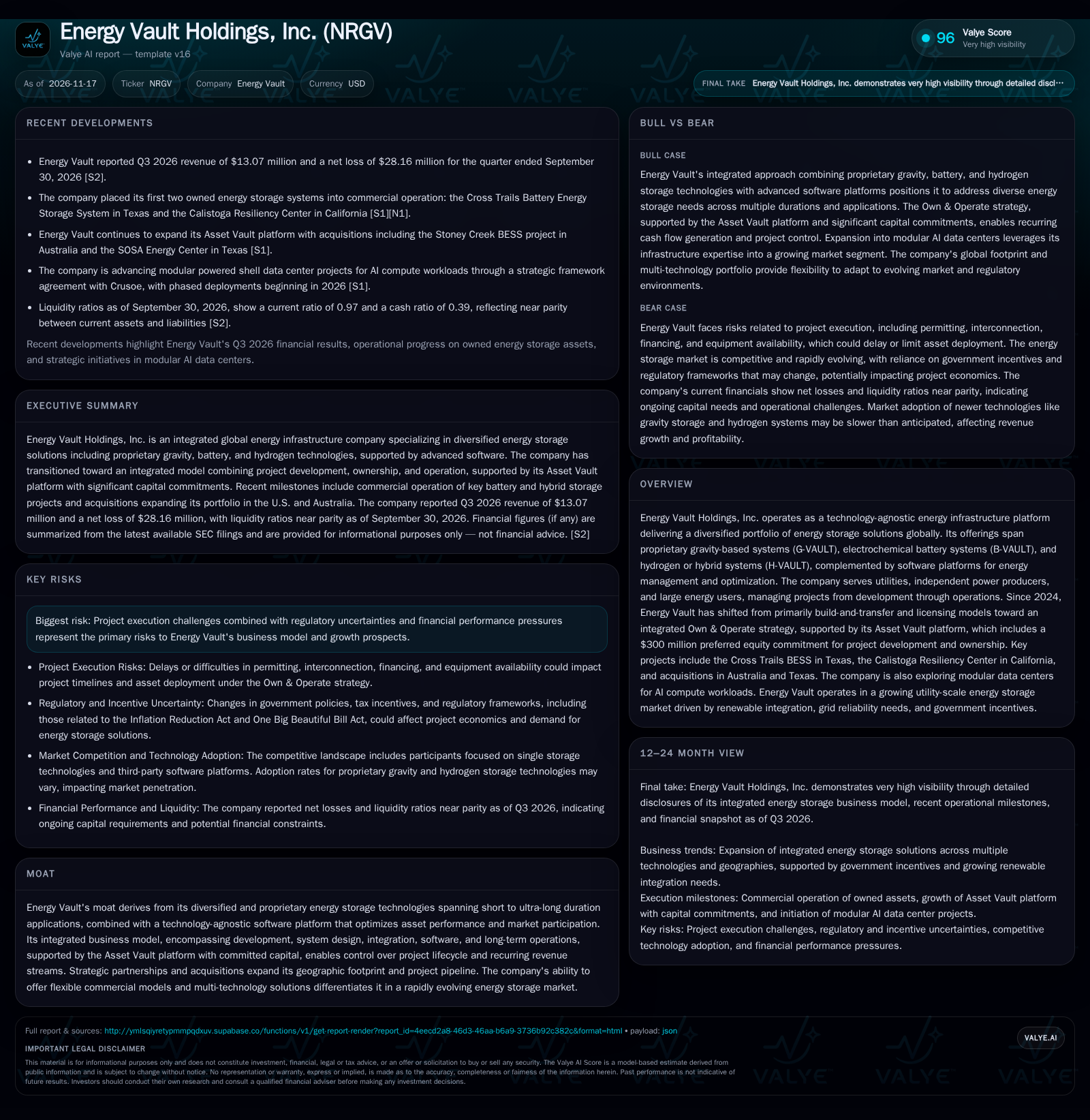
Energy Vault Holdings, Inc. has pivoted from a legacy project sales model to an integrated Own & Operate approach, aiming to capture recurring cash flows across gravity, battery, and hydrogen storage technologies. Recent asset deployments in Texas and California, expansion via acquisitions, and new capital commitments demonstrate operational momentum, but persistent net losses and tight liquidity ratios highlight unresolved financial and execution pressures.
Energy Vault’s shift to owning and operating energy storage assets, combined with a $300 million equity commitment and first-of-kind project launches, signals a bid for recurring revenue and broader market relevance. Yet, Q3 2026 results show continued losses and near-parity liquidity, underscoring the need for successful project execution, asset ramp-up, and careful capital management to realize the integrated model’s promise. [S1] [S2]
Energy Vault Holdings, Inc. is attempting a strategic transformation from a pure-play energy storage technology provider to an integrated asset developer, owner, and operator. By launching its Own & Operate strategy, placing flagship battery and hybrid storage systems into commercial use, and leveraging a $300 million preferred equity commitment, the company is seeking to create more stable, recurring revenue streams. However, Q3 2026 results reveal persistent losses and a liquidity profile that leaves little margin for error. The company’s ability to execute on its pipeline, monetize new technologies at scale, and manage capital will be decisive in determining whether this transformation delivers sustainable value or exposes Energy Vault to heightened financial and operational risks.
Recent Asset Deployments and Financial Strains Define the Strategic Pivot
Energy Vault’s most material developments over the past year include the commercial commissioning of its first two owned energy storage assets—the Cross Trails Battery Energy Storage System (BESS) in Texas and the Calistoga Resiliency Center in California. The Texas BESS (57 MW / 114 MWh) operates under a 10-year offtake agreement with Gridmatic and is notable for its physically settled revenue floor contract, a first for battery systems in ERCOT. The Calistoga project, meanwhile, demonstrates a hybrid approach by integrating hydrogen fuel cells and lithium-ion batteries, serving PG&E under a long-term energy services arrangement. These moves mark a tangible shift from project sales to recurring revenue models. [S1]
On the financial front, Energy Vault reported Q3 2026 revenue of $13.07 million but a net loss of $28.16 million. The company reported cash and liquidity metrics for the period; these figures do not by themselves establish operating runway, investment capacity, financial flexibility, or financing capacity. This financial posture amplifies the importance of timely project execution, asset ramp-up, and prudent capital deployment. [S2]
How the Asset-Heavy Model Could Unlock (or Constrain) Cash Flow
Energy Vault’s economic model is evolving from upfront revenue recognition through build-and-transfer or licensing to a blend of recurring cash flows from owned energy storage assets and ongoing technology/services sales. The new approach is capital-intensive: developing, building, and operating multi-megawatt storage systems requires substantial upfront investment, but could yield higher long-term returns if asset utilization and contract terms are favorable.
The Cross Trails BESS, with its decade-long offtake agreement and revenue floor, provides a template for potential contracted revenue stability, mitigating merchant market volatility. The Calistoga hybrid project’s long-term arrangement with a major utility further supports the recurring cash flow thesis. However, the economics of gravity and hydrogen storage remain less proven at scale, and project-level returns will depend on capex discipline, cost of capital, and actual operating performance.
The Asset Vault platform’s $300 million preferred equity commitment offers a mechanism for non-dilutive project-level funding, but the company will likely need to balance portfolio growth aspirations with the realities of debt service, maintenance capex, and potential project overruns. Software (VaultOS, Vault-Bidder, Vault-Manager) could provide incremental high-margin revenue, especially as asset fleets grow, but the core business remains asset-centric and exposed to capital efficiency and utilization risks.
Technology Breadth and Software Integration: A Differentiator or Diversification Risk?
Energy Vault positions itself as a technology-agnostic provider, offering gravity, battery, and hydrogen-based storage solutions managed by a unified software suite. This breadth allows it to address a wider variety of customer needs—short-duration grid balancing, long-duration backup, and integration with intermittent renewables—potentially differentiating it from single-technology competitors (such as pure battery or hydrogen storage firms) and third-party software platforms.
However, this multi-technology approach introduces complexity. Competitors focusing on a single storage modality may benefit from sharper cost curves, faster learning cycles, and greater standardization. Gravity and hydrogen storage, in particular, are still gaining commercial traction, and slower adoption could weaken Energy Vault’s differentiation. The company’s software suite could create modest switching costs if it demonstrates superior optimization or energy market participation, but this will depend on customer adoption and integration depth.
In addition, the move toward modular data center power solutions—particularly for AI compute workloads—opens a new adjacency but brings its own set of specialized competitors and execution risks. The question is whether Energy Vault’s platform can achieve enough scale and operational reliability to establish a durable competitive advantage.
Recurring Cash Flows from Owned Assets and Software Scale Could Drive Margin Expansion
The most favorable scenario sees Energy Vault successfully executing its Own & Operate strategy, ramping up a diversified portfolio of contracted energy storage assets across multiple geographies.
Widespread adoption of its gravity and hydrogen storage solutions would further differentiate the company, especially if these technologies prove more cost-effective or reliable for long-duration applications. Software-driven optimization and AI-powered dispatch could enhance asset returns and provide high-margin, recurring SaaS-like revenue.
Evidence that would confirm this scenario includes: expanded backlog of contracted and operational assets, growing recurring revenue as a share of total sales, improving operating margins, and visible adoption of gravity/hydrogen solutions at commercial scale. Strategic partnerships (such as with Crusoe for modular data center deployments) that convert to material revenue would also support the upside thesis.
Balanced Growth—Recurring Revenue Ramps Slowly, Capital and Execution Limit Pace
The most plausible outcome is that Energy Vault achieves moderate growth in recurring revenue from its initial set of owned and operated assets, while continuing to supplement cash flow with traditional technology and services sales. New project deployments and acquisitions proceed, but at a measured pace dictated by available capital, permitting, and execution bandwidth.
The Own & Operate model delivers some cash flow stability, but gravity and hydrogen storage adoption remains slow, with batteries dominating near-term deployments. The software suite gains traction mainly among existing hardware customers, limiting third-party upside. Net losses persist but narrow gradually as the asset base grows and utilization improves, though the company periodically returns to capital markets or project-level partners to fund expansion.
This scenario would be confirmed by steady (but not exponential) increases in owned/operated asset count, recurring revenue rising as a portion of total sales, and liquidity ratios that remain tight but stable. Slow but visible operational progress, with no major project setbacks or write-offs, would support the base case.
Execution Slippage or Capital Shortfall Could Imperil the Integrated Model
The adverse scenario would see Energy Vault hampered by delays or cost overruns in project development, permitting, or interconnection—leading to slower asset commissioning and weaker cash generation. If government incentives or regulatory support wane, project economics could deteriorate, particularly for non-battery technologies still seeking market validation.
Persistent net losses and near-parity liquidity could force the company to curtail growth, sell assets, or dilute shareholders via emergency financing. Technology risks—such as underperformance of gravity or hydrogen solutions—could lead to writedowns or customer reluctance, while software adoption lags due to integration complexity or competition. The modular data center initiative could prove a distraction or capital drain if not rapidly commercialized.
Downside confirmation would include stalled asset deployments, rising project costs, deteriorating liquidity ratios, missed revenue or margin targets, and any indication of distress-driven asset sales or restructuring. Regulatory or incentive headwinds—such as cuts to storage tax credits—would further exacerbate risks.
Milestones That Will Determine Whether Energy Vault’s Integrated Playbook Succeeds
Growth in operational owned/operated energy storage assets (by MW/MWh and contracted revenue base) over the next 12–24 months.
Recurring revenue as a percentage of total revenue—if disclosed, to test the transition from upfront to recurring cash flow.
Pipeline and backlog for new projects, including contracted offtake agreements with revenue floors or minimum payments.
Adoption rates and commercial performance of gravity and hydrogen storage solutions, not just batteries.
Gross and operating margin trends as the asset portfolio scales and software revenue contribution grows.
Liquidity and capital-raising events, including draws on the Asset Vault preferred equity commitment and any new project-level or corporate financings.
Execution timelines—on-budget and on-schedule project commissioning versus delays or overruns.
Material progress or revenue from modular powered shell data center deployments for AI compute workloads.
Disclaimer: This is research-only, informational analysis and not investment advice. It may include AI-generated interpretation and general industry context. Always verify important details using primary sources.

Comments