
Marchex’s Analytics Ambition: AI Integration, Customer Concentration, and the Battle for Sustainable Profitability
Marchex’s Q3 2026 profitability and AI-driven product expansion mark operational progress, but heavy reliance on large automotive clients and intense competition from digital analytics giants sharpen both the company’s upside and risk profile. The acquisition of Archenia highlights Marchex’s bid to grow capabilities, yet the path to durable earnings may hinge on broadening its customer base and navigating evolving regulatory and technology landscapes.
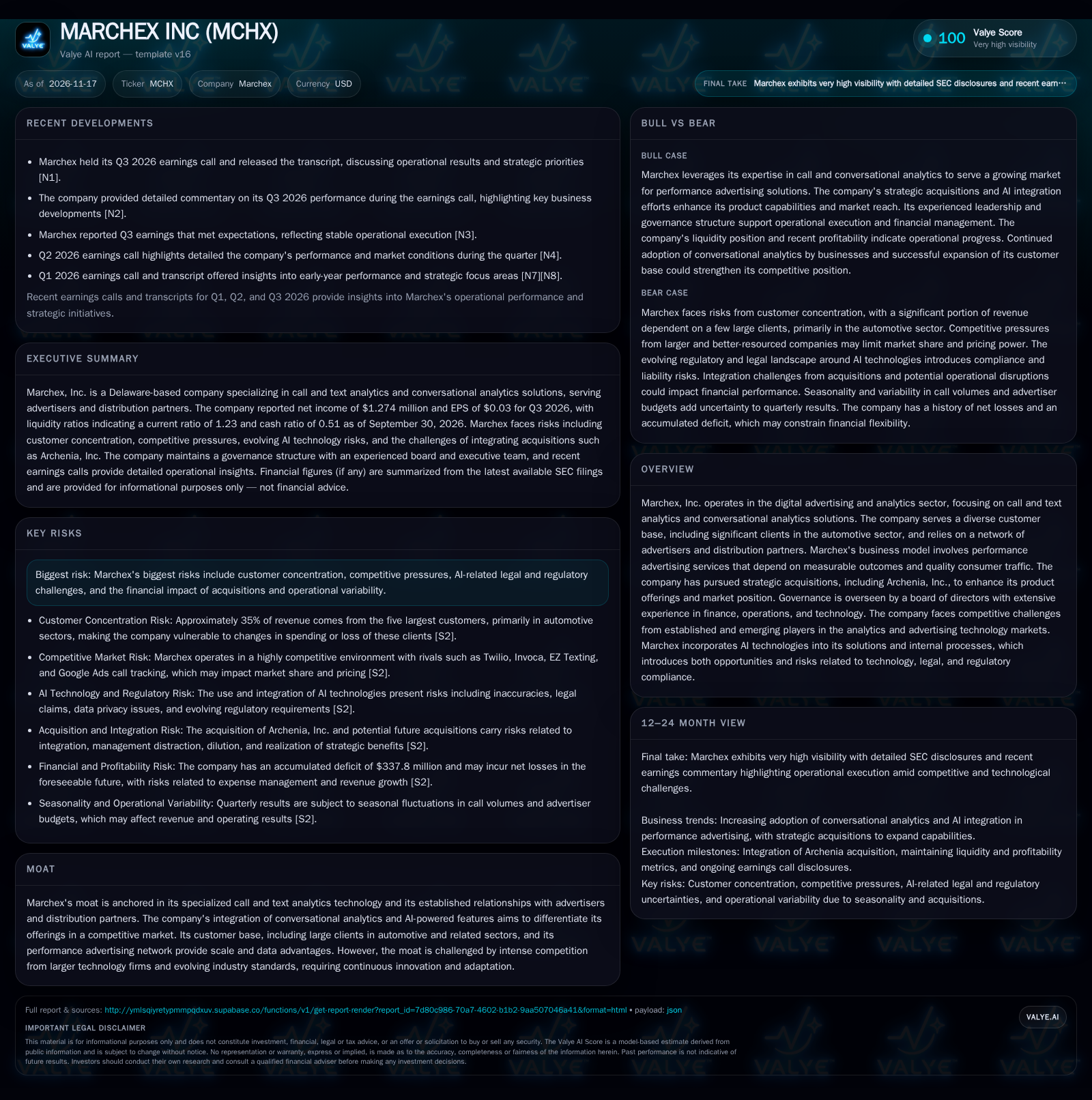
Marchex reported Q3 2026 net income, integrating AI and acquiring Archenia to expand analytics offerings. However, with 35% of revenue tied to its top five customers—mainly in automotive—customer concentration and fierce competition remain significant risks. Sustainable progress will depend on successful integration of acquisitions, further customer diversification, and managing AI-related legal and operational challenges. [S2]
Marchex, a specialist in call and conversational analytics, finds itself at a crossroads in late 2026. The company’s return to profitability and AI-powered product expansion are promising signals for a business that has weathered years of losses and operational challenges. Yet, the heavy weight of customer concentration—especially within the volatile automotive sector—and the shadow of powerful competitors expose Marchex to significant strategic and financial risks. The recent acquisition of Archenia may open new avenues, but the true test will be whether Marchex can translate its operational momentum and technological ambition into a broader, more resilient business model.
Profitability Trends, Customer Concentration, and Strategic Initiatives Define 2026 Outlook
Marchex reported net income of $1.274 million and EPS of $0.03 for Q3 2026, a positive turn after a history of net losses and an accumulated deficit of $337.8 million as of September 30, 2026. This marks a notable operational milestone for the company. [S2]
Approximately 35% of nine-month 2026 revenue came from its five largest customers, with a heavy tilt toward the automotive sector. This concentration exposes Marchex to revenue volatility if any major client reduces spend or churns. [S2]
The company reported cash and liquidity metrics for the period; these figures do not by themselves establish operating runway, investment capacity, financial flexibility, or financing capacity. [S2]
The July 2026 acquisition of Archenia, Inc. signals Marchex’s intent to expand its analytics portfolio and perhaps diversify its customer and vertical mix. [S2]
Marchex’s Revenue and Cost Dynamics Underpinning Economic Leverage
Marchex generates revenue by providing call and text analytics, as well as conversational analytics solutions, to advertisers and distribution partners. The company's value proposition is rooted in performance advertising—helping clients measure, optimize, and prove ROI on their marketing spend, particularly in high-value verticals such as automotive.
Revenue is likely a mix of usage-based or subscription fees, depending on contract structure and client size, though the precise commercial mechanics are not disclosed. In this model, large enterprise clients can drive substantial revenue, but also heighten risk if churn occurs.
The cost structure combines fixed costs—engineering, product development, sales staff, and cloud infrastructure—with variable elements tied to data processing and customer support. As volume grows, Marchex could realize operating leverage through greater utilization of its platform, but this hinges on stable or expanding client relationships.
AI integration may reduce manual analytics labor and improve gross margins, but it also raises R&D costs and introduces new ongoing compliance and data management expenses. Acquisitions like Archenia can accelerate product expansion, but also add integration costs and potential dilution if not accretive.
Positioning Within a Competitive Analytics Market: Balancing Differentiation and Scale
Marchex operates in a highly contested digital analytics space, where barriers to entry for basic call tracking are low, but true differentiation comes from depth of analytics, integration, and actionable insights.
Its primary competition includes specialized analytics providers (like Invoca and EZ Texting), communications platforms (such as Twilio), and digital advertising giants (notably Google Ads call tracking). These competitors often have deeper pockets, stronger brand recognition, and more comprehensive product suites.
Marchex’s edge may lie in its vertical focus—particularly automotive—and in the sophistication of its conversational analytics, especially as AI capabilities are embedded. However, this is a moving target: rivals are also rapidly integrating generative AI, and enterprise customers may prefer holistic solutions from larger vendors or platforms already embedded in their marketing stack.
Switching costs for clients are moderate: while integration and training may create some friction, the prevalence of standardized APIs and the commoditization of basic analytics functions mean that retention depends on continuous innovation and demonstrable ROI.
AI Innovation and Strategic Diversification as Drivers of Potential Value
The most favorable outcome for Marchex would be a successful rollout of advanced AI-driven analytics that demonstrably improve advertisers’ conversion rates and ROI, cementing Marchex as an indispensable partner for data-driven marketing decisions.
If the Archenia acquisition enables entry into new verticals or enhances product breadth, Marchex could diversify its revenue base and reduce dependence on the automotive sector. This, combined with AI-powered automation, could allow for margin expansion even as the company scales.
Evidence that would confirm this scenario includes: a growing share of revenue from new verticals, material increases in average revenue per client, declining customer concentration, and ongoing positive net income. Additionally, public customer endorsements of AI features or new partnerships with large enterprise clients would signal traction.
Conversely, if AI integration results in only incremental product improvements and does not drive measurable client outcomes or retention, the upside would be capped.
Operational Gains Counterbalanced by Dependence on Key Clients and Market Fluctuations
The most plausible near-term scenario is that Marchex maintains modest profitability, supported by its largest customers and incremental gains from AI and acquisition-driven product enhancements.
Revenue remains concentrated, and while the Archenia acquisition and AI features may help win some new accounts, the pace of diversification is gradual. Operating leverage is achieved only if customer retention is stable and cost discipline persists.
This scenario would be confirmed by continued positive but modest net income, stable gross margins, and revenue growth tracking with industry averages. Customer concentration would remain high, and any material churn among top clients would quickly pressure results.
Falsification would come from either a sudden loss of a major client (causing a step-down in revenue) or from an inability to maintain profitability despite topline stability, suggesting rising costs or competitive pricing pressure.
Risks from Customer Attrition, AI and Regulatory Challenges, and Margin Pressure
Adverse outcomes could be triggered by the loss or downsizing of one or more of Marchex’s largest clients, especially if these are in the automotive sector during an industry downturn or amid shifts in digital advertising budgets.
Simultaneously, rapid progress by larger competitors in AI-powered analytics could erode Marchex’s differentiation and pricing, forcing the company into a margin-diluting race to the bottom. If regulatory scrutiny of AI-driven analytics increases, compliance costs or product limitations could rise, further weighing on profitability.
Confirmation of this scenario would include: a sharp decline in revenue and gross margins, a return to net losses, rising R&D or legal expenses tied to AI and data privacy, and disclosures of customer churn or contract non-renewals.
A further warning sign would be if integration costs from acquisitions like Archenia outstrip realized synergies, resulting in negative operating leverage and cash burn.
Factors Influencing Marchex’s Strategic and Financial Development
Quarterly changes in customer concentration—especially the percentage of revenue from the top five clients—would help test whether Marchex is successfully diversifying its base.
Revenue growth and margin trends from newly acquired or AI-enhanced products, if disclosed, would indicate the effectiveness of Marchex’s innovation strategy.
Retention and churn rates among large enterprise customers, if disclosed, would provide insight into competitive pressures and switching frictions.
Updates on regulatory or legal developments related to AI analytics, particularly around data privacy or accuracy, would signal compliance risk and potential cost increases.
Gross margin trends, as a proxy for pricing power and operational efficiency, should be monitored for signs of margin compression or expansion.
Integration progress and realized synergies from the Archenia acquisition—such as cost savings, cross-sell success, or new vertical penetration—would be key milestones.
Disclosures of new partnerships, product launches, or customer endorsements would serve as leading indicators of market acceptance and momentum.
Disclaimer: This is research-only, informational analysis and not investment advice. It may include AI-generated interpretation and general industry context. Always verify important details using primary sources.

Comments