
Traws Pharma: Pipeline Progress and Financing Versus Regulatory and Liquidity Headwinds
Traws Pharma has made progress with its antiviral drug pipeline, notably completing Phase 2 enrollment for Ratutrelvir and securing up to $60 million in financing for its influenza program.
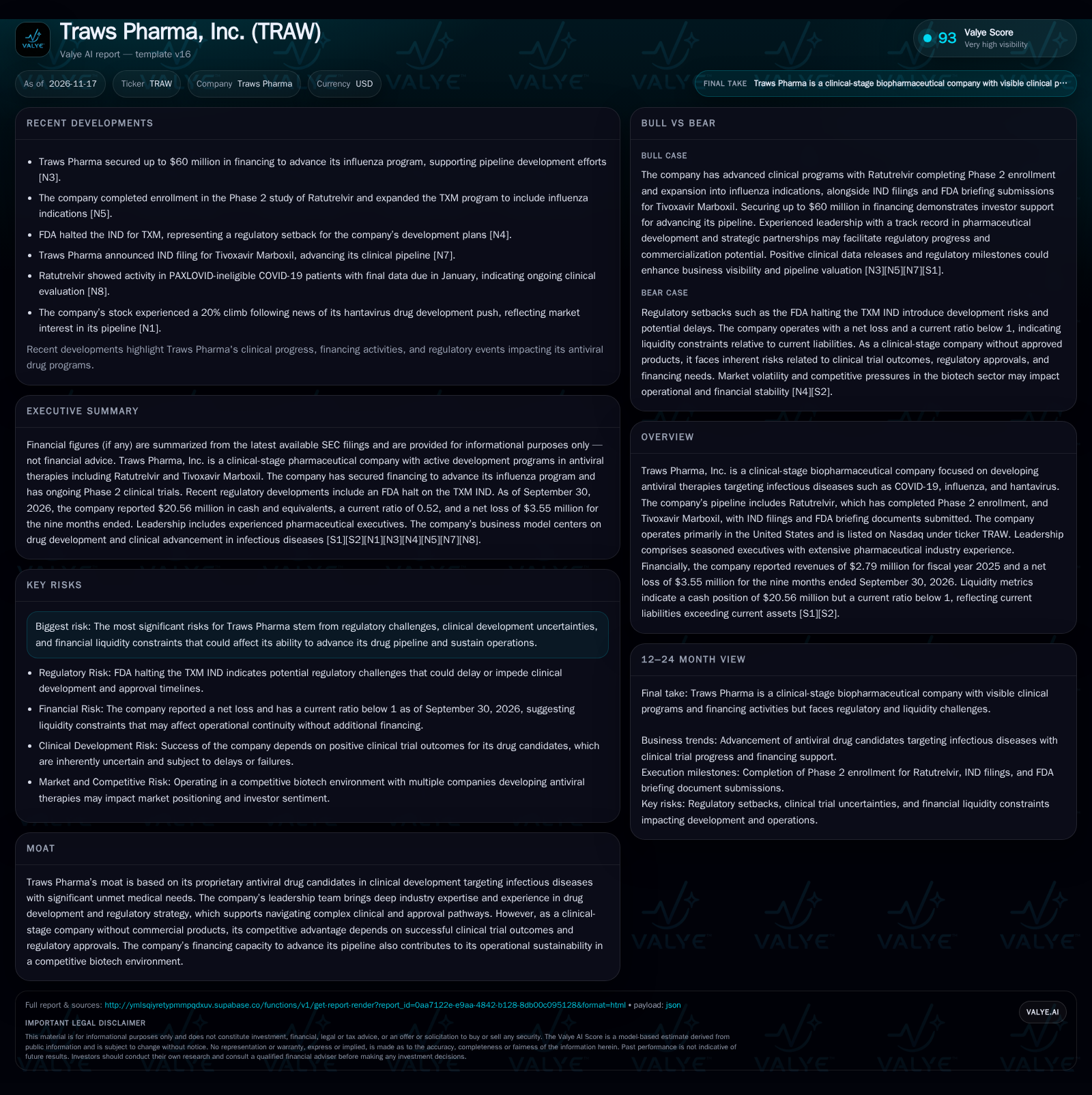
Traws Pharma has made progress with its antiviral drug pipeline, notably completing Phase 2 enrollment for Ratutrelvir and securing up to $60 million in financing for its influenza program. The company’s ability to convert clinical milestones into future revenue hinges on overcoming these setbacks and maintaining funding momentum. [S1] [S2] [N3] [N4] [N5]
Traws Pharma, Inc. is navigating a classic clinical-stage biotech dilemma: the company is advancing a pipeline of antiviral candidates—with Ratutrelvir and Tivoxavir Marboxil targeting high-need infectious diseases—while contending with acute regulatory interruptions and liquidity pressures. The coming quarters will test whether Traws Pharma can leverage its scientific and financial momentum to overcome regulatory barriers and reach value-inflecting milestones, or whether persistent risks will erode its strategic position.
Recent Pipeline Milestones and Continuing Regulatory Setbacks Shape the Outlook
Traws Pharma has completed patient enrollment in a Phase 2 study of Ratutrelvir, marking a significant step in its COVID-19 and influenza clinical program. This progress is matched by the company’s expansion of its TXM program to influenza and the filing of an IND for Tivoxavir Marboxil, signaling an intent to diversify its antiviral portfolio. However, the FDA’s decision to halt the TXM IND has delayed development timelines and underscores the regulatory unpredictability inherent in clinical-stage biotech. Financially, Traws Pharma reported $20.56 million in cash and equivalents as of September 30, 2026, but its current liabilities substantially exceed current assets (current ratio 0.52), raising questions about near-term liquidity. The company also raised up to $60 million in financing to propel its influenza program, indicating some investor confidence even amid setbacks. [S1] [S2] [N3] [N4] [N5] [N7] [N8]
How Traws Pharma’s Clinical-Stage Model Could Convert Pipeline into Value
Traws Pharma’s economics are shaped by the high fixed costs of drug development, with variable expenses driven by clinical trial scale and regulatory requirements. Revenue to date remains minimal ($2.79 million in 2025), consistent with a business not yet commercializing products. The company’s immediate financial needs are dominated by R&D, regulatory filings, and trial execution, which typically require external capital until a product achieves approval and market entry. The up-to-$60 million financing suggests an ongoing dependence on equity or structured financings, rather than internally generated cash flows. If clinical success is achieved, the company’s value proposition would hinge on out-licensing, strategic partnerships, or direct commercialization—each with distinct margin profiles, up-front payments, and potential for milestone-based revenue. Operating leverage could be significant if a lead asset is approved, as incremental revenue from drug sales tends to outpace increases in SG&A and manufacturing costs, but this inflection is only realized post-approval. Until then, capital discipline and access are paramount.
The capital-intensive nature of Traws Pharma’s clinical-stage operations necessitates a finely tuned balance between expenditure and financing strategy. Given the inherent uncertainty in drug development timelines and outcomes, the company’s ability to manage cash burn while optimizing trial design and patient recruitment efficiency will be critical. Moreover, the choice between equity dilution and structured debt or royalty-based financing has implications for long-term shareholder value and operational flexibility. If disclosed, a useful metric would be the company’s burn multiple, which measures capital efficiency relative to clinical progress. Strategic decisions around prioritizing assets within the pipeline could also materially affect capital allocation, especially if certain candidates demonstrate earlier signs of clinical viability or market differentiation.
Competitive Pressures and the Challenge of Differentiation in Antiviral Therapeutics
Traws Pharma operates in a fiercely competitive antiviral landscape, where established companies and numerous clinical-stage peers are targeting COVID-19, influenza, and emerging infectious diseases. Its competitive edge currently rests on the novelty and clinical performance of Ratutrelvir and Tivoxavir Marboxil, as well as management’s experience navigating regulatory processes. However, larger pharmaceutical companies possess greater financial resources, broader pipelines, and established commercial infrastructure—making speed to market and differentiated clinical data critical for Traws. The regulatory setback with TXM highlights how quickly competitive positioning can erode if development is delayed. In this environment, successful differentiation often requires not only strong efficacy and safety data, but also targeting populations underserved by existing therapies, or demonstrating clear advantages over standard-of-care treatments. The company’s ability to form partnerships or attract licensing deals may depend on achieving such clinical differentiation.
In the antiviral therapeutic space, differentiation extends beyond clinical efficacy to encompass intellectual property positioning and regulatory strategy. Traws Pharma’s ability to secure robust patent protection for its compounds and formulations can create barriers to entry and enhance licensing attractiveness. Additionally, navigating expedited regulatory pathways, such as emergency use authorizations or priority review vouchers, could accelerate time to market and improve competitive positioning. However, these pathways often require clear demonstration of unmet medical need or superiority over existing therapies, underscoring the importance of targeted clinical trial design. The company’s scale also limits its capacity to compete on global commercial reach, making strategic partnerships not only a source of capital but also essential for market access and distribution.
If Clinical and Regulatory Breakthroughs Accelerate, Pipeline Value Could Be Unlocked
A favorable scenario for Traws Pharma would see resolution of the TXM IND hold and the release of positive Phase 2 data for Ratutrelvir—especially if these results show efficacy in patient populations not adequately addressed by current antivirals. In this case, the company could secure additional non-dilutive funding through partnerships or grants, and potentially negotiate licensing agreements with larger pharmaceutical firms. Evidence that would confirm this scenario includes: FDA clearance to resume TXM trials, strong clinical data demonstrating superiority or complementary efficacy to existing drugs, and announcements of partnership or out-licensing deals. Milestone-based payments or upfront license fees could materially improve liquidity and extend runway, setting the stage for late-stage trials or even accelerated approval pathways.
Incremental Progress with Ongoing Financing and Regulatory Hurdles Likely to Persist
The most plausible path for Traws Pharma is continued incremental progress on its clinical programs, punctuated by periodic regulatory and funding challenges. The company may advance Ratutrelvir and Tivoxavir Marboxil through subsequent trial phases, but will likely require additional dilutive or structured financing to bridge to potential pivotal data. Regulatory dialogue may yield eventual resolution of the TXM IND hold, but such processes often extend timelines and consume further resources. Confirming evidence would include steady clinical enrollment, timely data releases, and periodic financing announcements. Conversely, persistent delays in regulatory feedback, slow trial enrollment, or lack of new funding would undermine this scenario. The company’s ability to maintain investor confidence through visible milestones is likely to be a key determinant of its survival and valuation trajectory.
Under this scenario, the timing and magnitude of future financing rounds will be pivotal in sustaining operations and advancing clinical programs. The company’s ability to demonstrate incremental clinical data that de-risks its assets will influence investor appetite and valuation. Additionally, regulatory interactions that clarify requirements for pivotal trials or approval criteria can reduce uncertainty and improve planning. However, the protracted nature of clinical development means that even with progress, cash flow remains negative for an extended period, requiring disciplined expense management. If disclosed, monitoring changes in operating expenses relative to clinical milestones would help assess capital efficiency. The interplay between clinical progress and financing terms will ultimately shape the company’s runway and strategic options.
Regulatory Delays and Liquidity Shortfalls Could Force Strategic Retrenchment
A less favorable outcome materializes if the FDA maintains the TXM clinical hold for an extended period, or if Ratutrelvir’s Phase 2 data prove inconclusive or negative. In this scenario, Traws Pharma could struggle to raise additional capital—especially with a current ratio below 1 and ongoing net losses. Extended regulatory delays would increase burn rates, potentially forcing the company to suspend certain programs, pursue asset sales, or seek a strategic merger under distressed terms. Evidence supporting this scenario would include continued lack of regulatory progress, negative or equivocal clinical results, and an absence of new financing announcements. Deteriorating liquidity could also manifest in workforce reductions or public statements about ‘strategic alternatives’.
Milestones and Metrics That Will Determine Traws Pharma’s Strategic Trajectory
Resolution or continued status of the FDA clinical hold on TXM, and any guidance from regulatory agencies regarding next steps.
Release of final Phase 2 data for Ratutrelvir, particularly efficacy and safety outcomes in targeted patient populations.
Announcements of new financing rounds, partnership agreements, or non-dilutive funding, which would directly impact runway and operational flexibility.
Updates on clinical trial enrollment rates and timelines for Tivoxavir Marboxil and other pipeline programs.
Changes in cash and equivalents and current liability profile in subsequent financial disclosures.
If disclosed, burn rate projections and management commentary onreported liquidity position and capital allocation priorities.
Evidence of licensing discussions or collaboration agreements with larger pharmaceutical companies.
Disclaimer: This is research-only, informational analysis and not investment advice. It may include AI-generated interpretation and general industry context. Always verify important details using primary sources.

Comments