
Nocera, Inc.: Navigating Default, Diversification, and the Search for Sustainable Profitability
Nocera, Inc. faces acute financial and operational uncertainty as it seeks to transform from a niche trading and aquaculture player into a diversified, technology-focused holding company. Despite reported liquidity position, the company’s defaulted debt, persistent losses, and going concern warning underscore the urgency of achieving profitable scale or securing new capital.
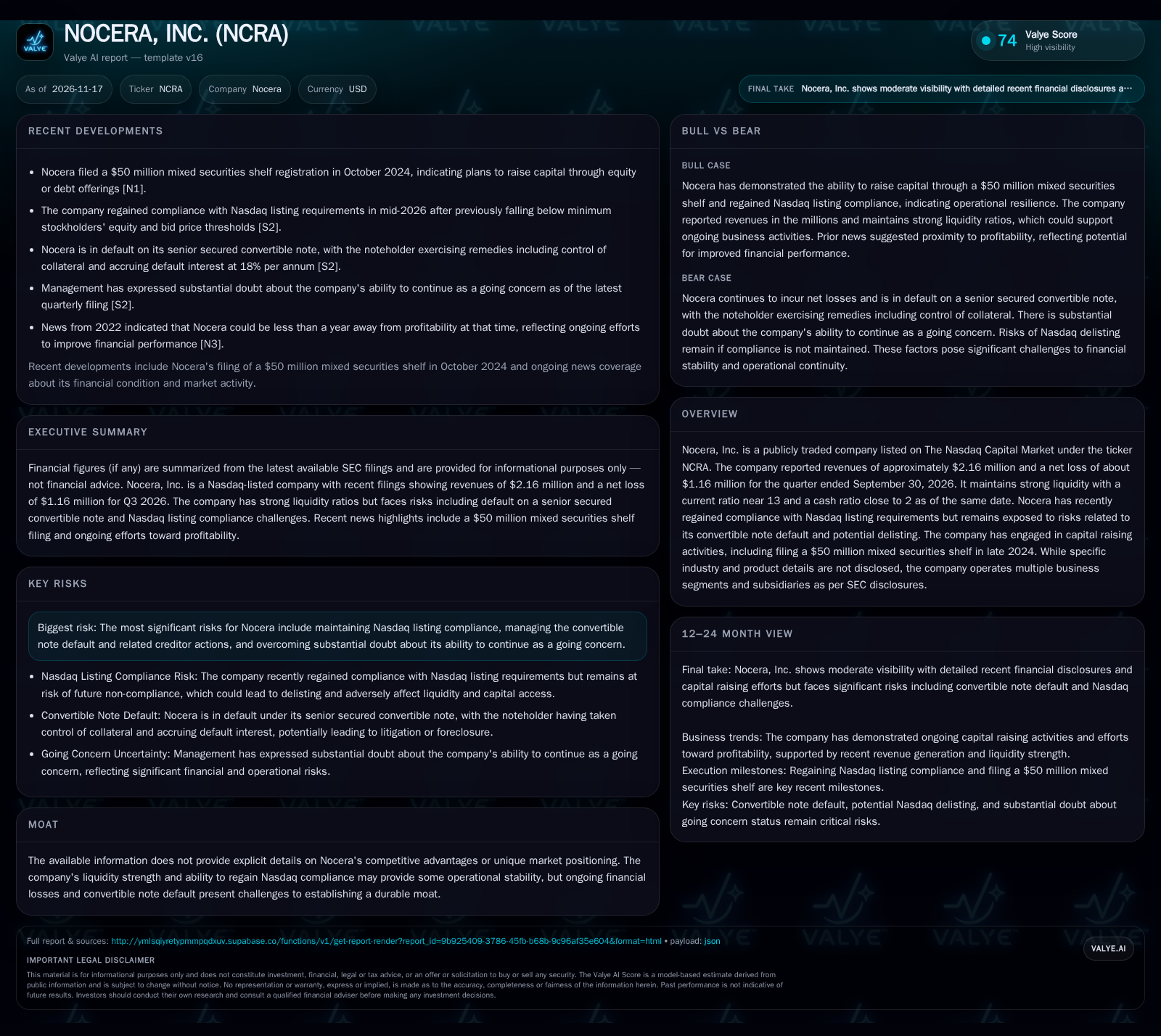
Nocera, Inc. has regained Nasdaq compliance and maintains reported liquidity position, but remains in default on a senior secured note and continues to post quarterly losses. The company is attempting to reposition itself as a diversified technology holding entity, yet faces substantial doubt about its ability to continue as a going concern, making future funding and execution on its strategic ambitions critical to its survival. [S2] [N1]
The company’s recent return to Nasdaq compliance follows a period of financial distress, yet its ongoing net losses, defaulted convertible debt, and management’s explicit going concern warning highlight the gravity of its situation. Nocera’s attempt to reposition itself as a diversified, technology-focused holding company may offer new growth pathways, but absent immediate operational profitability or fresh capital, the risk of further distress—including delisting and creditor action—remains uncomfortably high. [S2] [N1]
Default, Compliance, and Strategic Transformation: Recent Facts that Set the Stage
Nocera reported $2.16 million in revenue and a net loss of $1.16 million for Q3 2026, extending its history of operating losses.Despite holding $1.02 million in cash and maintaining a reported current ratio of 12.98 at quarter end, the company is in default on its senior secured convertible note. The lender has exercised remedies, including taking control of a custodial account and charging default interest at 18% per annum, with further actions such as litigation or foreclosure possible. Nocera has also only recently regained compliance with Nasdaq listing requirements after previously falling below minimum equity and bid price thresholds, but remains at risk of future non-compliance and potential delisting. Management has formally stated substantial doubt about the company’s ability to continue as a going concern. [S2]
Strategically, Nocera is attempting to diversify beyond its legacy fish trading, e-commerce, and electronic components trading segments, aiming to become a technology-focused holding company with interests in AI, data centers, edge computing, and energy. However, the current revenue base remains concentrated in lower-margin trading activities, and the transition to higher-value technology segments is still at an early stage. [S2]
How Nocera’s Economic Model Could Shift—and Why Margins Are Under Strain
Nocera’s historical business lines—fish trading, e-commerce facilitation, and electronic components trading—are typically characterized by thin gross margins, high working capital requirements, and exposure to commodity price volatility. In these segments, pricing power is limited, and profitability hinges on scale, operational efficiency, and supply chain management. The company’s quarterly revenues of $2.16 million have not been sufficient to offset operating expenses, as evidenced by the persistent net losses and negative operating cash flow. [S2]
The company’s pivot toward technology—specifically AI infrastructure, data centers, and energy storage—could, if executed, provide access to higher-margin, more defensible business models. These sectors often offer recurring revenue streams (e.g., from SaaS, colocation, or power purchase agreements) and the potential for operating leverage once fixed costs are covered. However, capital intensity is typically higher, and success requires significant upfront investment, technical expertise, and an ability to attract major customers or partners. At present, there is no evidence that Nocera has achieved material scale or profitability in these new verticals, and the cost of transition could exacerbate near-term losses unless matched by new capital or rapid revenue growth.
Competitive Realities: From Commodity Trading to Technology Holding Aspirations
In fish trading and electronic components, Nocera competes in fragmented, highly competitive markets where barriers to entry are low and price competition is fierce. Success is often dictated by relationships, logistics efficiency, and the ability to manage currency and commodity risk. E-commerce agency activities, particularly through live-streaming sales in China, face intense competition from both local incumbents and digital giants, making margin expansion difficult.
The company’s stated ambition to move into AI, data centers, and energy storage introduces a new set of competitors—ranging from large, well-capitalized technology firms to specialized infrastructure providers. These sectors are characterized by high technical and financial barriers, rapid innovation cycles, and customers who demand reliability, security, and scale. Without a clear differentiator—such as proprietary technology, unique assets, or exclusive partnerships—Nocera may struggle to establish a durable moat. The current absence of disclosed anchor customers, proprietary assets, or recurring contracts in these new segments suggests the company is still in the early phases of building a competitive position.
What Could Drive a Turnaround: Capital, Scale, and a Successful Pivot
The most favorable scenario for Nocera would involve successfully raising new capital—potentially via its $50 million mixed securities shelf—enabling the company to invest in scaling higher-margin technology businesses while stabilizing its balance sheet. If Nocera can convert its technology aspirations into tangible operations—such as launching a commercially viable AI infrastructure service, securing recurring contracts in data centers, or developing proprietary energy storage solutions—revenue mix would shift away from low-margin trading toward more sustainable, higher-margin businesses.
Confirmation of this scenario would require evidence of significant capital raising, rapid revenue growth in new business lines, and early signs of operating leverage (e.g., declining losses or a move toward breakeven). Winning a major customer contract, announcing a joint venture with a technology leader, or demonstrating a backlog of committed orders in a new vertical would be strong positive signals. Conversely, inability to attract capital or a lack of traction in new segments would quickly falsify this upside.
Stalled Transition: Incremental Progress but Persistent Losses
The most plausible near-term outcome is that Nocera continues to generate modest revenues from its legacy trading and e-commerce segments while making slow, uncertain progress in technology diversification. Operating losses persist due to limited scale, competitive pricing pressure, and the costs associated with attempting to enter new markets. The company may pursue small-scale pilot projects or partnerships in AI and energy, but without substantial new capital or a step-change in execution, these efforts are unlikely to materially improve the bottom line in the next 12-24 months.
Evidence confirming this scenario would include continued quarterly losses, modest revenue growth without a shift in segment mix, and an absence of major new contracts or customers in the technology verticals. If Nocera remains in compliance with Nasdaq but does not resolve its note default or demonstrate sustained profitability, this base case would be reinforced.
Liquidity Crunch or Delisting: How Adverse Events Could Trigger a Spiral
The negative scenario centers on the risk that Nocera is unable to raise additional capital, prompting an accelerated liquidity crunch as operating losses and creditor actions mount. With the senior secured note in default, the lender could pursue litigation, foreclosure, or force asset sales, further destabilizing operations. If the company fails to maintain Nasdaq compliance—due to continued net losses, declining equity, or a sustained drop in share price—delisting could occur, severely limiting capital market access and further eroding stakeholder confidence.
Confirmation of downside risk would come from deepening net losses, deteriorating liquidity, announcements of legal action or asset seizures by creditors, or a formal delisting notice from Nasdaq. Any inability to service payables, meet payroll, or retain key personnel would also be red flags for imminent distress.
Milestones That Will Determine Whether Nocera’s Pivot Becomes Viable
Progress on resolving or restructuring the defaulted senior secured convertible note, including any forbearance, settlement, or refinancing.
Evidence of successful capital raising—such as takedowns from the $50 million shelf registration, new debt or equity financings, or strategic investor participation.
Quarterly revenue mix by segment: tracking whether technology and higher-margin businesses begin to contribute meaningfully to top-line growth (if disclosed).
Gross margin trends and operating expense discipline, especially as new business lines are launched or scaled (if disclosed).
Nasdaq listing status: updates on compliance, minimum equity levels, and bid price thresholds.
Announcement of new partnerships, customer contracts, or strategic alliances in AI, data center, or energy segments.
Cash burn and operating cash flow: whether negative cash flow moderates or accelerates as the business model evolves (if disclosed).
Management commentary about going concern status and any updated guidance on profitability timelines.
Disclaimer: This is research-only, informational analysis and not investment advice. It may include AI-generated interpretation and general industry context. Always verify important details using primary sources.

Comments