
All In FutureTech Alliance: Ecosystem Ambition at the Intersection of Gaming, AI, and Experiential Entertainment
All In FutureTech Alliance, Inc. (AGAE) is executing a multi-pillar expansion strategy that fuses physical esports venues, mobile gaming, digital content, and emerging technology investments.
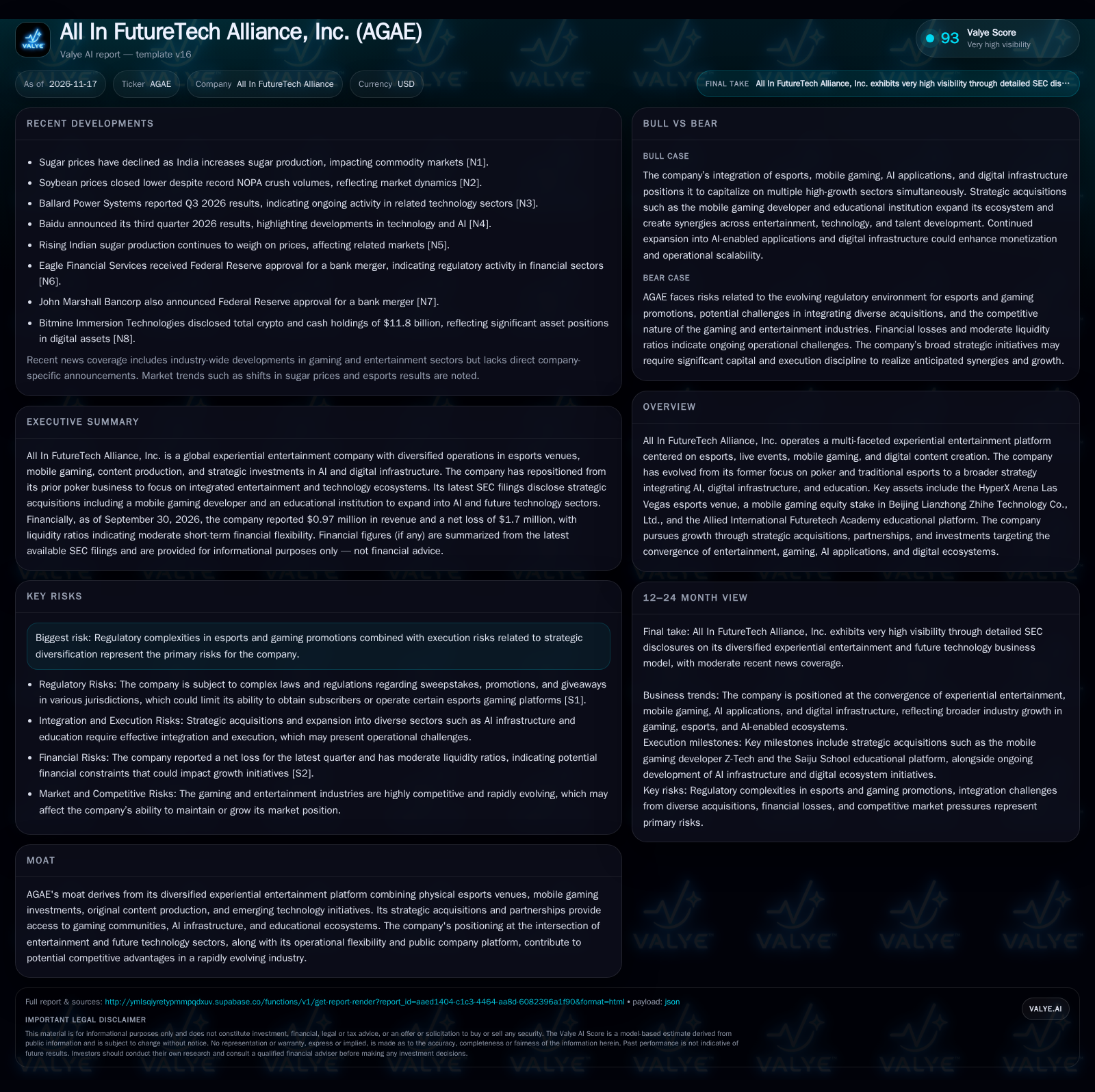
AGAE is building a broad entertainment and technology ecosystem spanning esports venues, mobile gaming, content creation, AI, and education. Recent acquisitions—a controlling stake in a mobile game developer and a Japanese educational institution—signal its intent to develop synergistic platforms but also add integration complexity. With modest revenue and continued losses, the near-term thesis pivots on the company’s ability to monetize its assets and execute on cross-vertical expansion.
All In FutureTech Alliance, Inc. is pursuing a high-conviction strategy to build an experiential entertainment and technology ecosystem at the convergence of esports, mobile gaming, AI, and education. Through recent controlling investments in a Chinese mobile game developer and a Japanese educational institution, AGAE is positioning itself to serve younger, digitally native audiences and tap into emerging monetization models. Yet, with modest current revenue and persistent losses, the company’s ability to translate its platform breadth into sustainable profit and growth remains unproven—making execution, integration, and capital allocation central to the near-term investment thesis.
Strategic Acquisitions and Financial Snapshot Define the Near-Term Landscape
AGAE’s recent acquisition of a 40% equity stake and board control in Beijing Lianzhong Zhihe Technology Co., Ltd. (Z-Tech) marks a material shift towards mobile gaming, granting direct influence over a casual gaming developer with a foothold in the large Chinese market. This complements the November 2025 purchase of Saiju School in Japan, which is being transformed into the Allied International Futuretech Academy—an education platform integrating esports, content creation, AI, and gaming technologies [S1].
These facts matter because they highlight both the breadth of AGAE’s strategic ambition—spanning gaming, education, and digital infrastructure—and the company’s ongoing need to demonstrate that such investments can be integrated and monetized efficiently.
How the Platform Could Monetize: Multi-Pronged Revenue Streams and Operational Leverage
AGAE’s business model aspires to generate revenue from multiple streams: venue operations (ticketing, event hosting, sponsorships), mobile gaming (in-app purchases, advertising, licensing), content production (media rights, branded content, distribution), and education (tuition, partnerships, digital courseware). Additional upside could come from investments in AI infrastructure, digital ecosystems, and potential token-enabled platforms—if these are successfully commercialized.
The economics of esports venues and live events are typically high fixed-cost (leases, staffing, production) with variable revenue tied to event traffic and sponsorships; scale is critical for margin expansion. Mobile gaming offers more variable cost structure and can be highly scalable if user acquisition costs are contained, but competition for engagement is fierce and monetization per user varies widely.
The integration of education (via the Futuretech Academy) introduces a subscription/tuition model with potential for digital scale but also requires upfront content and curriculum investment. AGAE’s forays into AI infrastructure and digital infrastructure services could, if realized, provide higher-margin B2B or B2B2C revenue, but these remain strategic options rather than proven contributors. The company’s persistent net losses suggest that operating leverage has yet to be achieved, and capital needs may remain elevated as the platform expands.
Competing for Relevance: Ecosystem Play Versus Focused Rivals
AGAE’s competitive set spans global esports venue operators, mobile game publishers, digital content studios, and emerging edtech and AI infrastructure players. Large, vertically integrated gaming companies and pure-play mobile game studios often have scale, brand, and user acquisition advantages. Meanwhile, traditional esports operators and event companies may be more agile or have deeper relationships with sponsors and publishers.
AGAE’s edge could stem from its diversified platform—cross-pollinating audiences across live events, mobile gaming, content, and education—and its early moves into AI and digital infrastructure. However, such breadth risks dilution of focus and execution complexity. The company’s ability to create unique user experiences, leverage data and creator networks, and build high-retention communities will be central to its defensibility.
Switching frictions for consumers in both gaming and education are typically low unless there is a compelling content, community, or credentialing advantage. The question is whether AGAE’s cross-vertical integration can deliver a differentiated ecosystem that retains users and attracts partners in a highly competitive landscape.
Synergies Across Gaming, Education, and AI Drive Ecosystem Monetization
A favorable outcome would see AGAE successfully integrating Z-Tech’s mobile gaming portfolio with its live event and content infrastructure, using cross-promotion to drive user acquisition and engagement across platforms. The Futuretech Academy could become a feeder for both talent and content, creating a virtuous cycle where educational offerings build brand loyalty and seed new creators, players, and technologists for AGAE’s events and media.
If AGAE can leverage early investments in AI infrastructure and digital ecosystems to offer unique experiences—such as AI-driven game design, personalized content, or tokenized fan engagement—it could unlock new monetization models and higher-margin revenue streams.
Evidence supporting this scenario would include accelerating revenue growth from cross-platform initiatives, rising user engagement and retention across gaming and educational verticals, successful launch of new AI/digital ecosystem products, and improving margins as operating leverage takes hold.
Incremental Integration Progress Amid Competition and Execution Hurdles
The most plausible near-term path is one of gradual integration—AGAE incrementally combining its acquired assets while navigating the complexities of operating across multiple sectors and geographies. Revenue may grow modestly as synergies between live events, mobile gaming, and education are realized, but persistent competition and high fixed costs in venues and content production could keep margins under pressure.
Operating losses may continue unless the company demonstrates clear monetization of its cross-vertical offerings and effective cost control. The success of the Futuretech Academy and Z-Tech integration will likely be mixed, with some wins in audience growth or partnership development but offset by investment and integration costs.
Confirming this scenario would be stable or slightly improving revenue, continued but narrowing losses, and evidence of operational discipline—such as cost containment, selective investment, or pruning of underperforming initiatives.
Integration Strains and Cash Burn Outpace Monetization
In an adverse scenario, AGAE struggles to integrate its acquisitions, leading to fragmented operations, missed cross-promotion opportunities, and dilution of management focus. Regulatory challenges in esports or gaming promotions—especially across jurisdictions—could restrict core operations or add compliance costs.
Persistent operating losses and reported liquidity position could become acute if revenue growth stalls, forcing the company to scale back initiatives, raise dilutive capital, or divest assets. Competitive pressure from focused mobile gaming studios, established esports operators, or well-funded edtech and AI infrastructure players could erode AGAE’s share of user attention and sponsorship dollars.
Downside confirmation would include declining or stagnant revenue, widening net losses, cash burn accelerating faster than asset growth, or announcements of restructuring, asset sales, or emergency financing.
What Will Reveal Whether AGAE’s Ecosystem Strategy Can Deliver Sustainable Growth?
Revenue growth and mix across core verticals—esports, mobile gaming, content, and education—would help test whether the multi-pillar strategy is gaining commercial traction.
Gross margin trends, if disclosed, to assess whether incremental scale is translating to improved unit economics or if fixed costs are constraining profitability.
Cash flow from operations and net cash burn rate, as continued losses may require additional financing or asset sales if not contained.
User acquisition, active user retention, and engagement metrics for both Z-Tech’s mobile games and the Futuretech Academy would signal ecosystem health.
Progress on AI infrastructure and digital ecosystem launches—such as new products, partnerships, or monetization milestones—would clarify the pace of expansion beyond legacy entertainment.
Integration milestones: evidence of cross-platform promotions, bundled offerings, or shared technology stacks between acquired businesses.
Updates on regulatory or compliance costs, particularly in jurisdictions with complex gaming and esports laws, as these could impact scalability.
Any announced partnerships, joint ventures, or new investments that expand or clarify the company’s competitive positioning and ability to monetize its platform.
Disclaimer: This is research-only, informational analysis and not investment advice. It may include AI-generated interpretation and general industry context. Always verify important details using primary sources.

Comments