
Bloomin' Brands Rebounds with Sharp Profit Growth Despite Liquidity Challenges
The casual dining operator reported a robust turnaround in operating income and net profit for fiscal 2025 while managing complex capital structure dynamics.
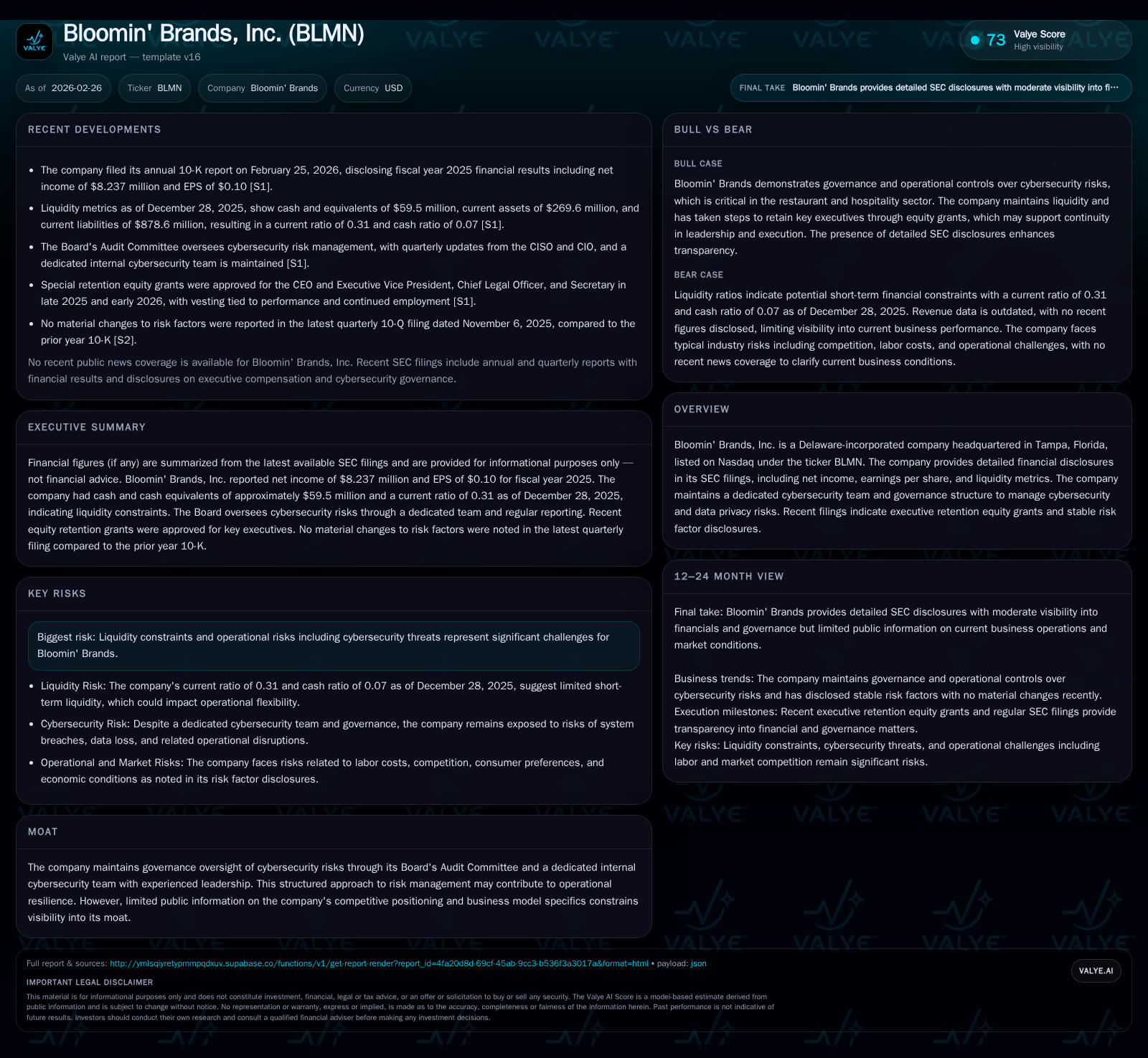
Bloomin' Brands, Inc. showcased a significant recovery in profitability in 2025, with operating income and net earnings improving markedly from the prior year. This rebound follows a period of notable losses and reflects operational adjustments and cost management. Despite these gains, liquidity ratios remain tight due to elevated current liabilities, warranting attention to working capital and debt servicing capacity. The company’s capital allocation favored dividends over share repurchases in 2025, marking a shift from earlier years. Cybersecurity risk management remains a priority supported by experienced leadership and formal governance structures.
Historical Performance: Recovery Following Volatile Earnings
Bloomin' Brands has demonstrated considerable volatility in its financial results over recent years. Revenue hovered close to $1 billion back in 2018 ($1.013 billion[F1]), consistent with figures going back to at least 2015, indicating a relatively stable top line without meaningful growth.
Operating income presents a narrative of recovery: falling dramatically through early 2020s but rebounding sharply to $37.16 million in fiscal 2025 from just $16.2 million the prior year[F1]. Net income shifted from a significant loss of approximately -$128 million in 2024 back into modest positive territory ($8.24 million in 2025)[F1]. These swings highlight an operating environment challenged by external factors (including pandemic repercussions) but suggest successful turnaround initiatives starting materializing results.
Operating cash flow followed suit improving by over 21% year-over-year to $276.7 million for the full year of 2025[F1], supporting liquidity somewhat though still strained given balance sheet composition.
Historical performance (annual)
| FY | Net ($mm) | CFO ($mm) | OpInc ($mm) | Capex ($mm) | Net YoY |
|---|---|---|---|---|---|
| 2025 | 8 | 277 | 37 | 180 | +106.4% |
| 2024 | -128 | 228 | 16 | 221 | -151.7% |
| 2023 | 247 | 532 | 325 | 324 | +142.8% |
| 2022 | 102 | 391 | 330 | 220 |
Source: SEC companyfacts cache [F1].
Capital returns and efficiency (annual)
| FY | Div ($mm) | Buybacks ($mm) | FCF ($mm) |
|---|---|---|---|
| 2025 | 38 | 0 | 97 |
| 2024 | 83 | 266 | 7 |
| 2023 | 84 | 71 | 208 |
| 2022 | 50 | 109 | 171 |
Source: SEC companyfacts cache [F1].
Note: Revenue is available only for historical periods; operating income and net income show volatility due primarily to operational challenges and non-cash charges.
Future Growth Prospects and Constraints
While the top line shows stability around pre-pandemic levels without clear growth indicators, improvement in profitability suggests operational efficiencies or cost controls enacted internally are paying off as per latest SEC releases[S1][S3]. The company’s continued focus on cybersecurity risk governance—led by veterans with decades of experience—and stringent oversight through its Audit Committee may bolster operational resilience amid increasing digital threats[S1][S7].
However, Bloomin’ Brands faces liquidity constraints highlighted by its low current ratio (~0.31), driven by substantially higher current liabilities relative to current assets as of fiscal year-end[F1]. This indicates pressure on working capital management which could cap agility for expansion or cushion against market disruptions.
Additionally, cash deployed toward dividends was cut nearly by half compared with prior year levels while share buybacks ceased altogether in fiscal '25 after high volumes in '24[F1][S15][S17]. This pivot may reflect prioritization of liquidity preservation amid ongoing debt obligations and capital expenditure needs.
Capital Allocation and Returns
Return on equity remains low at approximately 2.5% given reversion to small net profits relative to equity base of $333.6 million at end of last fiscal year[F1]. Free cash flow remains positive (~$96.8 million), backed by strong operating cash flows partially offset by substantial capital expenditures focused likely on maintenance or strategic remodeling projects reported earlier[F1].
Dividend payouts indicate shareholder returns are maintained but scaled back significantly, reflecting a cautious stance amid financial improvements yet operational uncertainties[S15][S20]. No buybacks occurred during the latest reporting period breaking prior trends further emphasizing conservative cash deployment.
Recent executive retention grants approved include multi-year restricted stock units with vesting tied to performance milestones such as comparable sales growth and adjusted EBITDA targets[S15][S17][S23], signaling management’s alignment with sustainable operational improvements.
Governance and Risk Management Highlights
Cybersecurity remains prominent within risk disclosures, with Management's commitment observable through board-level oversight mechanisms involving quarterly updates from Chief Information Security Officer and CIO leadership[S1][S7]. The cybersecurity team includes exclusively company employees handling diverse functions such as PCI DSS compliance and incident response protocols.
Notably, no material changes have been indicated regarding other corporate risk factors since the prior annual reports; however, ongoing concerns regarding commodity pricing inflation, labor availability, regulatory compliance, and political risks remain relevant[S2][S6][S4].
Moreover, new board appointments bringing seasoned leadership from fitness and hospitality sectors indicate thoughtful enhancements along governance dimensions intended to support scalable growth strategy execution and oversight quality[S23][S24].
What To Watch / Analysis
- Monitoring trends in liquidity is essential given the low current ratio; any deterioration could impact debt servicing and operational funding.
- Management’s ability to sustain profitability gains hinges on navigating labor cost pressures and commodity price volatility.
- Capital allocation focus may continue favoring dividend payments over buybacks unless liquidity improves further.
- Progress against performance-based compensation targets for senior executives can provide signals on underlying business momentum.
- Impact of cybersecurity program enhancements on operational continuity will be a key intangible factor influencing investor confidence.
Disclaimer: This report provides an analytic summary based solely on publicly filed regulatory documents without offering investment advice or recommendations related to Bloomin’ Brands’ securities or business prospects.
Disclaimer: This is research-only, informational analysis and not investment advice. It may include AI-generated interpretation and general industry context. Always verify important details using primary sources.

Comments