BitMine Immersion Technologies’ Strategic Shift to Ethereum Services Amid $6B ETH Losses
BitMine Immersion Technologies pivots from mining to an asset-light Ethereum-focused model, facing significant unrealized losses while expanding staking and advisory services.
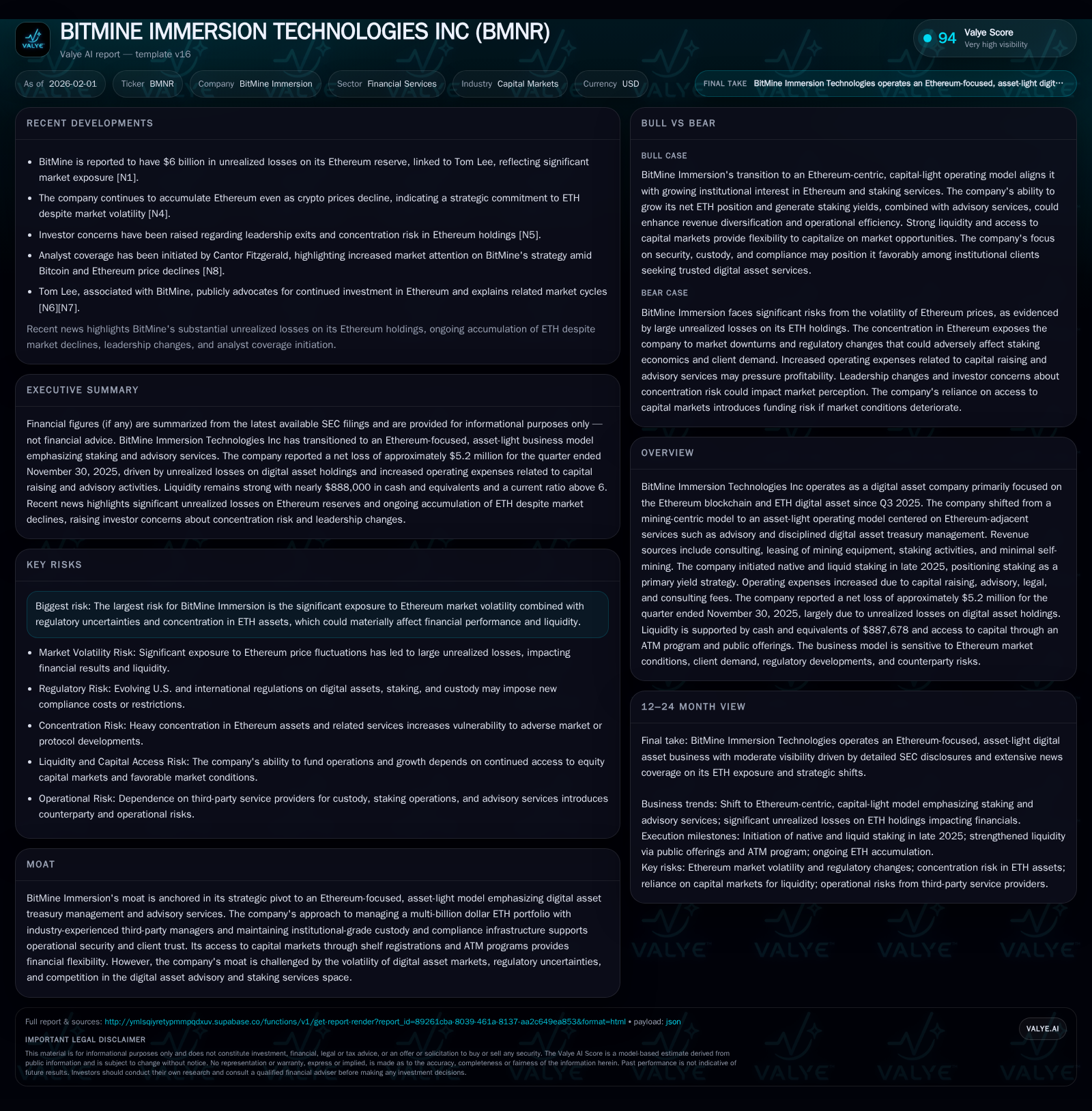
BitMine Immersion Technologies (BMNR) has transitioned from a mining-centric operation to an asset-light, Ethereum-focused platform emphasizing staking and advisory services since Q3 2025. The company reported a substantial $5.2 million net loss in Q3 2025, primarily driven by $6 billion in unrealized losses on its ETH holdings amid volatile market conditions. Despite these headwinds, BitMine continues to increase its Ethereum exposure and staking activities, supported by liquidity from equity raises and a flexible cost structure. Regulatory uncertainties, market volatility, and concentration risk remain critical challenges in realizing sustainable profitability.
What Changed Recently
BitMine Immersion Technologies, trading as BMNR, has undergone a notable strategic pivot in 2025, transitioning away from its legacy mining-centric business model toward an asset-light, Ethereum-focused services platform. This shift, initiated in the third quarter of 2025, reorients the company’s core activities around Ethereum-adjacent offerings including advisory, disciplined digital asset treasury management, staking (both native and liquid), and leasing of mining equipment to third parties [S1, S3].
However, the strategy coincides with a turbulent market environment. As of early 2026, BitMine’s Ethereum holdings have incurred an estimated $6 billion in unrealized losses due to depressed ETH prices, contributing to a net loss of approximately $5.2 million in the latest quarter [N1, N2, N6, S8]. Despite this, management has doubled down on staking by adding $440.5 million worth of ETH to its staked assets recently, signaling conviction in Ethereum’s long-term prospects [N4, N7].
Simultaneously, the company has bolstered liquidity through equity raises, including an underwritten public offering and an ATM program with Cantor Fitzgerald & Co. and ThinkEquity LLC, enabling access to up to $20 billion in common stock sales, of which $4.6 million remains available as of November 2025 [S6, S8, S14]. Leadership changes, including a new CEO and CFO appointed in late 2025 and early 2026, have added attention to governance and execution risks [S6, N8].
Business Model as a System
BitMine Immersion’s evolved business model centers on Ethereum and related digital assets, leveraging a multi-pronged approach:
Digital Asset Treasury Management: The company maintains a significant Ethereum reserve, aiming to grow net ETH holdings over time through opportunistic acquisitions and staking. Treasury risk is managed conservatively with an emphasis on institutional-grade custody, security, and compliance infrastructure to safeguard assets [S3, S6, S9].
Staking Operations: Initiated in late 2025, staking has become a primary yield generation strategy. BitMine conducts native and liquid staking, carefully sizing exposures and partnering with best-in-class validators and custodians. Staking yields are sensitive to Ethereum protocol parameters, validator participation, and market conditions [S3, S11].
Advisory and Consulting Services: BitMine has expanded consulting revenue, providing operational and strategic services to clients in the digital asset space. As of Q3 2025, consulting revenue totaled $199K, derived from a single consulting agreement, marking a new revenue stream for the company [S7, S11].
Equipment Leasing: Mining equipment leasing has emerged as a revenue line, where BitMine leases its miners to third parties under agreements that require maintaining hash rate and continuous operation. Leasing revenue increased to $1.1 million in Q3 2025, reflecting this shift away from proprietary mining [S7, S11].
Self-Mining Activities: The company is winding down its self-mining operations, resulting in minimal revenue ($2K in Q3 2025) and reduced capital expenditure, reflecting a deliberate retreat from capital-intensive mining [S7, S11].
BitMine’s cost structure has also transformed. Operating expenses now skew toward cybersecurity, custody, compliance, and advisory enablement, while capital expenditures remain modest (~$1,500 monthly for maintenance) [S1, S3]. The company maintains a flexible cost base, aiming to align expenses with service activity and treasury scale [S3].
Industry Map & Competitive Battlefield
BitMine operates at the intersection of digital asset management, blockchain infrastructure services, and financial advisory within the capital markets ecosystem. Its primary industry focus is Ethereum and related blockchain services, which distinguishes it from pure Bitcoin miners or broad crypto platforms.
Competitive Landscape: Key competitors include specialized crypto staking platforms, institutional digital asset managers, and advisory firms offering treasury management and regulatory compliance support. Larger diversified crypto companies with integrated mining, trading, and custody capabilities also compete indirectly.
Moat Characteristics: BitMine’s moat stems from its institutional-grade custody arrangements, risk-averse treasury management, and access to capital markets. Its ability to maintain regulatory compliance and security controls is critical in establishing trust with clients and partners.
Regulatory Environment: The digital asset sector faces evolving U.S. and international regulatory scrutiny, especially around ETH staking, custody, and advisory services. Regulatory developments can materially affect operating flexibility and compliance costs [S6, S17, S18].
Market Dynamics: Ethereum’s protocol upgrades, layer 2 scaling solutions, and cross-chain interoperability developments influence staking yields and client demand. Market volatility affects asset values, service pricing, and capital access, creating cyclical risks [S3, S6, S18].
Where the Economics Become Real
BitMine’s unit economics have shifted dramatically with the business model transition:
Revenue Mix: In Q3 2025, total revenues nearly doubled year-over-year to $2.3 million, primarily driven by leasing ($1.1 million), staking ($980K), and consulting ($199K). Self-mining revenue plummeted to negligible levels ($2K), reflecting the strategic wind-down [S7, S11].
Cost of Sales: Total cost of sales declined 18% year-over-year to $1.0 million, mainly due to reduced mining costs. Leasing and staking costs, including maintenance and service fees, now account for the bulk of cost of sales [S11, S12].
Operating Expenses: Operating expenses exploded to $5.5 million from $874K in the prior year quarter, driven by one-time capital raising, legal, advisory fees, and increased compliance and cybersecurity spend [S8]. This surge underpins the net loss despite revenue growth.
Capital Expenditure: Capex is minimal, focused on maintenance of existing equipment and technology platforms, reflecting a capital-light strategy [S1].
Liquidity and Capital Structure: With $888K in cash and working capital of $752K, BitMine’s liquidity is supported by equity proceeds from recent raises, including a $7.7 million net inflow in Q3 2025. The company’s shelf and ATM programs provide flexible access to the equity capital markets, contingent on market conditions [S6, S8, S14].
Unrealized Losses: The dominant economic drag is the $6 billion unrealized loss on ETH holdings, which heavily impacts net income and equity valuation. These mark-to-market losses underscore the volatility and risk inherent in BitMine’s treasury strategy [N1, N2, N6, S8].
Diligence Questions / Disconfirming Signals
ETH Concentration Risk: How does BitMine plan to mitigate concentration risk given its heavy ETH exposure? Are diversification strategies or hedging instruments under consideration?
Staking Yield Sustainability: Given protocol changes and validator competition, how stable and predictable are the staking yields over the medium term?
Regulatory Impact: What is BitMine’s assessment of evolving regulatory risks related to staking and custody? How might new regulations impact operational costs or limit service offerings?
Liquidity under Stress: How robust is the company’s liquidity profile if ETH prices remain depressed or further decline? What are the contingency plans if capital market access tightens?
Client Demand Stability: How sensitive is advisory and leasing demand to ETH price volatility? Are there multi-year contracts or recurring revenue mechanisms to stabilize cash flow?
Competitive Differentiation: Beyond compliance infrastructure, what differentiates BitMine’s advisory and staking services from competitors? How defensible is this moat?
Leadership Transition: How might recent changes in senior management affect strategic execution and investor confidence?
Accounting for Digital Assets: How transparent and conservative are the company’s accounting policies regarding valuation and impairment of digital assets?
Capital Allocation: Given the sizeable unrealized losses, what is the company’s capital allocation philosophy? Is there a bias toward accumulating ETH or increasing service offerings?
Operational Risks: What controls and monitoring frameworks exist around third-party validators, custodians, and counterparties to minimize operational and credit risks?
BitMine Immersion Technologies illustrates the complex balance digital asset companies face in managing volatile cryptocurrency portfolios while building adjacent services. The pivot to Ethereum-centric staking and advisory services reflects a strategic attempt to extract value in a capital-light manner, but the massive unrealized losses highlight the inherent risks of market concentration and price fluctuations. Strong liquidity management, regulatory navigation, and client diversification will be critical factors shaping the trajectory and resilience of BitMine’s business model.
Disclaimer: This report is for informational purposes only and does not constitute investment advice or a recommendation to buy or sell any securities. All financial data is sourced from publicly available filings and news reports as cited. Future outcomes are inherently uncertain.
Disclaimer: This is research-only, informational analysis and not investment advice. It may include AI-generated interpretation and general industry context. Always verify important details using primary sources.

Comments