
Urban Edge Properties: Navigating Retail Real Estate in the D.C.-Boston Urban Corridor
Urban Edge Properties leverages its focused urban corridor presence and proactive asset management to unlock value amid retail sector challenges and market tightness.
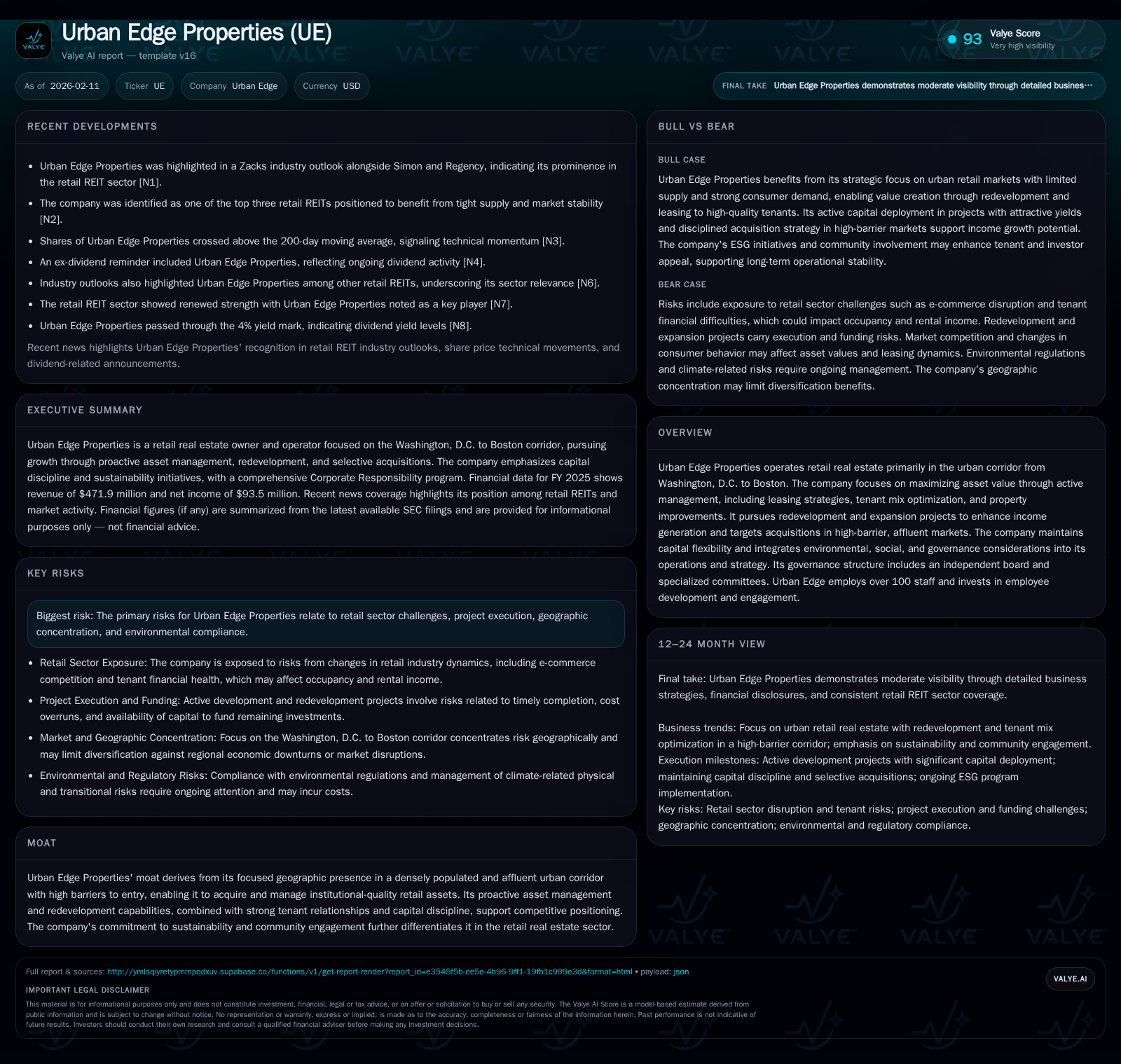
Urban Edge Properties (UE) operates primarily within a densely populated, affluent retail corridor stretching from Washington, D.C. to Boston, where high barriers to entry constrain new competition. The company’s strategic emphasis on active leasing management, tenant mix optimization, and redevelopment initiatives enables it to realize premium income growth opportunities. Financial discipline combined with ESG integration supports long-term value creation but industry headwinds and execution risks remain notable. Recent market sentiment is increasingly favorable given UE’s positioning in a tight urban retail supply environment.
Navigating the High-Barriers Urban Retail Landscape
Urban Edge Properties stands apart by concentrating its portfolio in the competitive and tightly held commercial corridor running from Washington, D.C., through New York to Boston. This stretch represents one of the most densely populated, affluent regions in the United States, characterized by limited institutional-quality retail inventory and high barriers that discourage new developments or entrants [S1]. This scarcity coupled with strong consumer spending power underpins the intrinsic moat UE enjoys.
Within this corridor, demographic vibrancy translates into steady consumer foot traffic supporting retail tenants' sales performance—an attractive trait for institutional landlords. UE's ability to selectively manage assets here allows it to leverage market fundamentals uncommon among more diffuse REIT portfolios. High land values and restrictive zoning amplify replacement costs and create natural supply constraints that protect rental rate growth potential.
The company’s detailed involvement in understanding trade area dynamics offers a critical competitive edge. By continuously evaluating tenant composition against local competition and consumer trends, UE sustains occupancy at healthy levels while commanding rents that reflect market realities [S1]. This focused geographic specialization is a clear pillar of their moat as it cultivates operational expertise deeply tied to these unique urban submarkets.
Summary takeaway: UE leverages scarce institutional retail assets in a densely packed metro corridor where demographic strength meets structural supply limitations—a foundation for durable property-level value.
Asset Management as a Growth Engine: Leasing and Tenant Strategy
At the heart of Urban Edge's value creation model lies aggressive yet disciplined asset management strategy centered around leasing initiatives. The firm employs multiple levers including rental escalations embedded in lease contracts, recapture of below-market rents upon expirations, and strategic attraction of tenants aligned with evolving market demands [S1].
Given the rapid shifts reshaping brick-and-mortar retail—accelerated e-commerce adaptation particularly—UE prioritizes tenants who can demonstrate omni-channel capabilities alongside stable financial metrics. Their tenant roster emphasizes categories less susceptible to online substitution such as grocery stores, discount big-box retailers, entertainment venues, health clubs, and an expanded food service footprint [S1].
Active monitoring of tenant sales performance and payment timeliness further reduces credit risk exposure while fostering proactive dialogue with retailers regarding merchandising strategies or space reconfigurations needed to boost traffic flow. This ensures facilities remain attractive destinations in highly competitive trade areas.
Importantly, lease structures incorporate exclusivity rights, co-tenancy clauses, and other provisions that guard against dilution of tenant trade draws or erosion through substandard neighbors [S1]. Regular engagement with brokers and merchant relationships helps UE identify early market shifts enabling timely leasing adjustments.
Summary takeaway: Proactive leasing mixed with targeted tenant mix optimization underpins steady NOI expansion while mitigating retailer risk in a transforming sector environment.
Redevelopment Projects: Unlocking Hidden Value
Urban Edge maintains an active redevelopment pipeline valued at $165.5 million as of year-end 2025 with $85.6 million still unfunded [S1]. These projects primarily focus on densification—adding leasable square footage—and repurposing legacy spaces for new uses better suited to shifting consumer preferences.
Typical redevelopment efforts include expanding anchor pads for grocers or entertainment venues; repositioning aging centers through facade upgrades; or converting traditional retail footprints into mixed-use layouts that integrate food halls or wellness offerings [valye_report_excerpt].
Crucially, these capital-intensive projects are targeted to yield roughly 14% unleveraged returns at completion—a threshold reflecting thoughtful underwriting rooted in contemporary market rent expectations and absorption forecasts [S1]. The incremental income potential supports longer-term portfolio cash flow resilience.
Redevelopment also mitigates obsolescence risk among older assets still privately owned or undercapitalized by smaller operators—a structural advantage afforded by UE’s scale and financial strength.
Summary takeaway: Redevelopment serves as a potent value catalyst through yield-accretive densification investments enhancing property competitiveness over time.
Investment Discipline in Competitive Metropolitan Markets
Urban Edge exercises disciplined capital deployment emphasizing risk-adjusted return profiles over volume growth [S1]. Acquisition targets must reside within the firm’s established corridor footprint featuring desirable demographics, access quality, notable barriers-to-entry, and properties amenable to eventual redevelopment.
Environmental due diligence forms an essential component of acquisitions reflecting growing regulatory stringency as well as alignment with the company’s Corporate Responsibility strategy [S1]. Prospective assets undergo rigorous evaluation of contamination liabilities or sustainability upgrades needed.
Tenant mix considerations weigh heavily when assessing an asset given heightened e-commerce disruption risks distinct across different categories — properties anchored by grocery or discount formats typically command premium pricing due to defensive characteristics [S1]. Furthermore, rent potential relative to existing leases factors prominently into underwriting assumptions alongside visibility/traffic metrics.
Concurrently UE employs selective disposition strategies shedding assets misaligned with current yield targets or strategic fit thereby recycling capital toward higher opportunity zones within core markets.
Summary takeaway: Acquisition discipline focused on high barrier urban properties aligned with ESG criteria underpins portfolio quality preservation amid competitive bid environments.
Capital Structure and Financial Flexibility Amidst Growth Plans
Financial stewardship at Urban Edge balances prudent leverage utilization with maintaining ample liquidity buffers supporting organic growth plus active redevelopment programs [S1][F1]. Cash holdings stood at $48.8 million as of December 2025 year-end providing immediate funding capacity absent debt drawdowns [F1].
Unsecured revolving credit facilities together with delayed draw term loans supplement liquidity sources offering flexibility for opportunistic acquisition or project financing without premature equity issuance dilution [S1]. Access to equity markets remains an option but is employed conservatively consistent with capital discipline tenets.
Capital expenditure prioritisations seek efficient allocation maximizing incremental ROIs while constraining non-core investment creep—reflected in sustained operating expense control programs embedded within day-to-day property management activities [S1].
This balance sheet approach enables UE to remain agile navigating evolving market conditions—even as sector headwinds intermittently pressure retailer viability — ensuring sufficient runway for strategic initiatives without undue financial stress.
Summary takeaway: Well-managed liquidity coupled with moderate leverage empowers Urban Edge’s growth aspirations while cushioning against economic variability.
Sustainability and Governance: Integrating Responsibility with Performance
Urban Edge demonstrates purposeful integration of Environmental, Social and Governance (ESG) principles within its strategic framework overseen directly by its independent Board of Trustees [valye_report_excerpt][S1].
Environmental stewardship manifests through energy-efficient building upgrades incorporated during redevelopments; sustainable landscaping; water usage reduction measures; plus ongoing monitoring aimed at minimizing carbon footprint across operations [valye_report_excerpt].
Social initiatives cover employee development programs supporting retention among over 100 staff members alongside community engagement endeavors cultivating local stakeholder goodwill essential for urban asset acceptance [valye_report_excerpt].
Governance structures entail specialized committees focusing on audit oversight, compensation fairness tied to long-term value creation metrics rather than short-term incentives enhancing accountability transparency [valye_report_excerpt].
Such comprehensive corporate responsibility positioning differentiates UE positively among peers aligning brand image with broader institutional investor ESG mandates increasingly prominent post-2020.[S1]
Summary takeaway: ESG embedded into governance enhances stakeholder confidence creating a durable brand platform amid rising responsible investment expectations.
Risks in Focus: Retail Sector Headwinds and Execution Challenges
Despite numerous strengths Urban Edge faces multiple noteworthy risks inherent in the retail real estate domain compounded by geographic concentration effects [S1][S2][valye_report_excerpt].
Shifts toward e-commerce continue altering traditional retail footprints regardless of defensive anchoring creating pressure on some tenant categories risking vacancy spikes or rent concessions absent continual active management [S2].
Execution risks surround redevelopment pipelines—cost overruns or delivery delays could compress forecasted yields requiring treasury vigilance during project life cycles [S1][valye_report_excerpt].
Geographic concentration entails dependency on economic vitality and regulatory environment stability within the D.C.-Boston corridor exposing UE to region-specific downturns or policy changes impacting landlord economics differently than more diversified platforms.
Environmental compliance constitutes both cost centers via remediation requirements plus legal exposure potential if lapses occur necessitating thorough due diligence upfront plus ongoing monitoring post-acquisition.[S1]
UE's transparent risk disclosures provide balanced insights signaling awareness though no mitigation strategy guarantees elimination given sector volatility.
Summary takeaway: Key vulnerabilities arise from sector transformation pressure combined with concentrated asset footprint requiring vigilant operational execution & regulatory adherence.
Market Sentiment & Recent Share Price Momentum
Recent developments point toward increasingly constructive investor sentiment around Urban Edge shares supporting valuation stability amid macro uncertainties. As documented by Nasdaq analyst commentary published January 2026[ N3 ], UE stock notably crossed above its 200-day moving average—a widely tracked technical signal—marking renewed momentum phase potentially attracting broader institutional interest.[N3]
Industry outlook reports recognize Urban Edge alongside leading peers like Simon Property Group and Regency Centers emphasizing benefits derived from tightly supplied urban markets where demographic strength supports rent resilience despite persistent retail headwinds[N1][N2]. Moreover analysts highlight deep tenant relationships plus redevelopment agendas as positive earnings catalysts sustaining confidence.[N2]
This enhanced technical backdrop coincides with fundamental solidity built around disciplined management enabling UE shares to weather correction bouts effectively while positioning for eventual sector recovery phases.[N3]
Summary takeaway: Strengthening share price technical indicators align well with analyst emphasis on UE’s niche positioning amid structural retail real estate shifts promoting gradual valuation re-rating potential.
Comparative Positioning Among Top Retail REITs
Within the competitive landscape dominated by large-scale players such as Simon Property Group (SPG) and Regency Centers (REG), Urban Edge asserts a distinctive stance via concentrated urban corridor specialization combined with hands-on operational tactics.[N1][N2][valye_report_excerpt]
While SPG operates one of the broadest mall portfolios nationally exhibiting scale advantages; REG emphasizes grocery-anchored centers across multiple geographies parlaying diversification benefits,[N1] UE focuses intensely on the Washington-Boston belt delivering localized expertise enabling nimble tenant adjustment, proactive redevelopment targeting highest use scenarios plus environmental governance alignment often more challenging for sprawling platforms.[valye_report_excerpt]
Investment analysts reference this focused approach as enabling superior capture of premium rent niches less contested by generic suburban malls or lifestyle centers while facilitating adaptive reuse strategies vital for future-proofing urban retail space.[N2]
In essence UE carves out a defensible micro-niche intersecting dense metropolitan demand patterns currently less pursued at scale by major peers affording meaningful differentiation.summary takeaway: Urban Edge’s tightly-geographic focused model complemented by active property-level maneuvers positions it uniquely amidst diversified national competitors navigating evolving brick-and-mortar realities.
Disclaimer: This analysis is intended solely for informational purposes based on publicly available documents including SEC filings dated February 11th 2026 ([S1]), recent news articles ([N1]-[N3]), company-reported facts ([F1]), and Valye News internal report excerpts. It does not constitute investment advice nor recommendations regarding security transactions.
Disclaimer: This is research-only, informational analysis and not investment advice. It may include AI-generated interpretation and general industry context. Always verify important details using primary sources.

Comments