
Nuvectis Pharma's Tumor-Agnostic Quest Amid Clinical Setbacks and Financial Stresses
A clinical-stage biotech navigating the promise of precision oncology against pipeline challenges and cash limits.
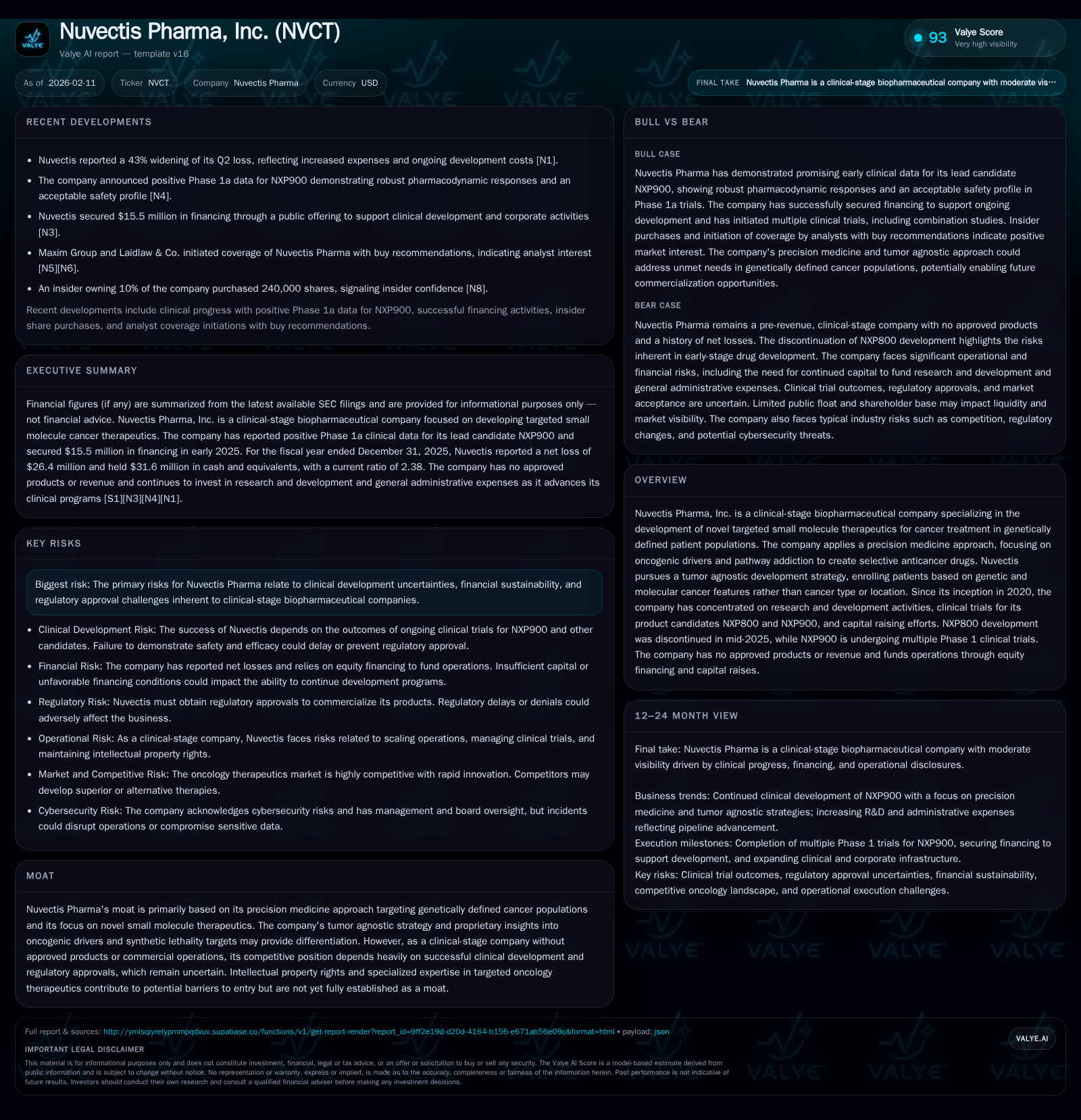
Nuvectis Pharma, Inc. pursues a precision medicine approach targeting genetically defined cancer populations through tumor-agnostic small molecule therapeutics. Despite its innovative strategy, the company faces headwinds marked by the mid-2025 discontinuation of its NXP800 candidate and ongoing Phase 1 trials for NXP900. Financially, Nuvectis remains sustained by equity funding but reports significant net losses and a limited but sufficient cash runway as of late 2025. Governance efforts highlight structured cybersecurity oversight amid broader early-stage biopharma risks inherent in regulatory approval and clinical development.
Precision Oncology at a Crossroads: Nuvectis’s Vision and Reality
Founded in 2020, Nuvectis Pharma positions itself at the forefront of precision oncology by adopting a tumor-agnostic development strategy—shifting traditional drug development paradigms that classify therapies based on cancer type or anatomical origin [S1][F1]. This approach enrolls patients based on genetic mutations or molecular aberrations that drive malignancy across diverse tumor types. The company's mission focuses sharply on oncogenic drivers and pathway dependencies, aiming to develop selective small molecule therapeutics that precisely disrupt cancer growth mechanisms.
However, as of early 2026, this aspiration contrasts with operational realities: Nuvectis remains a pure clinical-stage entity without any approved drugs or recurring revenue sources [S1][F1]. Since inception, it has concentrated resources on developing two key candidates—NXP800 and NXP900—with NXP800 discontinued mid-2025 following unfavorable trial outcomes. The lack of commercialized products underscores both the promise embedded in innovative science and the protracted timelines intrinsic to oncology drug development.
Decoding the Science: Tumor-Agnostic Small Molecule Therapeutics
Nuvectis’s scientific premise pivots on precision medicine concepts such as targeting oncogenic drivers—genetic alterations directly responsible for cancer cell survival—and exploiting pathway addictions where tumors rely heavily on specific cellular signaling cascades. Their approach further incorporates synthetic lethality principles, which identify gene pairs where simultaneous disruption results in cell death; selectively inhibiting one gene in cancer cells harboring defects in the other can yield targeted anti-cancer effects while sparing normal cells.
This granular targeting contrasts with conventional cytotoxic chemotherapies broadly toxic to dividing cells irrespective of genetic context. Small molecule therapeutics offer advantages including oral bioavailability and intracellular target engagement. Nonetheless, translating this intricate biology into effective treatments faces substantial clinical trial complexities, from heterogenous patient recruitment—given tumor agnostic enrollment criteria—to biomarker validation challenges. While these strategies suggest potential moat formation, success heavily depends on overcoming significant scientific and regulatory hurdles [N1][S1].
Pipeline Pulse: From NXP800 Discontinuation to NXP900’s Early Trials
Nuvectis's pipeline narrative exemplifies the 'fail fast' philosophy increasingly adopted in biotech to optimize resource allocation. The cessation of NXP800 development in mid-2025 followed Phase 1 trial data indicating insufficient efficacy or safety concerns [S1][F1]. Such decisions redirect focus toward more promising assets—in this case, NXP900—which is simultaneously undergoing multiple Phase 1 trials assessing tolerability, pharmacokinetics, and preliminary activity.
The tumor-agnostic framework influences patient enrollment designs by prioritizing molecular profiles over histology. While opening broader patient pools theoretically accelerates accrual, it introduces complexity in managing heterogeneity of response signals within trial cohorts. Early clinical readouts will be pivotal for guiding NXP900’s advancement trajectory.
Financial Lifelines: Assessing Cash Runway Against Operating Losses
Financially, Nuvectis demonstrates characteristics typical of early-stage biopharmaceutical companies reliant predominantly on equity funding rounds [F1][S1]. For the fiscal year ended December 31, 2025, the company reported a net loss approximating $26.4 million against cash and cash equivalents totaling roughly $31.6 million—a critical buffer supporting ongoing R&D expenditures.
With current assets near $31.7 million versus current liabilities around $13.3 million, the calculated current ratio stands at approximately 2.38, implying moderate short-term liquidity strength [F1]. Nonetheless, sustaining clinical programs without revenue inflow predicates timely capital raises or partnerships that carry inherent dilution risks.
This financial snapshot underscores an imperative balancing act between advancing costly trials and maintaining sufficient operational runway amid a competitive capital markets environment for biotech innovators.
Governance Under the Microscope: Cybersecurity and Management Oversight
Beyond science and finance, governance shapes investor confidence—particularly cybersecurity management amid increasing digital vulnerabilities targeting intellectual property-rich biotech firms [S1]. At Nuvectis, cybersecurity responsibilities integrate deeply within senior leadership structures; notably, the Vice President of Finance—boasting over 15 years in accounting controls—and CEO with extensive leadership experience oversee risk management frameworks.
Management actively participates in cybersecurity incident response planning and vendor engagement for penetration testing. Additionally, the audit committee exercises board-level oversight reinforced through routine reporting related to security threats and mitigation efforts [S1]. This multi-tiered governance model reflects awareness that protecting proprietary research data is integral to safeguarding competitive advantages.
Navigating Regulatory and Clinical Development Risks
Like many clinical-stage biopharma entities, Nuvectis confronts pervasive uncertainties tied to regulatory pathways and trial outcomes [S1][S2]. Potential pitfalls include failure to demonstrate safety/efficacy endpoints sufficient for FDA approval, delays arising from patient recruitment challenges intrinsic to niche genetic subgroups, and evolving regulatory standards impacting trial design or manufacturing compliance.
Financially material consequences could arise from these setbacks due to sunk R&D costs coupled with onerous capital requirements for continued development phases [N1]. While no material legal proceedings currently burden the company [S1], future litigation cannot be categorically ruled out given sector complexities.
These 'known unknowns' constitute systemic risks common within oncology-focused startups yet emphasize the high-stakes nature inherent in pioneering novel therapeutic modalities.
The Competitive Landscape and Intellectual Property Foundations
Nuvectis aims to carve a differentiated niche through intellectual property protections underpinning its small molecule candidates targeting genetic vulnerabilities unique to certain cancers [N1]. Scientific know-how applying synthetic lethality concepts further strengthens theoretical barriers by creating challenging-to-replicate expertise domains.
Nonetheless, competition arises from well-established pharmaceutical companies harboring broad late-stage oncology pipelines with diversified indications and substantial resources dedicated to targeted therapies. In this context, while Nuvectis’s moat potential centers on proprietary targets and precision approaches, it remains unproven absent product commercialization or late-phase clinical validation.
The company must therefore navigate strategically both patent landscapes and competitive pressures from organizations pursuing similar mechanistic pathways but armed with deeper pockets.
Investor Sentiment and Market Position Since Going Public
After listing on NASDAQ Capital Market under ticker NVCT in February 2022 [S1], Nuvectis has experienced typical public company growing pains associated with transitioning from private developmental stages into investor scrutiny regimes requiring enhanced disclosures and governance rigor.
The adoption of a Global Equity Incentive Plan since May 2021 evidences efforts to retain talent aligned with long-term value creation amid volatile share prices common in small-cap biotech sectors [S1]. Furthermore, availability of registered shares facilitates capital raising though increases susceptibility to share dilution concerns among existing investors.
Trading liquidity constraints often afflict specialized clinical-stage firms like Nuvectis due to narrow analyst coverage and speculative newsflow absence; however, transparent communications around milestones remain critical levers influencing market perception going forward.
This report synthesizes publicly filed SEC documents alongside company disclosures as of early 2026 without providing investment recommendations or price forecasts. Readers should consider risks inherent to clinical-stage biopharmaceutical ventures characterized by lengthy development cycles and uncertain regulatory approvals.
Disclaimer: This is research-only, informational analysis and not investment advice. It may include AI-generated interpretation and general industry context. Always verify important details using primary sources.

Comments