Unity Software at the Crossroads of AI Innovation and Profitability Challenges
Unity Software continues to push boundaries in AI-powered real-time 3D development while grappling with persistent operating losses amid a rapidly evolving competitive landscape.
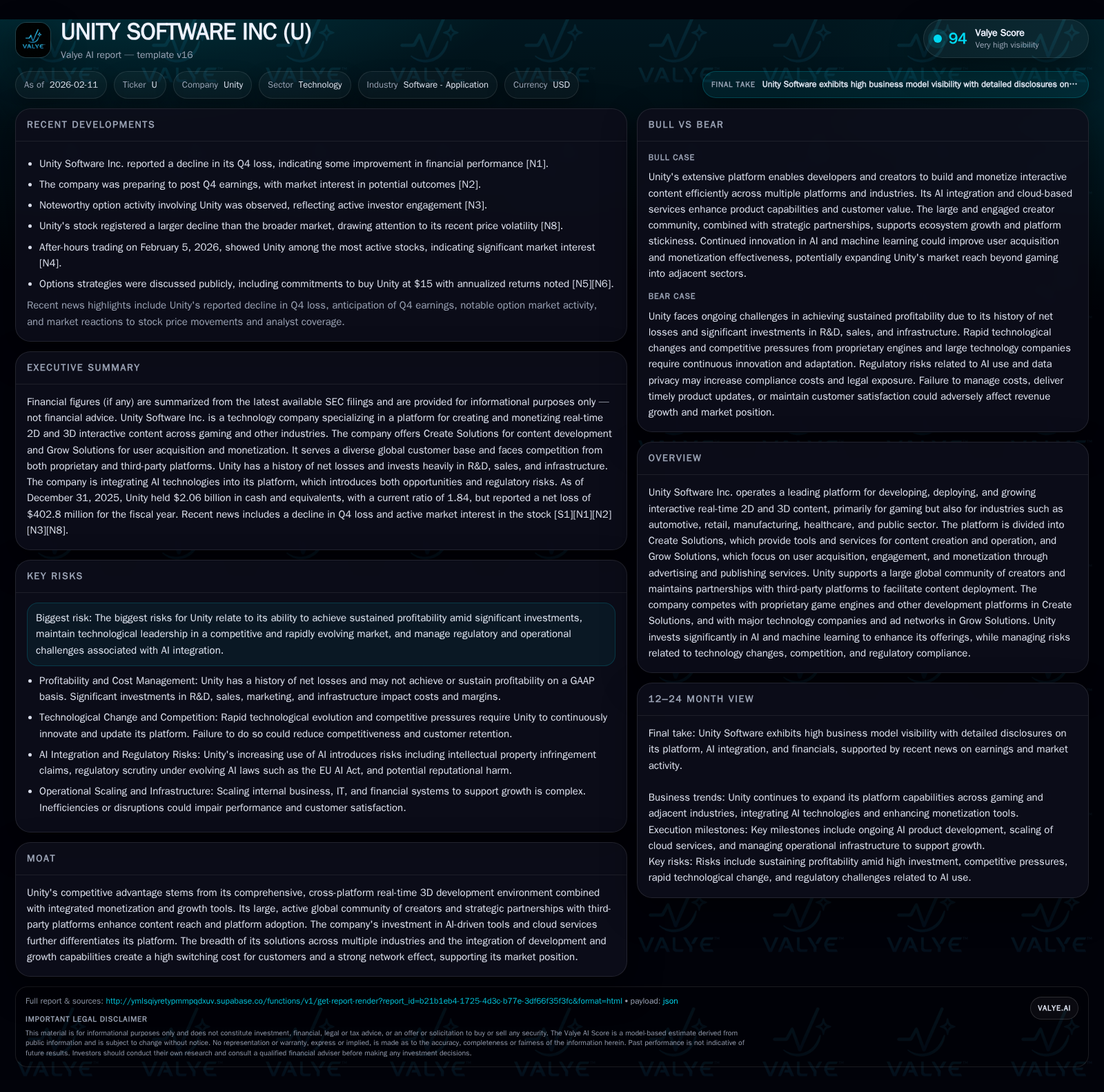
Unity Software remains a dominant force in real-time 2D and 3D content creation, leveraging integrated Create and Grow Solutions that serve industries beyond gaming. Despite robust revenue growth from its expansive platform and AI-driven tools like Unity Vector, the company has yet to achieve sustained GAAP profitability due to significant investments in R&D, sales, cloud infrastructure, and global expansion. Unity’s large creator community and strategic partnerships bolster its competitive moat, but regulatory uncertainties and the high costs of scaling present ongoing operational risks. Recent earnings beats suggest momentum, yet balancing growth with financial discipline remains Unity’s foremost challenge.
Unity’s Technological Core: Revolutionizing Real-Time 3D Development
Unity Software positions itself as the definitive platform for developing interactive real-time content across both gaming and multifaceted commercial sectors. At its core lies the Create Solutions suite—a sophisticated environment blending a custom-built real-time 3D engine with high-definition rendering pipelines tailored for photorealistic outputs. This technology stack extends beyond mere graphics; it incorporates AI-driven enhancements to workflows, advanced animation, audio toolsets, navigation algorithms, networking frameworks, and user interface components. Complemented by cloud-hosted DevOps tools and multiplayer support systems, these offerings allow creators to iterate swiftly and deploy across mobile, console, PC, XR devices, and more[S1].
The technological underpinnings differentiate Unity from closed-source proprietary engines by providing unmatched flexibility through extensibility APIs and cross-platform deployment on third-party sites. This breadth fosters strong stickiness among developers who require scalable tools adaptable not just for games but increasingly for automotive design simulations, robotics control interfaces, retail product visualizations, healthcare training modules, public sector applications, mechanical engineering modeling, architecture visualization, civil engineering projects, and construction planning. The underlying emphasis on real-time interactivity is the platform's unique selling proposition powering these diverse workflows.
Revenue Growth Versus Profitability: An Unfolding Financial Paradox
Despite impressive revenue growth spurred by broadening customer adoption across sectors (with cash reserves exceeding $2 billion while current liabilities stand near $1.5 billion yielding a healthy current ratio around 1.84), Unity continues to suffer substantial GAAP net losses—$403 million reported for fiscal year 2025[F1]. These operating deficits largely flow from heavy investments in R&D to sustain technological differentiation—especially AI integrations—and extensive sales & marketing spends aimed at expanding the user base globally[S1].
Further compounding these challenges are significant costs associated with third-party cloud services integral to supporting real-time rendering workloads at scale. Attempts at cost reduction via workforce adjustments or discontinuing legacy products have not visibly translated into immediate margin expansion due to ongoing infrastructure demands[S1]. The company confronts a difficult balancing act: scaling internal operational systems without impairing service quality or delaying product feature rollouts which could risk competitiveness.
This dynamic makes forecasting profitability complicated. While revenues have shown momentum boosted by AI-enhanced tools attracting new users and enabling broader monetization avenues (notably within Grow Solutions), expenses scale alongside these initiatives. The management underscores that achieving sustainable GAAP profits requires disciplined capital allocation coupled with continuous platform evolution—a formidable task amid rapid technological shifts.[S1]
Create Solutions: Expanding Beyond Gaming into Diverse Industries
Traditionally identified within gaming ecosystems, Unity has deliberately broadened Create Solutions’ applicability into industrial verticals where real-time interactive visualization enhances workflows substantially[S1]. Industries such as automotive leverage Unity's high-fidelity renderings for prototyping vehicle designs interactively before physical production; healthcare utilizes immersive simulations for medical training; manufacturing benefits from digital twins that optimize factory layouts or assembly lines.
Public sector clients explore urban planning scenarios or emergency response simulations using Unity’s interface technologies. Robotics applications manifest through simulation environments easing programming complexities before physical deployment.
This strategic expansion aims to diminish reliance on volatile gaming market cycles by embedding Unity deeper into mission-critical industry processes—effectively diversifying revenue streams while exploiting cross-industry commonalities in real-time interactive content creation.[S1]
Grow Solutions and Monetization Strategies: Navigating a Competitive Ad Tech Landscape
Unity's Grow Solutions anchor the company's monetization framework focused on scaling user acquisition and engagement post content creation[S1]. The umbrella encompasses an integrated ads ecosystem featuring mediation platforms aggregating multiple ad supply sources—boosting developer yield while optimizing user experience through targeted placements.
Their flagship is the Unity Ad Network enhanced by Unity Vector—a machine learning model launched in early 2025–improving ad targeting precision through behavioral data analytics[S1]. Furthermore, Supersonic offers publishing assistance empowering small studios lacking in-house expertise to maximize distribution channels effectively while retaining transparency.
Complementing these is Aura—a telecom-focused channel facilitating device-level app discovery enhancing user retention metrics. These diversified offerings collectively position Unity against large incumbent ad networks although competition remains intense from established digital advertising juggernauts integrating their own AI capabilities.
The symbiosis between creation tools and growth platforms creates an end-to-end ecosystem tempting developers seeking unified solutions for both content craftmanship and business scaling.
AI Integration: Unity Vector and the Future of Intelligent Platform Capabilities
AI stands at the fulcrum of Unity’s vision to redefine interactivity beyond static code paradigms[S1]. The release of Unity Vector illustrates this pivot—a proprietary machine learning model fine-tuned to optimize Grow Solutions’ performance via smarter ad mediation and tailored user experience adjustments.
Within Create Solutions, AI augments content creation accelerating iteration cycles through procedural generation assistance, animation prediction models reducing manual rigging effort, voice recognition APIs enhancing audio interactions amongst others. These capabilities strive not only to raise developer productivity but also enable higher fidelity experiences relevant in emerging areas like XR.
Management acknowledges that maintaining competitive edge hinges on relentless enhancement of these AI-driven assets which simultaneously drive substantial R&D expense increases impacting near-term profitability[S1]. Therefore, success depends on efficient algorithm deployment paired with scalable data infrastructure able to handle voluminous transaction processing inherent in real-time feedback loops.
Community and Partnership Ecosystem: The Network Effect as a Moat
Unity benefits from an expansive global network of active developers—spanning solo independents to large enterprises—engaged daily across its platform ecosystem[S1]. The sheer scale fosters vibrant knowledge exchange forums contributing to rapid troubleshooting innovations benefiting all participants.
Strategic alliances with major third-party platforms facilitate direct distribution pipelines allowing creators’ content effortless reach beyond native deployments thereby multiplying audience exposure without diluting brand identity or platform control.
These network effects produce high switching costs for users owing to accumulated integrations within development workflows plus entrenched familiarity with proprietary toolchains making migration expensive both financially and operationally.[S1]
Capital Allocation and Cost Management: Are Investments Yielding Sustainable Returns?
Management emphasizes capital discipline but concedes balancing aggressive innovation spending against margin pressures remains an ongoing challenge[S1]. Cloud infrastructure costs form a particularly complex variable given unpredictable workload spikes tied to live service game usage alongside demand surges caused by newer AI features driving compute intensity.
While cost-cutting measures like workforce resizing or office consolidation have been executed periodically they have not yet materially shifted overall expense trajectories which continue trending upwards amid expansion initiatives[S1].
Effective scalability of internal IT systems—including financial reporting automation—is cited as critical to enabling efficiency gains necessary for future profitability improvements pointing toward ongoing operational risk exposure should these implementations falter or delay[S1].
Analyzing Latest Earnings Beats and Market Sentiment Shifts
On February 11, 2026 news reports documented that Unity exceeded Q4 earnings estimates driven by stronger-than-anticipated top-line growth accompanied by a reduction in net losses relative to prior quarters[N1][N6]. This outperformance ignited favorable analyst responses including upgrades such as Oppenheimer’s revised outlook emphasizing confidence in management’s execution[N7].
Additionally, heightened pre-market trading activity underscored renewed investor interest pointing towards improved near-term sentiment dynamics despite lingering profitability concerns[N5]. These factors collectively suggest market participants are cautiously optimistic about the operational strategies bridging performance gaps highlighted over recent fiscal periods.
Regulatory and Operational Risks in an AI-Driven Future
Unity explicitly warns about risks associated with rapidly evolving technology paradigms especially around artificial intelligence integration increasing complexity across development cycles[S1]. Regulatory landscapes governing data privacy, automated decision-making algorithms embedded within advertising models (like Unity Vector), plus intellectual property issues linked to AI-generated content introduce layers of compliance uncertainty which could disrupt timelines or increase costs substantially.[S1]
Operationally scaling hardware-dependent cloud services without triggering service degradation represents another critical challenge bearing potential reputational damage if unmet. Furthermore, intensified competition from proprietary engines backed by major corporations capable of deep-pocketed R&D investments threatens market share erosion absent continuous innovation vigor.[S1]
Navigating these waters requires perpetual adaptability combined with prudent governance structures tuned specifically towards emerging AI-related ethical standards ensuring sustainable business practices amidst transformative technological change.
Disclaimer: This analysis is based solely on publicly available information as of February 11, 2026. It does not constitute investment advice or recommendations. Readers should conduct their own due diligence before making financial decisions.
Disclaimer: This is research-only, informational analysis and not investment advice. It may include AI-generated interpretation and general industry context. Always verify important details using primary sources.

Comments