
In-Depth Analysis of NNN REIT, INC.: Portfolio Strengths and Industry Positioning
Exploring NNN REIT's strategic asset base, financial stability, and sector dynamics in the triple-net lease space.
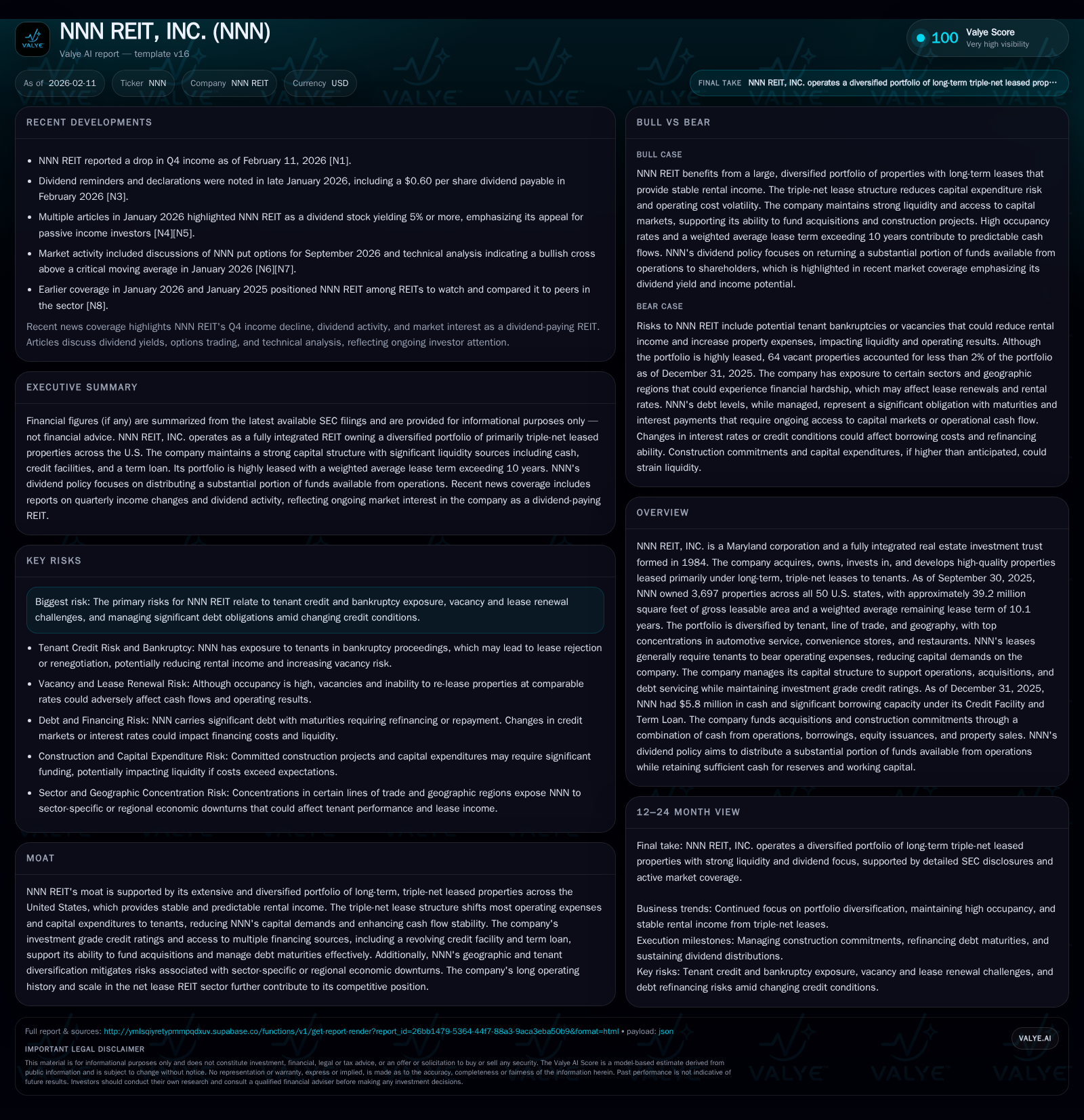
NNN REIT, INC., a seasoned player in the net lease real estate investment trust (REIT) market, operates an expansive portfolio of nearly 3,700 properties across all U.S. states. The company’s focus on long-term, triple-net leases to diversified tenants in automotive services, convenience stores, and restaurants underpins stable cash flows and robust occupancy rates exceeding 97%. Despite operating in growth-oriented regions like the Southeast and South U.S., NNN faces risks including tenant credit quality and debt management. Its investment grade ratings and conservative capital management support ongoing acquisitions and operational resilience.
Company Overview
NNN REIT, Inc., established in 1984 as a Maryland corporation, has evolved into one of the leading fully integrated REITs specializing in high-quality properties leased primarily under long-term triple-net arrangements. At its core, NNN’s business model emphasizes acquiring, owning, investing in, and occasionally developing retail real estate that benefits from stable contractual income streams with minimal landlord operational burdens.
As of December 31, 2025, the company owned approximately 3,692 properties dispersed throughout all fifty U.S. states plus the District of Columbia and Puerto Rico, aggregating roughly 39.6 million square feet of gross leasable area [S1]. Such scale not only solidifies its position as a national net lease operator but also diversifies exposures across multiple tenants and industries.
Portfolio Composition and Tenant Diversification
NNN strategically concentrates its investments in sectors that exhibit steady demand and resilient cash flow profiles. Leading tenant segments include automotive service facilities (18.4%), convenience stores (16.2%), restaurant establishments including both full-service and limited-service types (14.5%), entertainment venues (7.2%), and automobile dealerships (~6.6%) [S2]. This broad array of tenants mitigates concentration risk while positioning NNN advantageously in consumer-facing industries less vulnerable to short-term economic fluctuations.
The company leverages triple-net leases that require tenants to cover property taxes, insurance, maintenance, and other operating costs — a significant structural advantage that reduces landlord capital expenditures and variability in net operating income. Such leases have become industry standard among net lease REITs due to their favorable risk transfer characteristics.
Geographic Footprint
Geographically, NNN’s portfolio favors areas with robust demographic trends conducive to sustained retail demand. The Southeast (approximately 25%) and South (about 24%) U.S. regions dominate holdings by square footage [S1]. These areas have benefited from above-average population growth driven by factors such as favorable climate, expanding job markets, business-friendly policies, and migration patterns.
While the geographic concentration is aligned with long-term growth corridors providing income visibility and potential value appreciation, it also exposes the company somewhat to region-specific economic downturns or regulatory changes.
Financial Performance Highlights
Operationally, NNN reported total revenues nearing $926 million in fiscal year 2025 with net income standing around $390 million [F1]. These figures underscore the ability to generate sizable earnings from a diversified asset base with relatively stable rental income given a high occupancy rate maintained above 98% [S1].
Cash flow metrics remain robust; operating activities generated approximately $667 million in cash during the same period supporting dividend payments without reliance on capital markets [S1]. The balance sheet shows a conservative leverage profile with total debt representing roughly 42% of gross assets — no secured debt is reported — preserving financial flexibility [S1].
The company also exercises prudent liquidity management by maintaining access to significant undrawn borrowing capacity ($852 million credit facility availability plus $300 million term loan availability as of December 2025), complemented by equity issuance capabilities when market conditions are favorable [S1].
Competitive Positioning & Economic Moat
NNN's moat derives from several interrelated factors:
- Portfolio Scale & Diversity: Large property count spanning wide geographies dilutes localized risks.
- Lease Structures: Triple-net leases shift most operational risks onto tenants while providing predictable revenue streams.
- Tenant Credit Monitoring: Active evaluation involving financial statement analysis and ongoing communication helps manage tenant default risk.
- Investment Grade Credit Profile: Facilitates attractive financing costs enabling disciplined capital deployment strategies.
- Long-Term Lease Commitments: Weighted average remaining lease terms over ten years bolster income durability.
Together these elements create barriers for competitors seeking similar yields with comparable risk profiles while helping maintain steady distributions attractive to REIT investors focused on income.
Risk Factors & Challenges
Despite strengths, certain risks warrant attention:
- Tenant Credit Risk & Defaults: Though diversified, financial distress or bankruptcies among tenants could impact rents or recovery prospects.
- Lease Renewal & Vacancy: Extended vacancies or unfavorable lease renewals could compress yields temporarily.
- Debt Management Risks: While leverage fits industry norms presently at ~42%, rising interest rates or tighter credit conditions may increase refinancing costs.
- Regional & Sectoral Concentrations: Economic shocks impacting automotive services or convenience store sectors or growth slowdowns within dominant geographic markets could adversely affect revenue streams.
Management mitigates these by continual portfolio review processes including tenant credit assessments based on publicly available data supplemented by store-level performance monitoring plus engagement with tenant leadership teams [S1,S2].
Recent Developments & Market Context
Market commentary around January–February 2026 indicates mixed results amid broader retail real estate trends. Notably, National Retail Properties (a peer triple-net REIT) delivered Q4 results beating estimates while guiding FY26 earnings accordingly [N1], reflecting continued strength within this niche sector.
However, NNN reported Q4 income declines [N2], aligning with challenges faced broadly within retail segments undergoing disruption or macroeconomic pressure points. Despite this near-term hurdle, investor sentiment continues factoring NNN’s dividend yield appeal amidst low-yield environments [N5,N6]. Technical indicators also showed bullish momentum crossing critical moving averages recently [N8], possibly signaling improving investor confidence.
Industry Outlook Analysis (Non-Fact)
The triple-net REIT segment generally benefits from low landlord exposure to day-to-day property expense volatility combined with rising demand for flexible retail concepts tethered to essential service providers — particularly automotive service centers and convenience stores experienced consistent consumer patronage even during cyclical dips.
Nonetheless, evolving consumer habits accelerated by technology penetration may gradually reshape brick-and-mortar usage patterns impacting certain sub-sectors. The imperative for ongoing portfolio refreshment via acquisitions or dispositions aligned with emerging consumer trends remains vital for sustaining long-term competitive advantage.
Interest rate trajectories constitute another pivotal variable influencing cost of capital; rising rates can compress cap rates thereby weighing on valuations absent commensurate rent escalations embedded within leases. Strong sponsor balance sheets and credit standings like NNN’s will be crucial in navigating such cycles while maintaining shareholder returns continuity.
Conclusion
NNN REIT stands as a mature leader in the triple-net REIT landscape characterized by extensive national reach, diversified tenant mix centered on resilient consumer-oriented sectors, and considerably stable cash flows supported by long-duration leases transferring operational costs predominantly to tenants. The company's prudent capital structure complemented by investment-grade ratings positions it well for sustained acquisition activity even amid fluctuating market conditions.
Yet vigilance regarding tenant credit profiles and proactive lease management remains central as shifting economic environments continue exerting pressure across retail real estate domains. Investors analyzing NNN must weigh these carefully balanced elements without overlooking macroeconomic influences potentially affecting future performance trajectories.
This analysis is intended solely for informational purposes reflecting data up to February 2026 without providing buy or sell recommendations.
Disclaimer: This is research-only, informational analysis and not investment advice. It may include AI-generated interpretation and general industry context. Always verify important details using primary sources.

Comments