
Centrus Energy Corp: Navigating the Nuclear Fuel Supply with Strategic Enrichment Capabilities
Centrus Energy stands out as the exclusive U.S. producer of advanced nuclear fuel, positioning itself at the nexus of energy security and carbon-free power expansion.
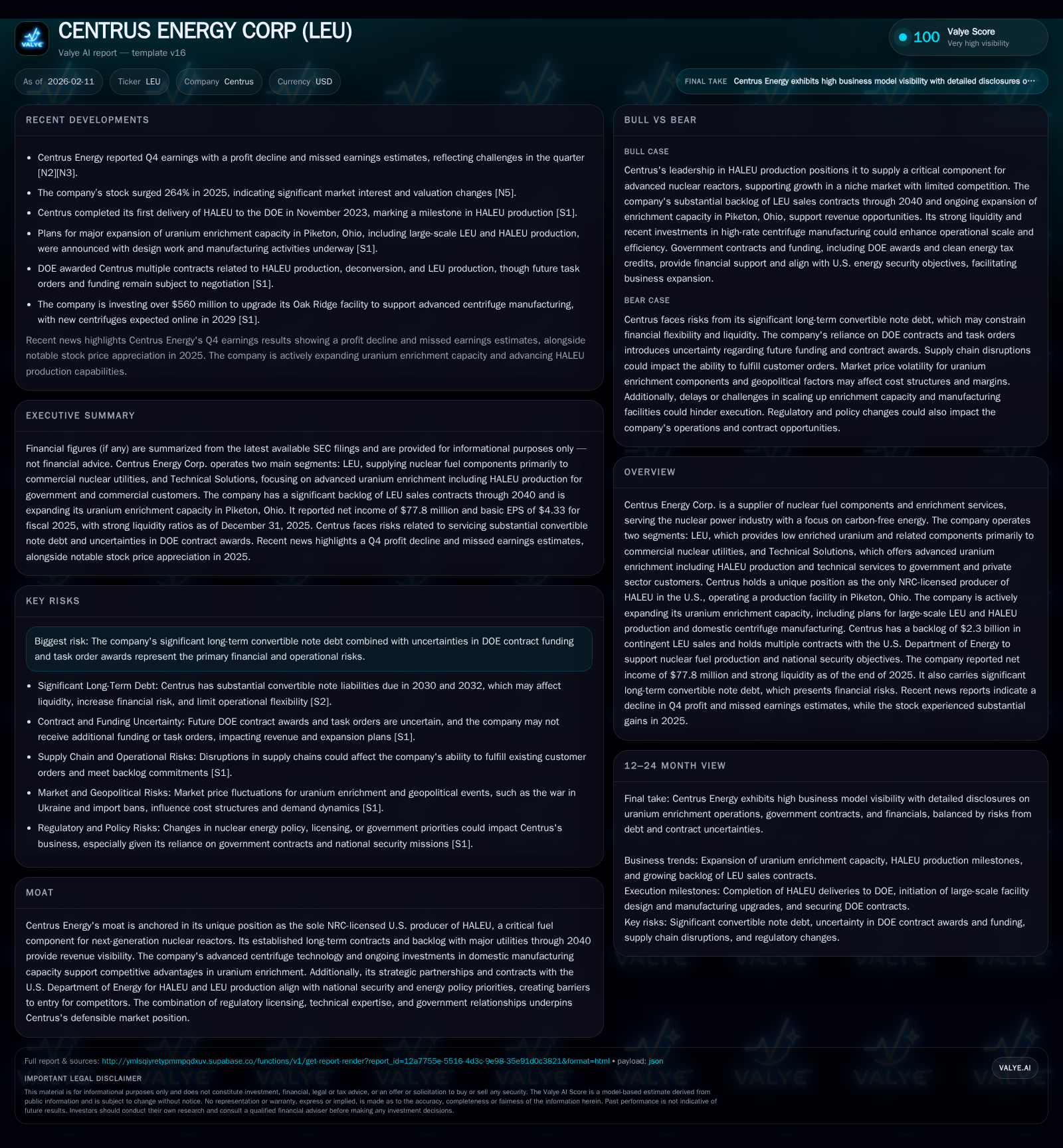
Centrus Energy Corp operates in the niche but critical sector of uranium enrichment and nuclear fuel supply, primarily through its LEU and Technical Solutions segments. It holds a unique NRC license for HALEU production in the U.S., supporting next-generation nuclear reactors amid increasing governmental and commercial demand. While the company benefits from strong long-term contracts and significant cash reserves, it faces operational risks tied to government funding uncertainties, geopolitical tensions, supply chain complexities, and a substantial debt profile. Centrus is actively expanding its domestic enrichment infrastructure to capitalize on tightening supply security priorities.
Company Overview
Centrus Energy Corp occupies a pivotal role in the uranium enrichment industry as a supplier of nuclear fuel components essential for carbon-free electricity generation globally. The company’s operations comprise two distinct but complementary segments: Low Enriched Uranium (LEU) and Technical Solutions. The LEU segment focuses on supplying low enriched uranium primarily to commercial nuclear utilities worldwide, constituting the majority of Centrus' revenue base. In contrast, Technical Solutions targets advanced uranium enrichment services—most notably HALEU (high-assay low-enriched uranium) production—as well as specialized technical services for both governmental institutions and private sector customers.
Headquartered around its flagship production facility in Piketon, Ohio, Centrus uniquely holds the only Nuclear Regulatory Commission (NRC) license enabling HALEU manufacture in the United States, positioning it as a linchpin for emerging next-generation nuclear technologies reliant on this advanced fuel form.
Industry Context & Market Position
The global nuclear power sector increasingly views HALEU as a cornerstone for future reactor designs promising improved efficiency and enhanced safety profiles. With many nations seeking carbon emission reductions amid stringent climate policies, nuclear energy offers an attractive baseload alternative to intermittent renewables. Centrus has leveraged these dynamics by cultivating deep capabilities in centrifuge technology—essential for uranium isotope separation—and aligning strategically with U.S. Department of Energy (DOE) initiatives aimed at revitalizing domestic nuclear fuel cycle activities.
This dual focus on serving traditional commercial utilities via LEU sales while pioneering technical advancements in HALEU undergirds Centrus' defensible moat. Long-dated sales backlogs totaling approximately $2.3 billion underpin revenue expectations through 2040 [S1], while government contracts embed strategic relevance tied to national energy independence objectives.
Financial Health & Capital Structure
Centrus exhibits solid liquidity metrics post-2025 fiscal year. Its reported cash and equivalents approximate $1.96 billion against current liabilities near $423 million—translating into a robust current ratio of about 5.6 [F1]. This financial cushion supports ongoing capital projects aimed at scaling manufacturing capacity domestically.
However, notable financial risks stem from substantial long-term debt obligations represented by convertible notes carrying zero and 2.25 percent interest rates, maturing between 2030-2032 [S1][S2]. The embedded conditional conversion features could pressure liquidity if holders elect conversion en masse or if accounting standards necessitate reclassification of these liabilities as current.
Cash flow variability remains a concern due to the cyclical nature of contract awards—particularly under DOE frameworks—and price fluctuations for separated work units (SWU) and uranium inputs influenced by geopolitical tensions and market dynamics.
Operational Strategy & Expansion Initiatives
A key component of Centrus’ strategy involves augmenting its centrifuge enrichment infrastructure across multiple U.S. sites—principally Piketon and Oak Ridge—to enhance capacity for both LEU and HALEU production [S1]. This move addresses historical overreliance on Russian-sourced uranium products complicated by sanctions imposed amid the Ukraine conflict, which currently impact global supply chains [S1].
Optimizing indigenous production capability dovetails with government priorities emphasizing energy security and technological sovereignty. Moreover, it allows Centrus to service expanding demand pipelines linked to innovative reactor programs both domestically and internationally.
Beyond raw production scaling, Centrus endeavors to diversify its service offerings within Technical Solutions by applying its proprietary technologies toward advanced manufacturing techniques and engineering support services relevant to governmental agencies.
Risk Factors & Challenges
Multiple vectors present material risks:
- Geopolitical & Regulatory: The ongoing war in Ukraine has introduced sanctions-related uncertainties affecting import/export processes for uranium commodities. Compliance with evolving NRC regulations coupled with DOE contract management adds layers of operational complexity [S1].
- Financial Leverage: Ballooning long-term convertible debt coupled with contingent contract funding creates exposure to interest coverage pressures and refinancing risks [S2].
- Supply Chain Vulnerabilities: Disruptions linked to international trade restrictions may hinder timely fulfillment of customer orders despite diversified procurement strategies [S1].
- Competitive Landscape: Foreign competitors subsidized by state actors potentially challenge Centrus’ market share beyond domestic borders; barriers exist but require vigilant technological advancement to maintain lead.
- Execution Risks: Success hinges on flawless execution across manufacturing expansions alongside continuous adherence to stringent safety and environmental norms intrinsic to handling radioactive materials.
Recent Performance & Outlook Commentary
According to January-February 2026 analyst coverage ([N1][N2][N6]), Centrus recently posted earnings falling short of estimates amid compressed margins attributed partly to inflationary pressures affecting operational costs despite strong topline momentum from backlog execution. While short-term profit dips sparked some stock volatility ([N7]), sentiment recognizes substantial growth trajectory driven by escalating interest in nuclear energy renaissance themes ([N9]).
Investor dialogues also emphasize waiting for clearer DOE funding signals regarding new task order awards essential for sustaining Technical Solutions segment momentum ([S1]). Notably, long-term contracts provide foundational stability even as quarterly results display inherent volatility reflective of project-based government contracting environments.
Strategic Implications & Industry Trends Analysis (Analysis)
Industry-wide trends underscore rising urgency for carbon-free energy sources amid global climate commitments propelling nuclear power adoption curves upward over coming decades. Concurrently, terrorism threats and cyber vulnerabilities place premium value on domestically controlled fuel cycle capacities which companies like Centrus uniquely address through regulatory licensing barriers difficult for new entrants to navigate.
Continued innovation around HALEU physical properties unlocks potential efficiencies for small modular reactors (SMRs) gaining favor as scalable solutions complementing renewable grids. Thus, Centrus occupies a strategic crossroads blending legacy LEU business with frontier Technical Solutions developments critical for future-proofing energy portfolios.
Nevertheless, success depends not only on technical prowess but also political will evidenced through sustained federal appropriations facilitating research subsidies alongside policy frameworks favoring homegrown nuclear supply chains over competing foreign sources aided historically by Russian dominance.
Conclusion
Centrus Energy stands as an indispensable cornerstone provider within an evolving nuclear fuel ecosystem marked by advancing reactor technologies requiring enriched uranium forms that few players worldwide can deliver safely at scale. Its de facto monopoly status over U.S.-licensed HALEU production combined with tangible efforts toward capacity growth position it as a central participant aligned with both commercial utility demands and national strategic interests.
However, considerable uncertainties persist — particularly surrounding debt servicing under volatile market conditions compounded by complex government contracting landscapes subject to annual budget cycles — which mandates ongoing scrutiny from stakeholders monitoring both operational execution discipline and geopolitical developments impacting raw material access.
Ultimately, understanding Centrus’ helmed role requires appreciating not only its commercial fundamentals but also its embeddedness within broader energy security dialogues impacting how nations navigate transitioning toward sustainable power futures.
This report is intended solely for informational purposes. It does not constitute investment advice or recommendations.
Disclaimer: This is research-only, informational analysis and not investment advice. It may include AI-generated interpretation and general industry context. Always verify important details using primary sources.

Comments