Avantor Faces Profitability Headwinds Despite Robust Revenue; Cybersecurity Emerges as a Key Strength
Avantor's substantial revenues are tempered by ongoing net losses and market volatility, while its strong cybersecurity governance stands out as a strategic asset.
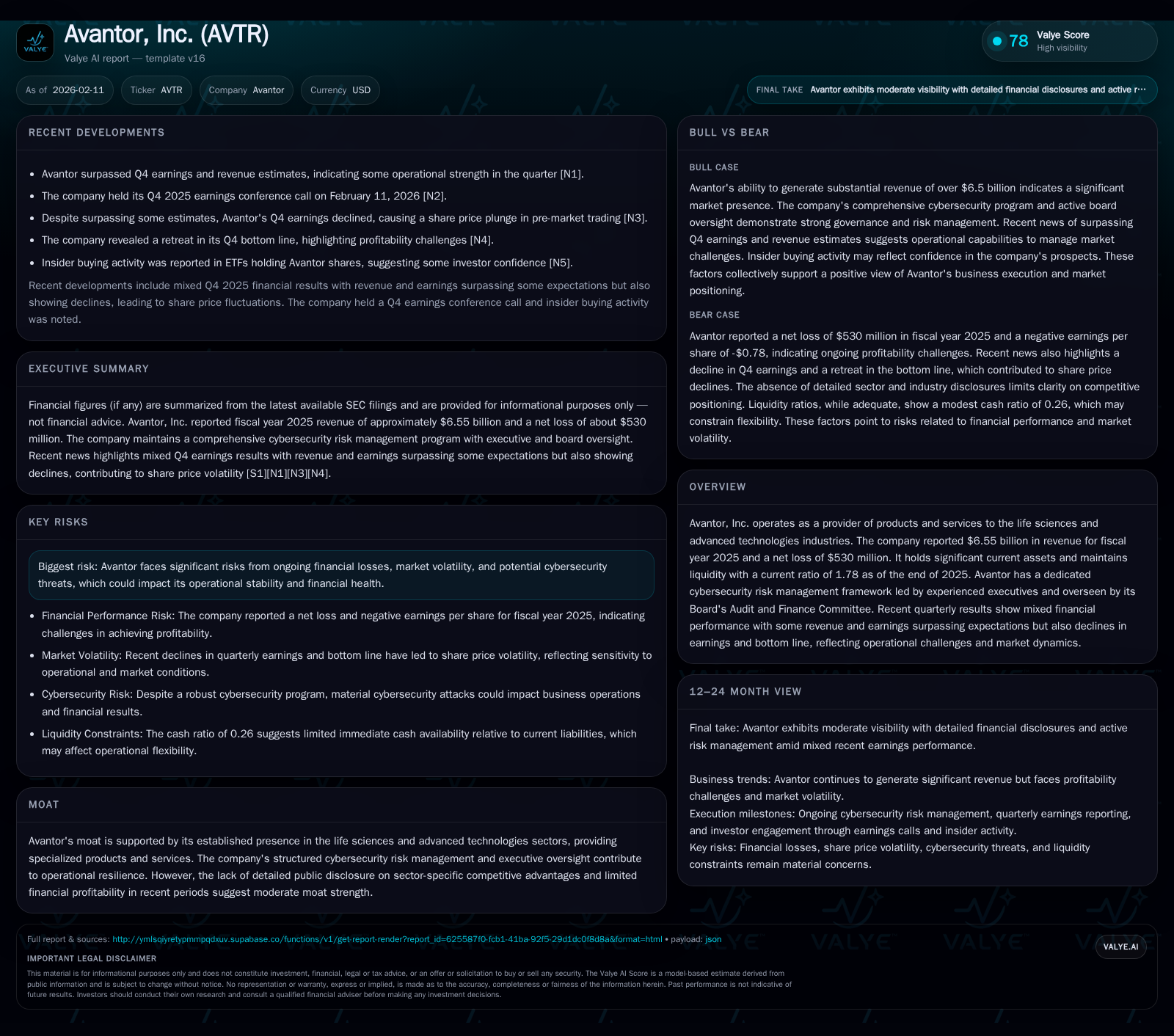
Avantor, Inc. reported $6.55 billion in revenue for fiscal 2025 but continues to grapple with substantial net losses totaling $530 million, reflecting persistent operational challenges amid shifting market dynamics. Recent quarterly results reveal mixed performance, with some revenue beats overshadowed by declines in earnings and investor pushback, underscoring the complexity of sustaining profitability. Meanwhile, Avantor’s disciplined cybersecurity framework—led by an experienced CISO and overseen at the board level—provides a critical layer of resilience in an industry increasingly vulnerable to cyber threats. As the company navigates liquidity considerations, competitive pressures, and investor skepticism, its path forward will depend on balancing risk mitigation with strategic growth initiatives in life sciences and advanced technologies.
Avantor’s Revenue Scale Overshadowed by Persistent Losses: What Lies Beneath?
Avantor closed fiscal year 2025 with revenues totaling an imposing $6.55 billion, firmly establishing itself as a considerable player supplying products and services across life sciences and advanced technologies [F1]. Yet this impressive top line belies ongoing struggles below the surface: the company recorded a net loss of approximately $530 million over the same period [F1]. This dissonance—significant revenue paired with persistent unprofitability—sets the stage for analyzing deeper operational concerns.
While high sales volumes demonstrate Avantor’s broad market reach and customer penetration, the inability to convert revenue into consistent profits highlights challenges such as cost management inefficiencies, pricing pressures, or investment-heavy R&D and infrastructure spending. News reports emphasize this tension; despite surpassing estimates in certain quarters post-fiscal-year end ([N1]), the firm simultaneously witnessed a retreat in Q4 bottom-line outcomes and subsequent share price plunges ([N3],[N5]). These developments suggest complexities beyond topline growth alone that weigh on investor confidence.
Understanding the drivers behind these losses requires dissecting recent operational results alongside external market forces impacting demand and competitive positioning.
Operational Pulse: Dissecting the Recent Earnings and Market Reactions
Avantor’s most recent quarterly earnings embodied this duality between positive momentum and cautionary signals. Official disclosures revealed that while both revenue and adjusted earnings occasionally eclipsed Wall Street projections ([N1]), overall net income erosion was evident heading into year-end ([N3],[N5]). The Q4 earnings conference call transcript ([N2]) provides valuable color on management's perspective: executives acknowledged headwinds including pricing pressure in certain segments and incremental costs related to supply chain realignments.
Market reaction mirrored this ambivalence; initial enthusiasm over revenue beats gave way to skepticism due to deteriorating profitability metrics. The share price slid sharply pre-market following earnings release ([N3]), reflecting investor apprehension about sustainable earnings quality.
Such mixed signals indicate that short-term operational improvements coexist uneasily with longer-term margin compression risks. The balance between aggressive growth initiatives—potentially weighing on near-term costs—and tightening efficiency levers will be pivotal going forward.
Cybersecurity as Competitive Armor: Governance, Risk, and Oversight in Focus
Amid financial headwinds, Avantor’s commitment to robust cybersecurity risk management emerges as a notable strategic strength and differentiator. The company has established a mature governance framework led by its Vice President of Information Security & Risk Management who concurrently serves as Chief Information Security Officer (CISO), boasting over 25 years of relevant industry expertise [S1].
This leadership directs a dedicated team tasked with continuous monitoring of information systems for threats, analytic review of incidents, and deployment of evolving mitigation strategies [S1]. Critically, the CISO maintains direct communication channels with key executive leaders—including the CEO and CFO—and presents comprehensive cybersecurity updates regularly to the Audit and Finance Committee of the Board [S1]. This ensures not only operational responsiveness but also strategic oversight at the highest governance levels.
Such structured risk management is indispensable given Avantor’s role supplying regulated industries where data integrity and system availability are paramount. It also serves as an implicit moat enhancer by fostering trust among clients wary of cyber vulnerabilities.
Liquidity and Balance Sheet Robustness: Cushion or Constraint?
Turning to balance sheet health provides insight into Avantor’s financial flexibility amid operating losses. The company reported current assets totaling approximately $2.45 billion against current liabilities near $1.38 billion as of fiscal year-end 2025 [F1], culminating in a current ratio of roughly 1.78—not an aggressive liquidity cushion but indicative of adequate short-term solvency.
Cash and equivalents stood at about $365 million [F1], representing available liquid resources for day-to-day operations or unexpected contingencies. While not excessively abundant relative to revenue scale, this level provides a meaningful buffer supporting working capital needs without immediate refinancing stress.
Nonetheless, sustained net losses continue to pose refinancing risks if cash burn accelerates or credit markets tighten—variables investors must monitor closely moving forward.
The Moat Mystery: Assessing Avantor's Position in Life Sciences and Technology Markets
Avantor’s strategic moat is rooted principally in its entrenched presence delivering specialized products and services tailored to life sciences research institutions, pharmaceutical companies, and advanced technology firms [valye_report_excerpt]. This foundational positioning allows the company to leverage domain expertise, regulatory know-how, and established client relationships.
Yet the moat characterization must be tempered by noted limitations: public disclosures provide scant detail on unique competitive advantages such as proprietary technologies or exclusive contracts [valye_report_excerpt]. Coupled with recurring financial losses undermining capital generation capacity, these factors collectively temper moat strength from robust toward moderate.
In essence, while Avantor maintains credible positioning relative to peers through sector specialization and integration capabilities, it faces ongoing challenges translating this status into defensible profitability.
Sector Dynamics and Peer Comparisons: Contextualizing Avantor’s Performance
Within broader industry context lies valuable comparative insight. Peers like Cencora recently posted stronger quarterly earnings surpassing analyst forecasts ([N4]), setting performance benchmarks that contrast with Avantor’s uneven profitability trajectory.
Such disparities prompt questions about operational efficiency variances, product mix competitiveness, or geographic footprint differences influencing market share gains or losses. They also highlight structural trends within life sciences supply chains—such as consolidation pressures or innovation cycles—that impact vendor performance differentially.
By situating Avantor amidst peer activity patterns, stakeholders can better calibrate expectations regarding growth pacing and margin potential relative to sector norms.
Investor Sentiment and Insider Moves: Signals Amid Price Volatility
Shareholder dynamics further illuminate interpretation of Avantor’s unfolding narrative. Insider purchasing activity has been documented recently ([N6],[N14]), indicating confidence by those closest to company operations despite broader market skepticism exacerbated by significant stock price declines (>40% over past year) reported earlier ([N13]).
Simultaneously, valuation debates surfaced across analyst circles questioning whether shares represent compelling value or face structural dampeners ([N7],[N8]). Large institutional fund movements add additional complexity ([N13]), reflecting competing hypotheses regarding turnaround potential versus persistent headwinds.
This patchwork signals an unsettled market stance where informed participants weigh risks against opportunities without clear consensus—typical for firms navigating profitability inflection points amidst transformational agendas.
Strategic Outlook: Risks, Opportunities, and Pathways to Stability
Looking ahead, Avantor confronts multifaceted risks including continued financial losses jeopardizing capital sustainability; heightened exposure to macroeconomic volatility; plus intrinsic cybersecurity threats despite solid governance frameworks [valye_report_excerpt],[S1],[S2].
Balancing these challenges is potential upside stemming from accelerating demand within life sciences innovation pipelines or next-generation technology applications constituting core addressable markets.
To regain stable profitability trajectories will likely require disciplined execution focused on operational efficiencies; targeted investments aligned with high-growth segments; possibly portfolio rationalization; plus leveraging cybersecurity leadership as a trust-building pillar for customer retention.
Ultimately, how effectively Avantor navigates these dynamics will determine whether it can convert scale into sustainable earnings power without undue risk accumulation—an evolving story warranting close attention from industry watchers going forward.
This analysis synthesizes publicly available financial disclosures alongside recent news coverage to present an integrated view of Avantor’s current business condition without recommending specific investment actions. Readers should consider company filings directly alongside evolving market data when forming their own judgments.
Disclaimer: This is research-only, informational analysis and not investment advice. It may include AI-generated interpretation and general industry context. Always verify important details using primary sources.

Comments