
Bitmine Immersion Technologies: Ethereum Treasury Scale, Staking Platform Ambitions, and the Fragility of a Concentrated Model
Bitmine Immersion Technologies now operates as one of the largest institutional holders and stakers of Ethereum, with nearly 5% of all circulating ETH and a business model centered on staking rewards through its MAVAN platform. While this scale offers unique leverage to Ethereum’s ecosystem, it also exposes Bitmine to acute risks—from staking yield volatility and regulatory flux to the operational and market hazards of digital asset infrastructure.
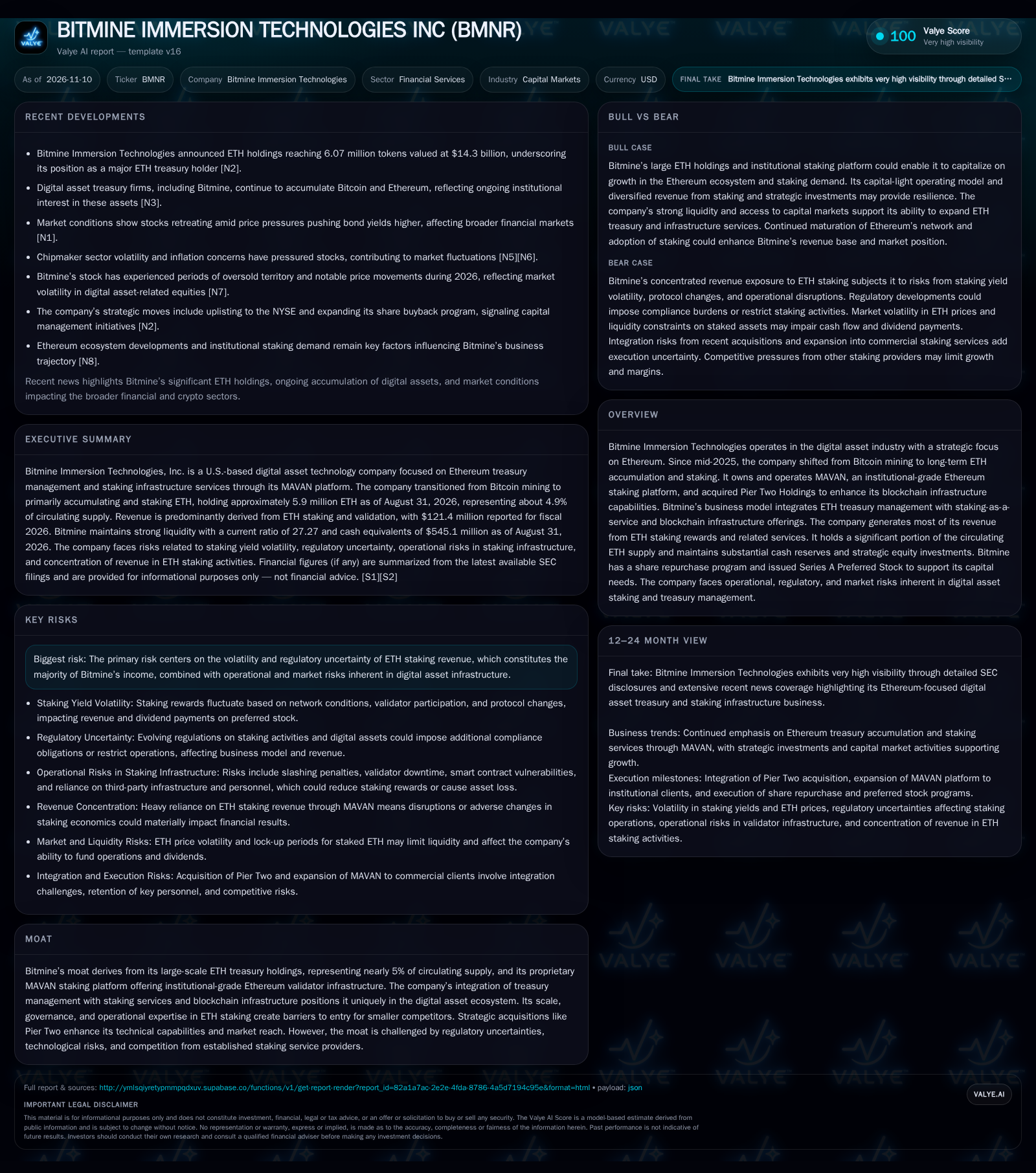
Bitmine Immersion Technologies holds over 6 million ETH (about 5% of supply) and earns nearly all its revenue from staking via its MAVAN platform. This positions Bitmine as a key institutional player in Ethereum infrastructure, but also concentrates its risk profile around ETH price, protocol changes, and evolving regulation. Recent acquisitions and capital raises support expansion, but operational and compliance execution will be critical as the company grows its institutional client base. [S1] [N2]
Bitmine Immersion Technologies has rapidly transformed from a traditional Bitcoin mining operation into a dominant Ethereum staking and infrastructure provider. By amassing over 6 million ETH—nearly 5% of the asset’s circulating supply—and shifting its business model to focus on staking rewards and institutional-grade blockchain services, Bitmine has positioned itself at the core of the Ethereum ecosystem. However, this scale and focus come with acute risks: revenue is almost entirely dependent on ETH yields and protocol stability, while regulatory and operational uncertainties could threaten both business continuity and growth ambitions. The company’s future will hinge on its ability to monetize its platform offerings, manage concentrated exposures, and navigate a shifting compliance landscape. [S1] [N2]
Bitmine’s ETH Holdings, Staking Revenue, and Platform Expansion Define Its Present
As of November 2026, Bitmine Immersion Technologies holds 6.07 million ETH—equivalent to about 4.9% of the total circulating supply—valued at $14.3 billion. This massive treasury is the foundation of Bitmine’s business model and makes the company a systemic participant in Ethereum’s network, with direct influence over staking, governance, and validator economics. [N2]
Nearly all of Bitmine’s revenue for the fiscal year ended August 31, 2026 ($121.4 million, or 97% of total) was derived from Ethereum staking and validation services. The company’s proprietary MAVAN platform, launched in March 2026, is now being extended from internal operations to serve institutional clients, marking a shift from pure asset accumulation to infrastructure services. [S1]
To fund its expansion and ETH accumulation, Bitmine completed a $271.5 million preferred equity raise in June 2026 and reported $545.1 million in cash and equivalents as of August 31, 2026. The company also acquired Pier Two Holdings to bolster its infrastructure capabilities. These moves underscore a capitalized, expansionist stance but also increase the complexity and execution demands of the business. [S1]
How Bitmine Monetizes Its Ethereum Exposure and Platform Assets
Bitmine’s revenue engine is powered by ETH staking rewards, which are earned by validating transactions and securing the Ethereum network. The company’s returns are thus a function of three key variables: the amount of ETH staked, the prevailing network staking yield, and the price of ETH (which determines the fiat value of rewards and asset holdings). Revenue is recognized as staking rewards accrue, but both the base asset and the reward stream are subject to high volatility.
Operating leverage is structurally high: once the staking infrastructure is built and validators are provisioned, incremental revenue from additional ETH staked or new client assets is achieved with modest marginal cost. However, fixed costs are significant for maintaining infrastructure, security, and compliance—particularly as Bitmine onboards institutional clients via MAVAN.
The business model is capital-intensive on the asset side (requiring large ETH holdings and ongoing acquisitions) but capital-light in infrastructure relative to traditional mining. The company’s ability to scale revenue depends on both its own treasury and its success in attracting external assets from institutions seeking staking-as-a-service. Fee structures for institutional clients are not disclosed, but the economics likely hinge on a mix of asset-under-management fees and performance-based revenue, with pricing power dependent on platform reliability, security, and regulatory clarity.
Bitmine’s preferred equity issuance, while non-dilutive to common shareholders, adds a fixed dividend burden (9.50% on $271.5 million) that must be serviced from cash flow—further tying operating success to the volatility and sustainability of staking rewards. [S1]
Ethereum Staking Landscape: Scale, Technology, and Regulatory Uncertainty Shape Competitive Dynamics
Bitmine’s competitive advantage is grounded in its scale—controlling nearly 5% of ETH supply—and its early move to institutional-grade staking infrastructure. This gives it a differentiated position compared to smaller staking providers or asset managers, as large treasury holdings confer voting power, network influence, and a reputational moat for institutional clients.
However, the competitive landscape is fluid. Major categories of competitors include other staking service providers (centralized and decentralized), large crypto exchanges offering staking-as-a-service, and emerging institutional fintechs targeting custody, staking, and blockchain infrastructure. Many of these peers have comparable technology stacks and are investing heavily in security, compliance, and client experience.
Bitmine’s recent acquisition of Pier Two Holdings aims to reinforce its technical capabilities, but integration risk remains. The company’s expansion into commercial staking services brings it into direct competition with established players that may have broader client networks or deeper compliance resources.
A significant counterforce is regulatory uncertainty: should new rules restrict staking-as-a-service or tighten custody and compliance requirements, Bitmine’s advantage could erode or the cost of doing business could rise sharply. Furthermore, technology substitution risk is non-trivial—protocol changes to Ethereum’s consensus mechanism, or the rise of alternative proof-of-stake chains with better economics, could reduce Bitmine’s relevance or margins.
Institutional Adoption and Ethereum Network Growth Drive Outperformance
The most favorable scenario for Bitmine is one in which institutional demand for ETH staking accelerates, Ethereum’s network continues to grow in adoption and value, and the MAVAN platform succeeds in capturing a meaningful share of external assets. If Bitmine can leverage its reputation, scale, and technology to attract large institutional clients—banks, asset managers, fintechs—staking fee revenue could scale rapidly without commensurate increases in operating cost.
Confirmation of this scenario would come from disclosed growth in institutional assets under management on MAVAN, new client wins, or strategic partnerships with major financial institutions. Sustained or rising network staking yields, continued expansion of Bitmine’s ETH holdings, and regulatory clarity that legitimizes staking-as-a-service would also reinforce the upside case.
Falsification would occur if institutional adoption stalls, if MAVAN fails to attract significant external assets (remaining primarily an internal tool), or if Ethereum’s network economics deteriorate due to falling staking yields or protocol changes that reduce validator profitability.
Concentration Risk, Execution Demands, and Regulatory Flux Temper Growth
The most plausible outcome is that Bitmine continues to earn the majority of its revenue from staking its own ETH treasury, with incremental growth from expanding MAVAN’s institutional client base. Revenue and profitability remain highly sensitive to ETH price and network yields, and while platform services may grow, they do not fully diversify the business away from concentrated ETH exposure.
Operational execution—particularly the integration of Pier Two Holdings and the scaling of the MAVAN platform—proceeds with manageable friction, but client acquisition is gradual amid regulatory uncertainty. Bitmine’s liquidity remains robust, but the fixed dividend on preferred equity introduces a non-trivial cash requirement.
This scenario is confirmed if Bitmine maintains or modestly grows its ETH holdings, continues to report staking as the dominant revenue stream, and announces steady (but not explosive) institutional platform adoption. Regulatory developments remain ambiguous but do not result in major restrictions.
Falsification would be evident if ETH staking economics shift materially—through protocol changes, slashing events, or a significant drop in network yields—or if regulatory action sharply limits staking services or imposes onerous compliance costs.
Protocol Change, Adverse Regulation, or Staking Disruption Trigger Revenue Collapse
The bear case centers on the fragility of Bitmine’s concentrated model: a sharp decline in ETH price, a major protocol change that slashes staking yields or restricts validator participation, or adverse regulatory action targeting staking-as-a-service could all undermine revenue and asset value. Since 97% of revenue is tied directly to ETH staking, any prolonged disruption would have an outsized impact.
Operational risks—including validator downtime, smart contract vulnerabilities, or slashing incidents—could result in direct asset loss, reputational damage, and client attrition. Integration challenges following the Pier Two acquisition or a failed institutional rollout of MAVAN could further erode confidence and growth prospects.
Confirmation of this scenario would include a sharp, sustained drop in reported staking rewards, forced asset sales to cover obligations, negative regulatory rulings, or publicized operational failures. Falsification would require evidence of resilience: stable or growing rewards despite adverse events, successful compliance adaptation, and client retention or growth even amid sector headwinds.
Testing Bitmine’s Ethereum-Levered Model: What Could Prove or Disprove the Thesis
Quarterly disclosure of ETH holdings and any change in the percentage of circulating supply controlled by Bitmine. Growth or contraction would show the company’s ability to defend or expand its core asset base. [N2]
Breakdown of revenue by internal vs. external (institutional client) staking on MAVAN—if disclosed—would clarify the success of the platform’s commercial rollout.
Reported assets under management (AUM) on MAVAN from third-party clients would help test the scalability of the institutional staking business.
Staking yield trends on Bitmine’s ETH holdings and the network as a whole. A sharp drop would signal risk to revenue and cash flow.
Updates on regulatory developments affecting staking, digital asset custody, or validator operations, and Bitmine’s compliance response.
Preferred stock dividend coverage from operating cash flow, especially if ETH yields decline or if asset liquidity is constrained.
Evidence of operational disruption—validator downtime, slashing events, or smart contract failures—impacting rewards or asset security.
Integration progress and personnel retention at Pier Two Holdings, as reported in company filings or management commentary.
Disclaimer: This is research-only, informational analysis and not investment advice. It may include AI-generated interpretation and general industry context. Always verify important details using primary sources.

Comments