
BM Acquisition Corp.'s Strategic Pathway Through Southeast Asia's SPAC Landscape
BM Acquisition Corp. pursues a targeted de-SPAC approach in Southeast Asia’s mid-market, balancing deal urgency with capital constraints.
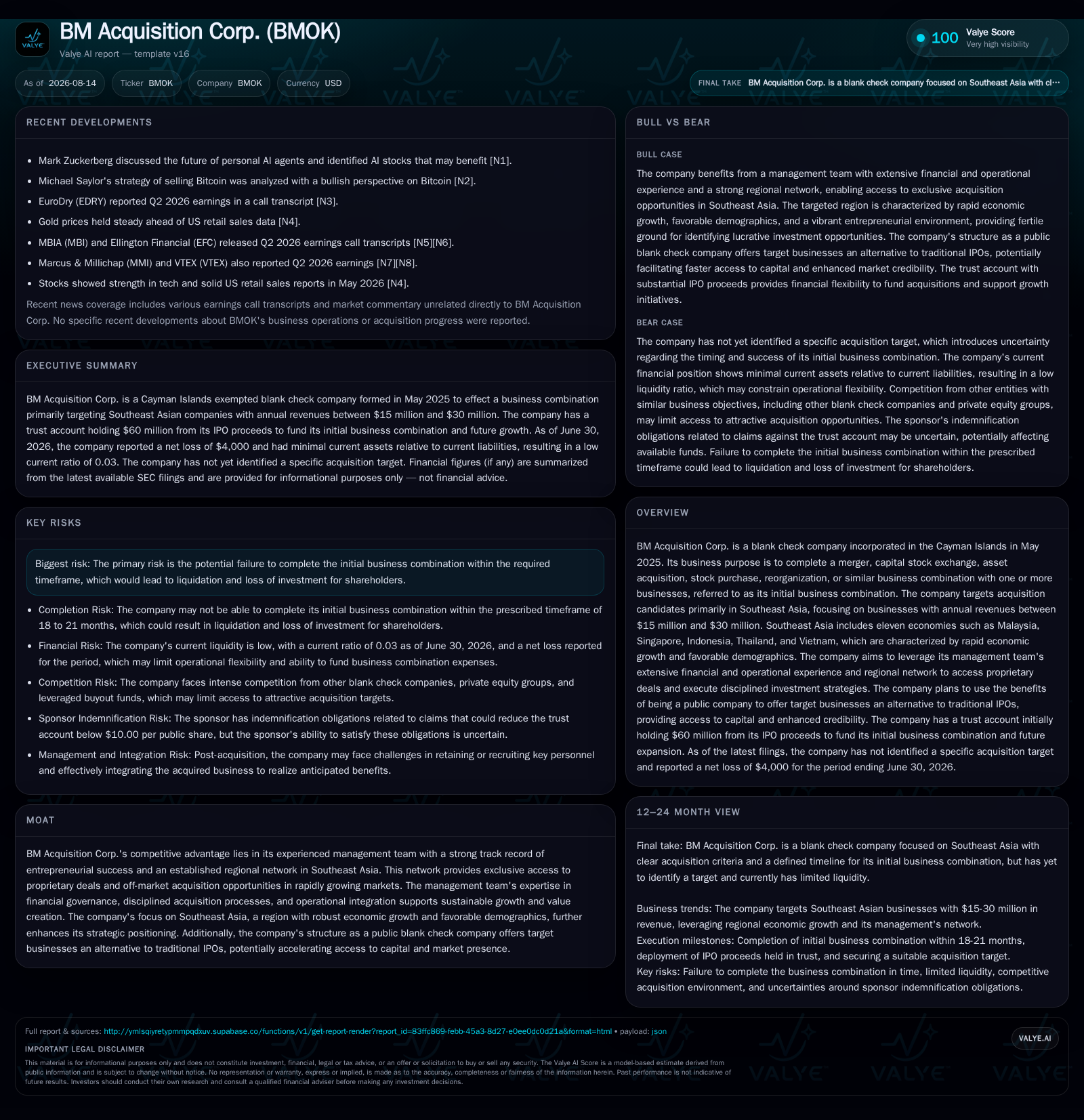
BM Acquisition Corp., a blank check company incorporated in 2025, focuses on acquiring mid-sized companies in Southeast Asia with revenues between $15 million and $30 million. Its latest quarterly filing reveals severe liquidity constraints with zero cash on hand and outstanding debt, underscoring the pressing challenge of completing an initial business combination within an 18-month deadline. The company leverages an experienced management team and regional network to access proprietary acquisition opportunities, but faces typical SPAC risks including shareholder redemptions, dilution from founder shares, and extension-related fees. The path ahead hinges on accelerating deal execution amid capital pressures, with key milestones including merger agreement announcements, shareholder vote outcomes, and redemption trends.
Latest Quarterly Insights Stress Time and Capital Constraints Post-IPO
BM Acquisition Corp.'s most recent 10-Q filing dated August 14, 2026 [S2] paints a stark picture of its current financial standing amid the active hunt for a business combination. As of June 30, 2026, the company reported zero dollars in cash and cash equivalents contrasted by total debt approximating $752,000 [F1]. This depletion of readily accessible funds intensifies the pressure on BMOK’s management to consummate a transaction swiftly or face liquidation given the finite timeline mandated post-IPO.
The firm has only 18 months from its initial public offering (closing date mid-2025) to finalize its initial business combination but can extend this period by three successive one-month increments capped at 21 months total through payment of $0.033 per public share into the trust account by shareholders [S1]. These extension fees represent incremental costs that effectively raise the financial hurdle for protracting deal execution and indicate tightening operational runway. This financial backdrop underscores an acute ticking clock scenario common for SPAC vehicles late in their lifecycle where trust account depletion signals both urgency and escalated risk of liquidation if no suitable target is secured.
'Blank Check' Strategy Focuses on Mid-Market Southeast Asia Targets Under Management Expertise Lens
According to the earlier annual filing on March 16, 2026 [S1], BM Acquisition Corp.'s strategic focus centers explicitly on businesses in Southeast Asia generating annual revenues between $15 million and $30 million — a sweet spot chosen for optimal scalability within emerging-market conditions favorable to efficient IPO transitions or alternative public listings post-business combination. Southeast Asia’s eleven economies including Malaysia, Singapore, Indonesia, Thailand, and Vietnam present rapidly growing consumer bases paired with burgeoning entrepreneurial ecosystems that offer fertile ground for mid-market acquisitions.
This deliberate targeting diverges from mass-scale SPAC approaches pursuing larger or more general targets subject to higher valuation volatility or competitive bidding dynamics. BMOK’s management team emphasizes its extensive operational experience coupled with an established regional network as essential competitive advantages enabling access to proprietary off-market deals often out of reach for less connected sponsors. This management pedigree coupled with regional insight is strategically pivotal given the complex nature of cross-border acquisitions in emerging economies where relationship-building heavily influences deal origination quality.
'Trust Account' Dynamics and Sponsor Incentives Underpin Deal Execution Outlook
The capital structure detailed in BMOK’s IPO underwriting exhibits classic founder-share economics wherein initial insiders acquired approximately 1.7 million founder shares at nominal prices near $0.014 each [S1]. While founder shares deliver substantial profit potential upon successful deal completion due to low entry cost relative to market/share pricing post-de-SPAC transaction, they inherently create dilution concerns for public investors who purchase units at significantly higher prices (typically $10/unit). Such dilution phenomena are common among SPACs but amplify alignment tensions between sponsor incentives seeking lucrative upside even if post-merger valuations soften versus public shareholders prioritizing value preservation.
In addition to founder shares, BMOK issued private units priced at $10 concurrently with its IPO comprised of Class A ordinary shares plus warrants exercisable under predetermined terms [S1]. Warrants add leverage to sponsors’ potential returns while also complicating capitalization tables impacting shareholder equity proportions over time.
The proceeds from the IPO were placed into a trust account intended to be used solely for acquisition purposes or returned if no business combination is consummated [S1]. However, as shown in the latest quarter's financial snapshot, cash resources stand depleted [F1], suggesting either operational expenses or pre-transaction costs have consumed much of these funds outside strict acquisition financing—a factor stressing management’s imperative to finalize deals imminently before trust funds are exhausted entirely.
'Competitive Positioning' Among Emerging Market SPAC Peers Highlights Strategic Network Advantage
Though disclosed competitor data is scant within filings specifically naming peer SPACs targeting Southeast Asia mid-market segments, industry comparative logic positions BMOK alongside a distinct subset of blank check companies leveraging localized expertise rather than broad global capital chases. Many contemporaneous SPACs focus geographically on U.S.-based targets or larger enterprise sizes exceeding hundreds of millions in revenue, limiting their relevance to highly entrepreneurial emerging market opportunities that require nuanced local knowledge.
BMOK’s emphasis on proprietary sourcing via regional networks differentiates its value proposition through sourcing exclusivity and tailored integration playbooks aligned with cultural and economic realities unique to Southeast Asian firms. Such strategic positioning is critical when dealing with fragmented mid-market companies where competition from traditional PE or IPO candidates can be limited given regulatory environments supporting novel capital-raising alternatives like SPAC de-SPAC mechanisms.
'Growth Catalysts' Rooted in Regional Economic Expansion and Investor Appetite for Alternative Listings
Southeast Asia stands out as one of the world’s fastest-growing regions economically supported by robust demographic trends including a youthful workforce expanding middle class and increasing digital adoption rates—all creating accelerating consumer demand supportive of scalable mid-market companies [S1]. BMOK’s stated intent to capitalize on these tailwinds aligns well with broader investor enthusiasm toward alternative public entry routes fueled by greater speed compared to traditional IPOs.
Investor appetite remains strong toward growth vehicles offering exposure to emerging markets via structured instruments like SPACs that mitigate some traditional IPO uncertainties such as volatile pricing windows or opaque valuations. This demand dynamic enhances BMOK’s prospects insofar as effective execution turns its pipeline into tangible acquisition agreements fueling credible momentum toward de-SPAC milestones.
'Execution Risks' Center on Redemption Rights, Extensions, and Sponsor-Public Shareholder Alignment
The inherent risks tied to BMOK’s strategy largely mirror those pervasive across the SPAC sector but bear heightened importance given liquidity stresses evidenced by near-zero cash balances juxtaposed against fixed operational costs and outstanding debt obligations [F1][S2]. Key vulnerabilities include failure to complete an initial business combination within prescribed deadlines triggering mandatory liquidation—a liability compounded by shareholder redemption rights allowing investors unfavorable toward proposed transactions to reclaim capital prior to deal closure.
Redemptions can materially reduce available acquisition capital forcing sponsors either to downscale deal size or seek alternative financing potentially dilutive or unfavorable [S1]. Concurrently, extension fees required for prolonging deal windows impose cash demands amid already constrained resources creating a direct economic penalty for delays exacerbating internal cost pressures.
Dilution from founder shares coupled with potential conflicts of interest due to sponsor economics additionally spotlight governance challenges regarding aligning incentives between insiders motivated by disproportionate gains versus public shareholder protections emphasizing value conservatism. Managing these dynamics transparently will be critical in garnering requisite shareholder approvals necessary for consummating any eventual merger agreement.
'Forward Signals' to Monitor: Business Combination Agreement Announcements, Shareholder Votes, Redemption Trends
Looking forward into BMOK's trajectory over the upcoming months through late 2026 will require close monitoring of several key developments serving as bellwethers for successful execution or distress signals warranting caution. First among these are formal announcements regarding signed merger agreements that would concretely advance the transition from blank check status toward operating entity ownership.
Subsequently, shareholder vote outcomes will reveal investor confidence levels reflecting trust both in management’s target selection acumen and deal terms fairness. Redemption percentages during proxy solicitations will provide important sentiment barometers influencing actual transaction financing capacity.
Lastly, disclosures around use or avoidance of one-month extension options bounded by premium fees will offer insight into execution pacing and management’s confidence in closing deals promptly amid financial constraints outlined previously.
Collectively these metrics will illuminate whether BMOK can convert its theoretically promising strategic positioning into realized investor value within narrowly defined windows imposed by SPAC operating mechanics.
DISCLAIMERS: This analysis is based exclusively on publicly filed SEC disclosures dated through August 14, 2026 [S1][S2] supplemented by contemporaneous fact patterns from domain knowledge applicable to special purpose acquisition companies (SPACs). No forward-looking guarantees or investment research views are made herein.
Disclaimer: This is research-only, informational analysis and not investment advice. It may include AI-generated interpretation and general industry context. Always verify important details using primary sources.

Comments