
Cantor Fitzgerald Income Trust Advances Portfolio Optimization with Selective Dispositions and Capital Raises
Recent quarterly reports reveal CFIT's strategic asset management, capital structure shifts, and distribution policy updates shaping its income-focused REIT profile.
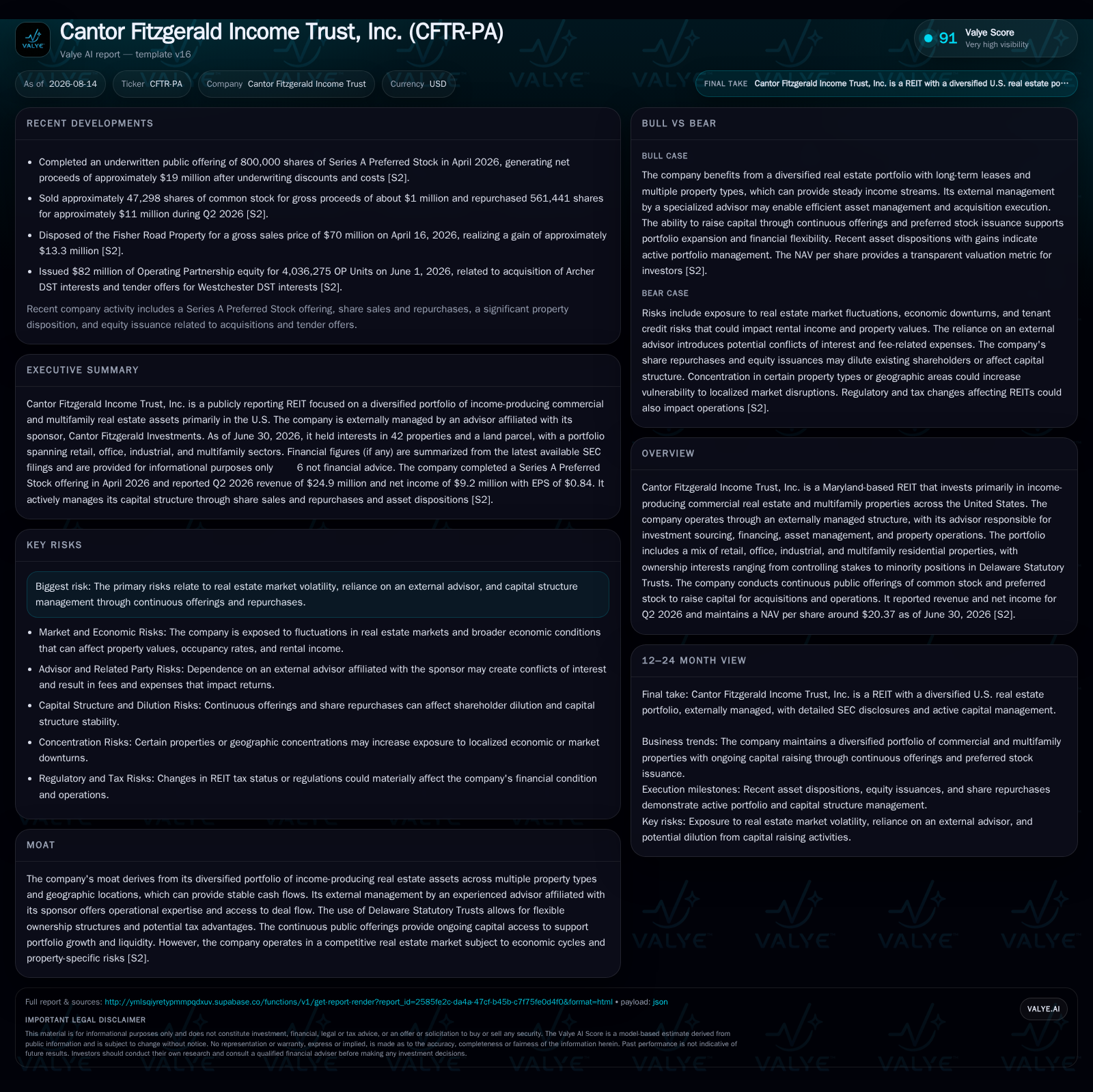
Cantor Fitzgerald Income Trust, Inc. (CFTR-PA) reported continued execution of its externally managed commercial and multifamily real estate investment strategy in Q2 2026. The company completed a $20 million preferred stock offering and disposed of a major asset with gains, reflecting active portfolio rebalancing. It maintains a diversified multi-property portfolio through direct and Delaware Statutory Trust interests, funded by continuous public offerings and moderate leverage. Distributions have transitioned to a NAV-based payout, aligning with capital preservation amid ongoing market uncertainties. External management supports deal sourcing and operations, while liquidity hinges on ongoing offerings and financing availability [S2][S3][S16].
Recent Operating Update
Cantor Fitzgerald Income Trust, Inc. (CFTR-PA) disclosed in its Q2 2026 10-Q a series of material developments underscoring its ongoing portfolio management and capital strategy execution. Notably, during Q2 the company sold approximately $1 million worth of common stock yet repurchased shares amounting to roughly $11 million under its continuous offerings program [S22]. This net share repurchase activity indicates management's dual focus on providing liquidity while managing dilution and supporting share price stability.
Capital deployment was further supported by an underwritten public offering completed in April of $20 million gross preference stock proceeds [S22], enabling flexible funding avenues amid tight market conditions. The company also executed a significant non-core asset disposition by selling the Fisher Road property for $70 million, realizing an estimated $13.3 million gain [S22], illustrating active repositioning towards higher-yielding or strategic assets.
These transactions came alongside issuance of operating partnership units tied to Delaware Statutory Trust (DST) interests acquisition or exchanges totaling over $82 million equity placements during the first half of 2026 through June 30 [S22]. Such structures provide tax-efficient fractional ownership and diversification across property types while allowing Cantor Fitzgerald Income Trust to maintain controlling or significant stakes in key multifamily residential assets.
Business Model Overview
As an externally managed Maryland REIT specializing in commercial real estate and multifamily properties nationwide, CFIT's revenue model centers on rental income derived from leases on owned properties and income distributions from DST investments [S1][S4]. Revenue generation is augmented through opportunistic acquisitions funded via continuous public offerings — both common and preferred equity — supplemented by conventional financing facilities capped within charter-defined leverage limits
Continuous public offerings facilitate steady capital inflows essential for portfolio growth yet introduce potential dilution risks that the company seeks to mitigate via opportunistic share repurchases as observed recently. The externally managed advisor firm plays a pivotal role in sourcing deals, managing assets including leasing and operations oversight, negotiating financing arrangements, and nurturing tenant relationships that ultimately drive occupancy rates and lease renewal metrics critical to stable cash flow generation [S15]. Given this structure, revenue growth depends heavily on the advisor’s ability to judiciously deploy capital into accretive assets while controlling operating expenses reimbursed to the advisor under capped contractual terms.
Industry Structure and Competitive Position
Cantor Fitzgerald Income Trust operates within the broad sector of equity REITs focusing on income-producing real estate assets. Its diversified property mix—combining retail net lease properties with office, industrial, multifamily residential holdings spread across multiple geographies—and deployment via DST interests distinguish its portfolio from more specialized peers such as Prologis (industrial-focused) or AvalonBay Communities (pure multifamily).
Externally managed REITs like CFIT typically carry higher operating expense ratios relative to internally managed peers due to fees payable to advisory firms but benefit from access to seasoned deal teams without incremental headcount costs. The use of Delaware Statutory Trusts is a strategic tool commonly employed in this sub-sector for added flexibility in ownership structuring, tax advantages, and selling smaller fractional interests which widen investor reach.
Leverage at approximately 50% debt-to-tangible assets aligns modestly below many larger diversified peers who often run toward 60%-70% leverage but reflects balancing growth ambitions with financial prudence amid present interest rate uncertainties [S4]. Ongoing portfolio dispositions signal responsiveness to market cycles and commitment to optimizing returns while maintaining capital recycling capacity.
Growth Drivers
Four main vectors underpin CFIT’s growth thesis: expanding demand for income-generating commercial/multifamily real estate driven by robust leasing fundamentals; continual access to equity capital via structured common/preferred stock offerings; external manager’s deal sourcing agility; and disciplined balance sheet management maintaining borrowing capacity.
The recent preferred offering coupled with active OP unit issuances tied to DST acquisitions reflect focused capital deployment into stabilized assets expected to generate steady rental streams. Strategic divestitures like Fisher Road crystallize gains which can be redeployed into potentially higher returning opportunities or used for debt reduction enhancing financial flexibility.
Transitioning distributions from fixed dollar amounts per share to percentage-of-NAV aligns payouts more closely with intrinsic value fluctuations preserving distributable cash over time—a prudent approach amidst volatile macroeconomic factors affecting rents or occupancy rates.
Incremental investments in infrastructure-related real estate funds plus controlling interests in multifamily DSTs hint at selective diversification into resilient sectors benefiting from secular demand trends such as data center expansion or affordable housing.
Risks and Watchpoints
Dependency on external advisors introduces operational risks tied to personnel retention, alignment of incentives, and effective cost controls given fee-based expense reimbursements capped but still material [S1][S15]. Slowdown or inability in raising capital through continuous offerings could constrain acquisition activity thereby reducing portfolio diversification benefits.
Tenant renewals at lower rents or increased vacancy rates could undermine rental income predictability impacting distributions. Moreover, share repurchase programs operate under liquidity constraints given illiquid underlying assets; sudden suspension or limitations may affect shareholder confidence.
Regulatory compliance including maintaining REIT status is continuously monitored; any failure would materially affect taxation status and distribution requirements leading to adverse shareholder impacts [S1][S20].
What To Watch Next
Upcoming milestones include tracking new offering proceeds figures which directly fuel acquisition momentum; monitoring disposition activity signaling tactical shifts; quarterly operating metrics such as occupancy rates or same-property NOI changes reflective of internal portfolio health; evolving distribution declarations post-transition to NAV-based payouts; debt maturity profiles including usage of extension options on credit facilities; advisor’s continuing underwriting performance evidenced by new deals closed; and any adjustments in share repurchase program terms driven by market conditions.
Investors should focus on liquidity indicators including free cash flow generation against declared distributions plus evolving general & administrative expense trends reflecting corporate cost controls amid external management fees [S9][S21]. A sustained ability to execute equity raises while deploying proceeds accretively will serve as a key barometer for long-term NAV growth potential.
Financial Profile Discussion
As of June 30, 2026, Cantor Fitzgerald Income Trust reported total debt approximating $573 million and net debt near $550 million, reflecting a debt-to-assets ratio just below 50%, signaling conservative leverage within offering-stage expectations aimed at approximate 60% ceiling post-deployment [F1][S4]. Cash and equivalents stood at roughly $23.5 million as of March quarter-end supporting operational liquidity buffers [F1].
Financing activities showed net cash outflow exceeding $71 million during the first half of 2026, driven by higher equity proceeds raised offset against substantial term loan paydowns under credit facilities—a net deleveraging signal enhancing balance sheet resilience despite ongoing acquisition commitments through OP units issuance related to DST interests exchange programs [S2]
Overall financial positioning combines moderate leverage with active capital recycling supported by continuous public equity raises buttressed by disciplined expenditure oversight reflective of an externally managed REIT navigating competitive real estate markets.
Disclaimer: This analysis is for informational purposes only and does not constitute investment advice nor an offer or solicitation.
Disclaimer: This is research-only, informational analysis and not investment advice. It may include AI-generated interpretation and general industry context. Always verify important details using primary sources.

Comments