
Collective Acquisition Corp. II Advances SPAC Execution Amid Trust Capital Retention and Trading Transition
The SPAC maintains robust capital reserves post-IPO while enabling distinct trading of its units and warrants, positioning for potential business combination.
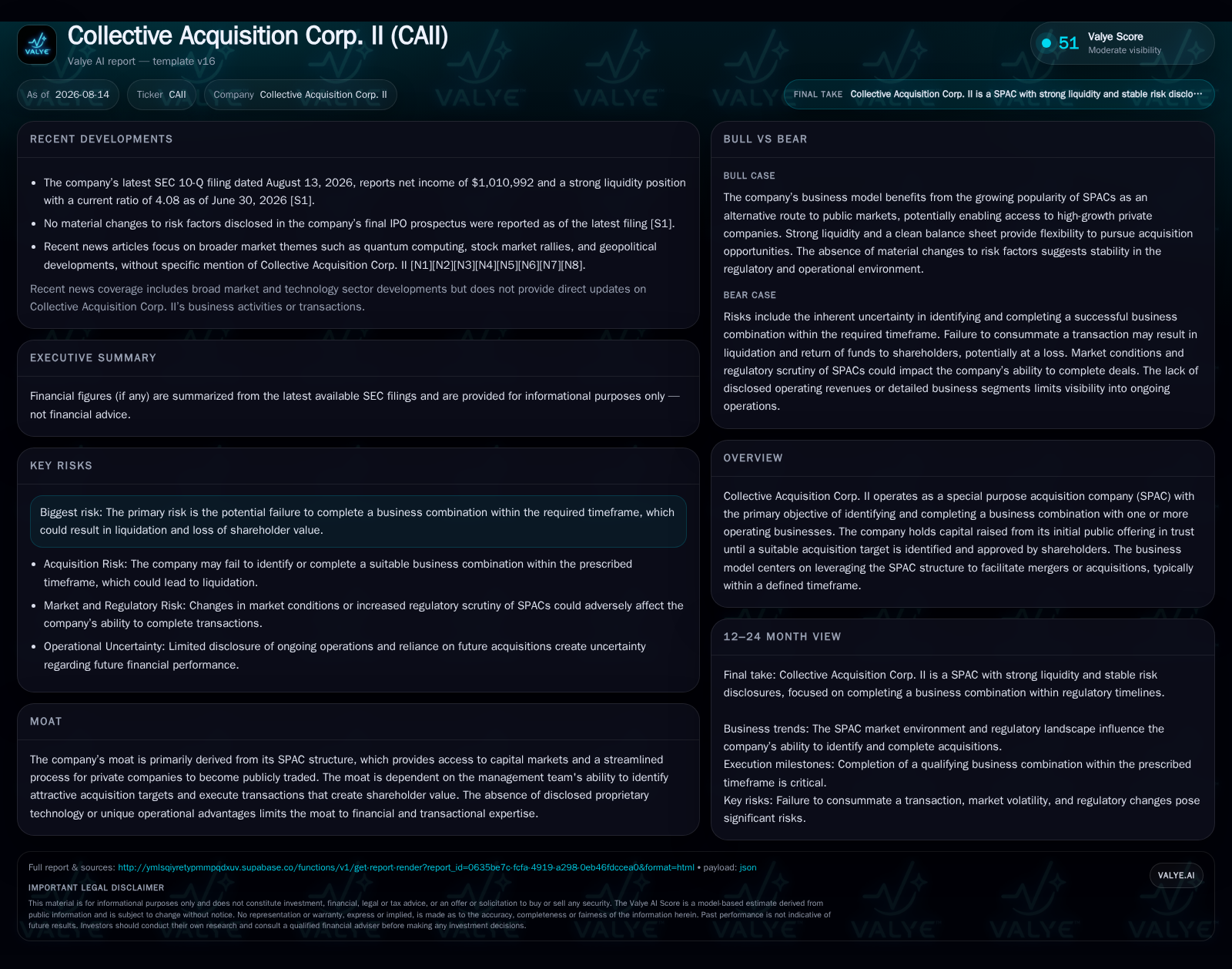
Collective Acquisition Corp. II (CAII) operates as a special purpose acquisition company with a $254 million trust account raised from its IPO and private placements. Recent developments include the separate trading commencement of Class A ordinary shares and warrants, providing enhanced liquidity options for investors. With a current ratio exceeding 4x and minimal debt, CAII retains strong financial flexibility as it searches for acquisition targets within its mandated timeframe. The company faces typical SPAC risks related to completing a business combination before liquidation deadlines, relying heavily on management expertise and market conditions to deliver shareholder value.
Recent Operating Update and Capital Status
Collective Acquisition Corp. II (CAII) recently filed its quarterly report on August 13, 2026, confirming continuity in risk exposures consistent with its IPO prospectus, with no new significant risks emerging [S2]. More notably, on June 17, 2026, CAII disclosed the initiation of separate trading for its Class A ordinary shares and warrants under ticker symbols "CAII" and "CAIIW," respectively, diverging from the previously bundled units ("CAIIU") structure [S3]. This move typically aims to enhance liquidity by allowing investors to monetize or hedge one instrument without affecting the other.
Financially, CAII holds approximately $254.3 million in its trust account following proceeds from the IPO and concurrent private placements [S3], a critical element ensuring investor protection by segregating acquisition capital until deployment. As of June 30, 2026, current assets stand near $1.01 million against current liabilities of about $247,000 for a strong current ratio of 4.08 — signaling comfortable short-term liquidity even during pre-merger operating expenses [F1]. Total debt is minimal at around $61,653 recorded as of March-end 2026 [F1], underscoring an unleveraged balance sheet common among SPACs pre-acquisition.
Operating losses are contained at $370,280 for the period ending June 2026 due to administrative costs inherent in maintaining the SPAC entity before a de-SPAC transaction; meanwhile net income shows a modest positive figure primarily driven by non-operational factors such as interest income or changes in warrant valuation [F1]. Such a financial profile aligns with typical SPACs during their pre-combination phase where operational revenue streams do not exist.
Business Model Explained
As a pure SPAC vehicle incorporated in the Cayman Islands but traded on Nasdaq, CAII’s model centers on raising capital through an initial public offering combined with private placements aimed at funding one or more acquisitions or mergers — collectively referred to as "business combinations." Upon raising funds upfront — placed in an independently managed trust account — the company embarks on identifying suitable private operating companies to bring public through merger rather than conventional IPO channels.
Investors purchase units consisting of Class A ordinary shares coupled with partial warrant rights exercisable at a set strike price ($11.50 per share as disclosed) post-de-SPAC transaction. These warrants incentivize long-term participation but also introduce dilution risk when exercised. Shareholders retain redemption rights before a business combination approval vote should they disagree with proposed acquisitions or find market conditions unfavorable.
Revenue generation only materializes post-merger through transaction fees payable by target companies and potential equity appreciation if the combined entity performs well publicly. Currently, CAII incurs expenses typical of blank-check companies: legal compliance costs, administrative overheads, and trustee fees—all placing downward pressure on net results in advance of any acquisition success.
Industry Structure and Competitive Position
Within the broader SPAC ecosystem—comprised of entities like Pershing Square Tontine Holdings (PSTH) or Social Capital Hedosophia Holdings—CAII operates as a capital gateway without proprietary assets or operational advantages beyond management’s industry relationships and deal sourcing capabilities. This intermediary role situates it between institutional/private equity investors seeking public market access and high-potential private companies looking to avoid traditional IPO rigors.
SPAC sponsors compete fiercely on access to promising targets given compressed timelines (often 18-24 months), requiring agility in deal negotiation combined with credible execution experience. While CAII has not publicly announced any merger targets yet nor completed any transactions—common for newly formed SPACs—the ability to leverage favorable market conditions and maintain shareholder confidence through transparent governance will be decisive relative advantages.
Unlike traditional underwriters facilitating standard IPOs who rely heavily on distribution capabilities and underwriting spreads, CAII’s revenue hinges on successful execution of business combinations backed by trust-account capital reserves large enough to fund meaningful deals without excessive reliance on PIPE financing (private investment in public equity).
Growth Drivers
Demand for alternate listing routes persists among private companies pressured by traditional IPO complexities like lengthy registration processes or volatile aftermarket pricing. The SPAC model offers streamlined public access mediated by vehicles such as CAII that can act swiftly given adequate deal flow pipelines supported by sponsor networks.
Recent regulatory clarification around SPAC disclosures has improved transparency somewhat relative to historical scrutiny episodes. When combined with improving capital market stability encouraging speculative growth investments, these factors create an environment conducive for well-positioned SPAC sponsors.
Moreover, innovations in concurrent PIPE financing arrangements provide complementary liquidity options that can enable larger or more ambitious deals beyond solely trust account funds—expanding feasible transaction sizes conducive to higher-profile acquisitions.
Risks and Constraints
Despite structural opportunities, CAII faces principal risks endemic to the SPAC space: failure to consummate a deal within prescribed timelines triggers mandatory liquidation resulting in return of trust funds minus expenses—essentially wiping out sponsor participation upside while limiting investor gains [S2].
Shareholder redemption patterns pose second-order threats by shrinking available deal capital if many elect out prior to combination votes; this can force renegotiation on target terms or reduce negotiating leverage.
Additionally, dilution arising from warrant exercises and sponsor promote structures potentially depresses post-merger earnings per share negatively impacting long-term value creation for some investors. Regulatory attention continues adapting rules around these elements which could further alter economic structures temporarily.
Finally, limited operating history means heavy dependence on management acumen for target vetting execution discipline introduces uncertainty versus established private equity peers who control portfolio operations directly.
What To Watch Next
The immediate focus lies on progress toward identifying merger candidates aligned with shareholder interests and maintaining trust account integrity sufficient to support such transactions. Key upcoming milestones include declarations of intent regarding specific acquisition targets accompanied by robust disclosures outlining strategic rationales.
Monitoring redemption trends—both announced elections prior to votes and after-trade behavior—is central to forecasting effective deal sizes. Similarly important is observing warrant exercise activity which influences underlying share counts post-combination.
Any formal announcements around negotiated merger agreements will come with shareholder vote preparations; regulatory filings will reveal transaction fees recognized during execution phases further illuminating potential sponsor economics scenarios.
Market sentiment toward newly separated trading of shares versus warrants may also provide clues about investor appetite nuances ahead of transactional developments.
Financial Profile Discussion
CAII’s latest financial snapshot reveals conservative balance sheet management consistent with industry norms emphasizing preservation of capital prior to deal-making stages.[F1] Holding over $254 million in trust protects principal against operational volatility while enabling readiness for prospective business combinations.[S3] Current liabilities remain modest compared with liquid assets yielding a current ratio above four times indicating ample working capital buffer.[F1]
Total debt is minimal at roughly $61,653 as documented last quarter,[F1] reflective mainly of normal accruals rather than leveraged positions—conforming again with typical SPAC profiles positioned strictly as capital conduits rather than operating entities incurring substantial borrowings.[F1]
Operating losses approximate $370k driven largely by general & administrative expenses incurred before de-SPAC transaction completion.[F1] However reported net income turns positive due mostly to nonoperational gains such as interest income earned on trust account balances.[F1] This underlines that without substantial deal-related revenues until merger closing, profitability metrics remain secondary indicators focusing more on expense control than growth trends initially.
In sum, financial data corroborates CAII’s prudent fiscal posture aimed at maximizing flexibility while minimizing risk case pending forthcoming acquisition activity.
Disclaimer: This is research-only, informational analysis and not investment advice. It may include AI-generated interpretation and general industry context. Always verify important details using primary sources.

Comments