
PALOMA ACQUISITION CORP I’s SPAC Trust Account Strength and De-SPAC Prospects in Q2 2026
As a newly listed SPAC, PALOMA ACQUISITION CORP I holds substantial trust account assets and has reported net income from interest in Q2 without operational revenues, highlighting its early-stage capital role ahead of a business combination.
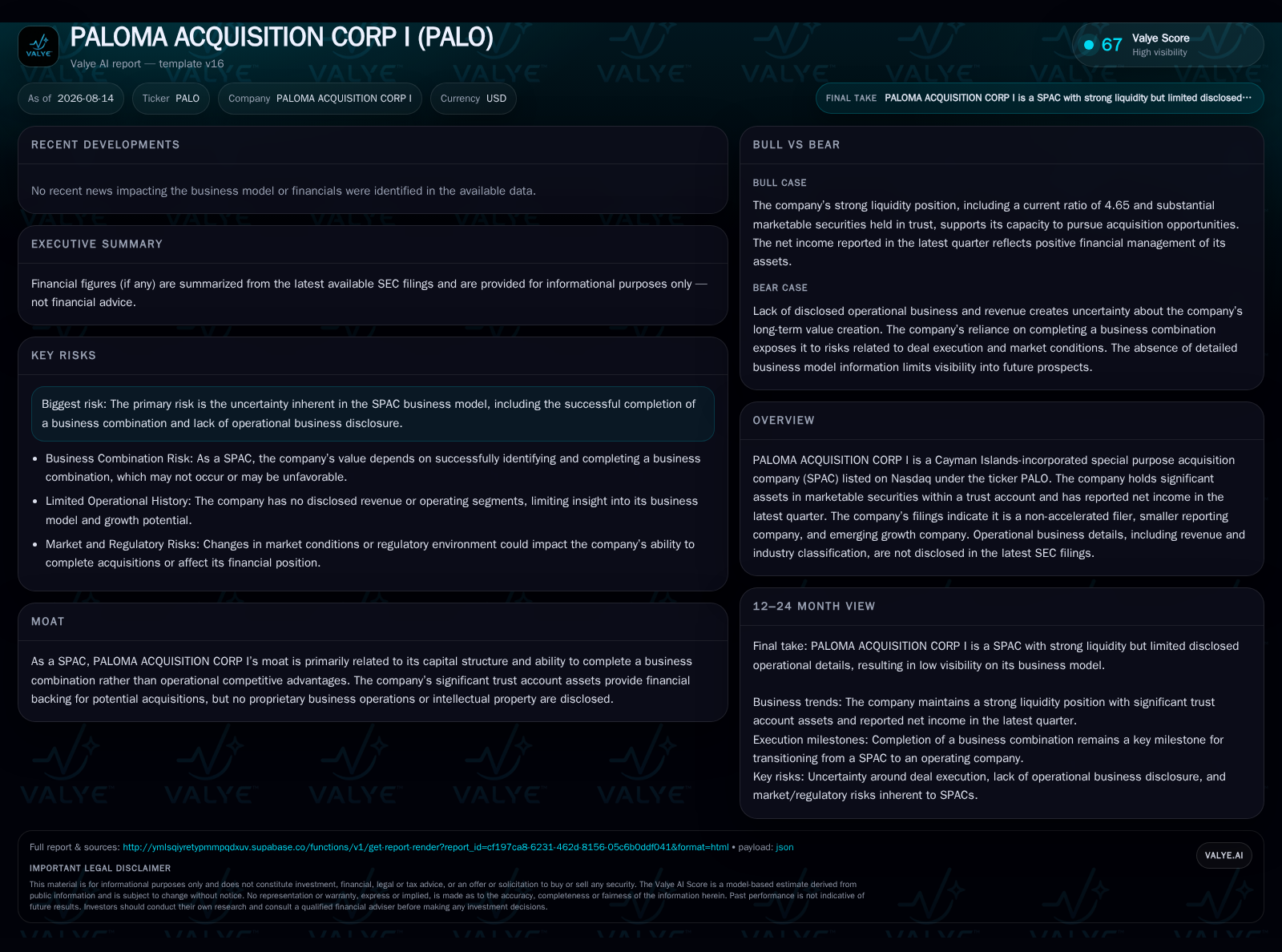
PALOMA ACQUISITION CORP I is a Cayman Islands-incorporated special purpose acquisition company (SPAC) formed for completing a business combination within a 24-month timeframe post-IPO. The latest quarterly filing as of June 30, 2026 confirms the company’s financial position characterized by a robust trust account primarily invested in money market funds and Treasury securities, generating positive net income through interest income. Operating losses reflect offering costs, consistent with the SPAC business model that lacks commercial operations prior to merger. Key operating metrics such as trust account balance, working capital loans, and offering costs underpin the company’s readiness for acquiring or merging with a private target, while redemption rights and warrant dilution remain potential risks to shareholders. The company’s ability to leverage sponsor-backed working capital loans and manage offering expenses relative to peers will be critical in navigating the path to a successful de-SPAC transaction.
Recent Operating Update: Trust Account Stability and Income Generation
Paloma Acquisition Corp I’s latest quarterly filing dated August 13, 2026 [S2] provides a window into its early operational phase as a newly formed SPAC since incorporation in August 2025. The company successfully raised gross proceeds of approximately $150 million through its February 2026 initial public offering (IPO), placing funds predominantly into a trust account invested almost entirely in conservative money market funds backed by U.S. Treasury securities as of June 30, 2026 [S14][F1]. This structure aligns with standard SPAC practices designed to protect public shareholders by segregating IPO proceeds until an initial business combination is executed or liquidation is triggered.
Operating results for Q2 reflect an operating loss near $260,000 attributed primarily to offering related costs including professional fees—which is typical for SPACs without commercial operations pre-merger [F1]. However, the company reports net income of roughly $1.25 million driven by interest income on trust assets held in low-risk instruments [F1]. This pattern—operating expenses without operational revenues but offsetting investment income—is consistent with the SPAC archetype where earnings predominantly come from financial asset yields rather than commercial activities.
Business Model: Capital Vehicle Structured Around Business Combination Execution
Unlike traditional operating companies, Paloma Acquisition Corp I functions solely as a blank-check entity. It monetizes capital raised via IPO units (comprising one Class A ordinary share and half a redeemable warrant) whose funds remain frozen in the trust account until an approved merger or acquisition occurs [S2]. Revenue streams are limited essentially to interest earned on these invested funds before any deal closure.
Sponsor participation is critical: founder shares represent approximately 20% post-IPO equity after adjustments linked to underwriters’ over-allotment option exercises [S2]. This ownership stake incentivizes sponsors but introduces dilution risk alongside public warrants exercisable at $11.50 per share post-combination—warrants valued using complex fair value measurements given their contingent nature [S8]. Working capital loans potentially totaling $1.5 million from sponsors or affiliates provide vital liquidity buffers for transactional expenses that exceed interest releases from trust assets. These loans convert into private placement units on deal completion or must be repaid from non-trust resources if the de-SPAC fails [S5][S15].
Prior to completing an initial business combination within the mandated two-year Completion Window following IPO closing, the company does not generate operating revenue nor engage in commercial activity [S2]. The timing pressure imposed by this window compounds importance on sponsor diligence and negotiating attractive merger terms.
Industry Structure & Competitive Position: A Typical Newcomer Among Nascent SPACs
As a Cayman Islands-incorporated emerging growth company listed on Nasdaq under ticker PALO[S9], Paloma Acquisition Corp I fits squarely within the SPAC industry segment characterized by companies raising IPO capital with no operating history. Peers like Churchill Capital Corp or Pershing Square Tontine Holdings similarly hold deposits in regulated trust accounts while scouting private targets.
Paloma's trust account size at roughly $165 million as of Q1/Q2 positions it well for mid-sized acquisitions relative to other SPACs launching deals at comparable scales[S22]. Management’s conservative investment approach minimizes potential erosion of liquidation value—a critical consideration for shareholder confidence amid uncertain merger outcomes.
Offering cost management appears disciplined relative to peer averages given operating losses under $300k quarterly despite ongoing professional service retention requirements[S15], which bodes well versus peers experiencing outsized expenses eroding cash before deal closure.
Growth Drivers: Capital Market Dynamics & Sponsor Incentive Alignment
Primary drivers enabling Paloma Acquisition Corp I’s growth hinge upon identifying promising private enterprises seeking efficient public market entry alternatives versus traditional IPOs—especially amid volatile equity markets favoring alternative listing paths. The availability of sizeable PIPE (Private Investment in Public Equity) financing post-announcement further supports valuation robustness.
Sponsor expertise and capital backing accelerate deal sourcing and execution capabilities, while shareholder confidence rests on maintaining close-to-trust valuation per share ahead of any redemption activities minimizing adverse liquidity impacts.
The short time horizon imposed by regulatory mandates compels focus on execution efficiency—making milestone tracking such as number of potential target companies evaluated and redemption rate thresholds imperative measures for investor sentiment monitoring.
Risks & Watchpoints: Redemption Risk, Dilution Concerns & Execution Uncertainty
Foremost among risks is failure to consummate any qualifying business combination within the prescribed Completion Window resulting in mandatory liquidation at near-trust-account values that may be less than original investment due to accrued taxes or unforeseen liabilities [S2][S17]
Redemption rights enable public investors reluctant about specific deals or sponsor credentials to exit at pro rata trust values—introducing financial uncertainty regarding cash outflows impacting merger structuring. Warrants pose additional dilution risk dampening post-merger equity economics if widely exercised.
Sponsor indemnification obligations concerning claims related to the initial public offering represent contingent liabilities with unclear enforceability given the Sponsor’s limited asset base outside founder shares[S17]. Furthermore, reliance on working capital loans for funding transaction costs creates cash flow dependency portfolios requiring scrutiny.
Market conditions influencing availability and pricing of PIPE funding alongside competition among emerging SPACs heighten execution risk dynamics affecting timing and valuations achievable.
What To Watch Next: Milestones & Financial Markers Indicating Progress Toward De-SPAC Completion
Monitoring Paloma Acquisition Corp I’s filings for disclosures around LOIs (letters of intent), definitive agreements pertaining to target businesses (if any emerge), updates on redemptions submitted prior shareholder votes related to proposed combinations, and any drawdowns or conversions against working capital loans will provide directional cues.
Interest income trends relative to treasury yield environment shifts also indirectly reflect trust account health while changes in fair value accounting for warrants reveal evolving market expectations regarding de-SPAC likelihood.
Management guidance (if issued) on expected timetable extensions or amendments thereto should also serve as meaningful checkpoints.
Disclaimer: This is research-only, informational analysis and not investment advice. It may include AI-generated interpretation and general industry context. Always verify important details using primary sources.

Comments