
Mangoceuticals Wrestles with Regulatory Risks and Liquidity Amid Product Expansion
The company’s latest quarter highlights critical Nasdaq compliance challenges, regulatory scrutiny on its compounding models, and a cash-constrained operating environment.
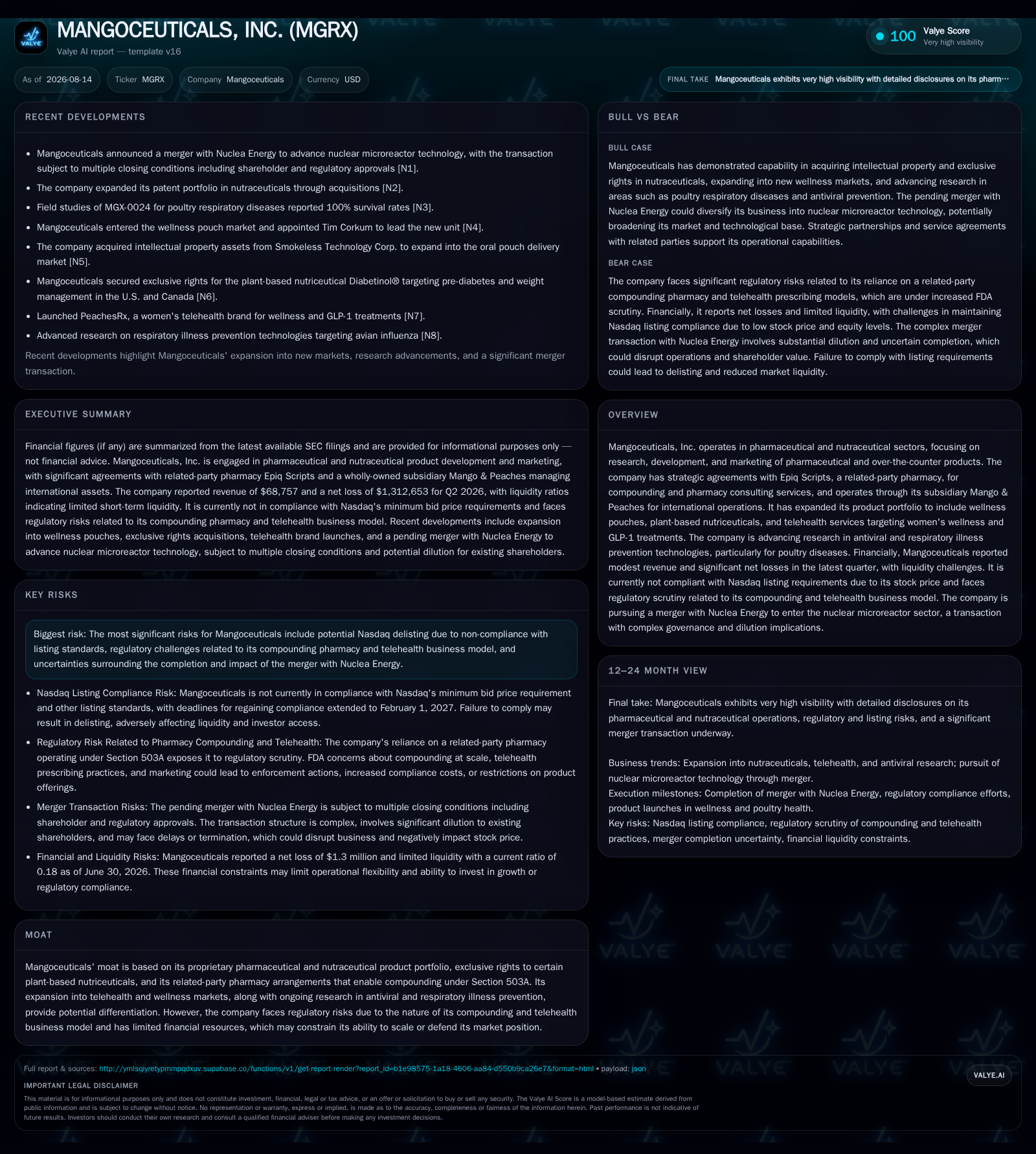
Mangoceuticals, Inc. (MGRX) operates at the intersection of pharmaceuticals and nutraceuticals with a distinctive reliance on a related-party compounding pharmacy under Section 503A exemptions. Its recent expansion into plant-based supplements and telehealth-enabled wellness services adds growth avenues but compounds regulatory exposure amid increased FDA scrutiny. The latest quarterly filing reveals ongoing non-compliance with Nasdaq listing standards and liquidity strains, spotlighting risks that could hamper operational scale or necessitate strategic alternatives. Key growth drivers include product portfolio broadening and telehealth integration, while key risks center on regulatory compliance, related-party transactions, and financial sustainability.
Recent Operating Update
Mangoceuticals’ most recent quarter filing dated August 13, 2026 ([S2]) reaffirms the company’s precarious standing with Nasdaq due to a sustained stock price below the $1.00 minimum bid requirement. The firm was originally notified of this deficiency in February 2026 and granted an initial six-month cure period which expired August 3, 2026. However, Nasdaq has extended this deadline by an additional six months through February 1, 2027 ([S2]). This extension reflects some amelioration in other listing requirements but underscores pressing pressure to reverse share performance or face delisting. This situation materially affects the company’s ability to attract capital and maintain investor confidence.
Business Model Overview
Mangoceuticals operates primarily in pharmaceutical formulation and nutraceutical product segments with a distinct strategic reliance on compounding pharmacy services conducted through Epiq Scripts LLC—a related party majority-owned by the company’s CEO ([S1]). The firm’s revenue model aggregates direct sales from proprietary pharmaceutical products (including over-the-counter compounds), nutraceutical supplements emphasizing plant-based ingredients, wellness pouches targeting lifestyle consumers, and telehealth-enabled service offerings focusing on women’s health and GLP-1 weight management treatments ([S1], [N1]).
Critical to revenue mechanics is the use of Section 503A exemptions of the Federal Food Drug & Cosmetic Act that allow pharmacies like Epiq Scripts to compound drugs based on patient-specific prescriptions without full FDA pre-approval ([S13], [S15]). Mangoceuticals contracts exclusively with Epiq Scripts for all pharmacy compounding functions including packaging and distribution ([S21]). This arrangement facilitates scalability in delivering customized formulations but exposes the company to legal risk if regulators deem it as manufacturing rather than traditional compounding.
Pharmacy consulting services provided by Epiq Scripts supplement this model and support the company’s international expansion efforts through subsidiary Mango & Peaches Corp ([S1]). Telehealth services augment core product sales by enabling remote consultations crucial for prescription fulfillment; however, rising regulatory attention on telemedicine prescribing practices poses business-model continuity risks ([S13], [S15]).
Industry Structure and Competitive Position
Within the pharmaceuticals and nutraceuticals industry space where Mangoceuticals competes—characterized by strict FDA oversight and evolving consumer preferences—the company occupies a midstream niche focused on customized drug compounding coupled with innovative wellness products. Peers in this sector include OTC suppliers like Perrigo for mass-market branded goods; compounding pharmacy networks such as PCCA; telehealth providers like Teladoc Health; and emerging plant-based supplement firms targeting natural health trends.
Mangoceuticals’ value proposition hinges on its intellectual property portfolio of plant-based nutriceuticals combined with exclusive rights to certain formulations delivered via its related-party compounding pharmacy network ([S1]). However, unlike large-scale pharmaceutical manufacturers certified across multiple jurisdictions, Mangoceuticals faces capacity constraints tied to regulatory licensing scope—currently limited to states where Epiq Scripts holds pharmacy licenses—and vulnerability to adverse enforcement actions if compounded drugs are deemed essentially copies of approved medications ([S21]).
Compounded prescription volume is a key operating metric influenced by patient acquisition through telehealth channels and prescribing validity under expanding regulations ([S13]). Customer retention relies heavily on discreet delivery logistics managed by Epiq Scripts alongside consistent product efficacy in wellness categories increasingly crowded by direct-to-consumer plant-based competitors.
Growth Drivers
Mangoceuticals has strategically broadened its product offering beyond traditional pharmaceutical compounds into high-growth adjacent categories like wellness pouches tailored for lifestyle enhancement and plant-based nutriceuticals anchored on consumer demand for natural health solutions ([N1], [S1]). The firm also leverages telehealth-driven prescribing models which target emerging markets such as women’s wellness programs and GLP-1 receptor agonists linked weight management treatments—markets experiencing robust growth due to rising chronic condition prevalence.
Research initiatives into antiviral agents aimed at preventing respiratory illnesses in poultry introduce an R&D avenue potentially differentiating Mangoceuticals from peers predominantly focused on human therapeutics ([N1]). While still early-stage without clear commercial returns yet reported, success here could unlock licensing or proprietary product revenue streams.
Regulatory approvals remain a critical gating factor for launching future pharmaceutical products within Mangoceuticals’ pipeline—a variable demanding vigilant monitoring given FDA scrutiny intensity surrounding compounded drugs functioning as substitutes for approved medications ([S13], [S15]). Moreover, international expansion through Mango & Peaches Corp offers geographic diversification prospects pending regulatory clearance in new markets.
Risks and Growth Constraints
Regulatory risk dominates Mangoceuticals’ risk profile due to its reliance on compounding exemptions under Section 503A. Recent FDA warnings highlight concerns about whether business models employing bulk drug substances without patient-specific prescriptions violate statutory frameworks—threatening to void the exemption and trigger manufacturing-level compliance burdens including expensive clinical trials ([S13], [S15]). Telehealth-related prescribing practices under scrutiny may also undermine legitimacy of prescriptions necessary for compounding security.
Legal exposure from product liability claims is significant given unapproved status of compounded drugs; litigation outcomes could result in costly damages or forced market withdrawals that impair commercial viability ([S18]). Dependence on related-party transactions with Epiq Scripts raises governance flags particularly around indemnification arrangements absent clear protections against product liability costs potentially imposing substantial financial strain ([S21], [S23]).
Liquidity constraints evidenced by minimal cash reserves relative to liabilities limit capacity to fund marketing expansion or large-scale R&D efforts without external capital infusions ([F1], [S7], [S12]). Failure to regain Nasdaq compliance may restrict access to public financing channels altogether ([S2]), amplifying execution risks.
Competitive pressures from entrenched pharmaceutical brands with broader FDA-approved portfolios challenge Mangoceuticals’ ability to scale its brand recognition especially amid shifting consumer perceptions towards validated therapeutics versus compounded products ([S14]). Macro headwinds including inflationary cost pressures further exacerbate operational stress.
What to Watch Next
Key milestones include monitoring the stock price performance relative to Nasdaq minimum bid compliance deadlines set for February 2027; failure here would precipitate delisting risks impacting investor liquidity and capital access ([S2]). Progress updates on regulatory clearances or warning letters from FDA concerning compounded product licensing will materially influence longevity of current pharmacy operations ([S13], [S15]).
Tracking new product launches especially in telehealth-driven wellness segments alongside expansion in international distribution via Mango & Peaches can shed light on customer acquisition effectiveness and portfolio diversification ([N1], [S3]). Early signals from antiviral research outcomes could indicate R&D execution capability.
Financially, quarterly operating results demonstrating revenue traction beyond modest levels or improved liquidity ratios would validate scaling potential amid historic losses ([F1]). Conversely, any announcement of financing difficulties or adverse legal rulings would elevate risk sentiment.
Financial Profile Discussion
Historical performance data within the latest annual reports show material net losses exceeding $20 million further accentuating reliance on equity or debt issuances to finance forthcoming growth initiatives ([F1], [S7], [S12]). Management acknowledges these constraints explicitly noting ongoing needs for capital raises amid competitive industry dynamics impacted by inflationary pressures and rigorous compliance costs ([S7], [S12]). These financial headwinds shape strategic decision making regarding potential asset sales, restructuring events, or mergers such as the announced merger talks with Nuclea Energy which remain uncertain but reflect attempts at corporate repositioning outside core pharmaceuticals operations ([N1]).
Overall liquidity status suggests investors should closely monitor forthcoming financing announcements and Nasdaq compliance updates as immediate determinants of operational continuity.
This analysis synthesizes recently filed SEC documents alongside industry-standard frameworks without investment advice. It aims to contextualize Mangoceuticals’ current business dynamics within its sector environment emphasizing regulatory challenges coupled with financial constraints shaping near-term viability prospects.
Disclaimer: This is research-only, informational analysis and not investment advice. It may include AI-generated interpretation and general industry context. Always verify important details using primary sources.

Comments