
Marblegate Capital Strengthens Taxi Medallion Loan and Fleet Operations Amid Industry Shifts
Latest quarterly filings reveal Marblegate Capital's strategic fleet growth and refined loan portfolio management in a regulated but evolving New York City taxi market.
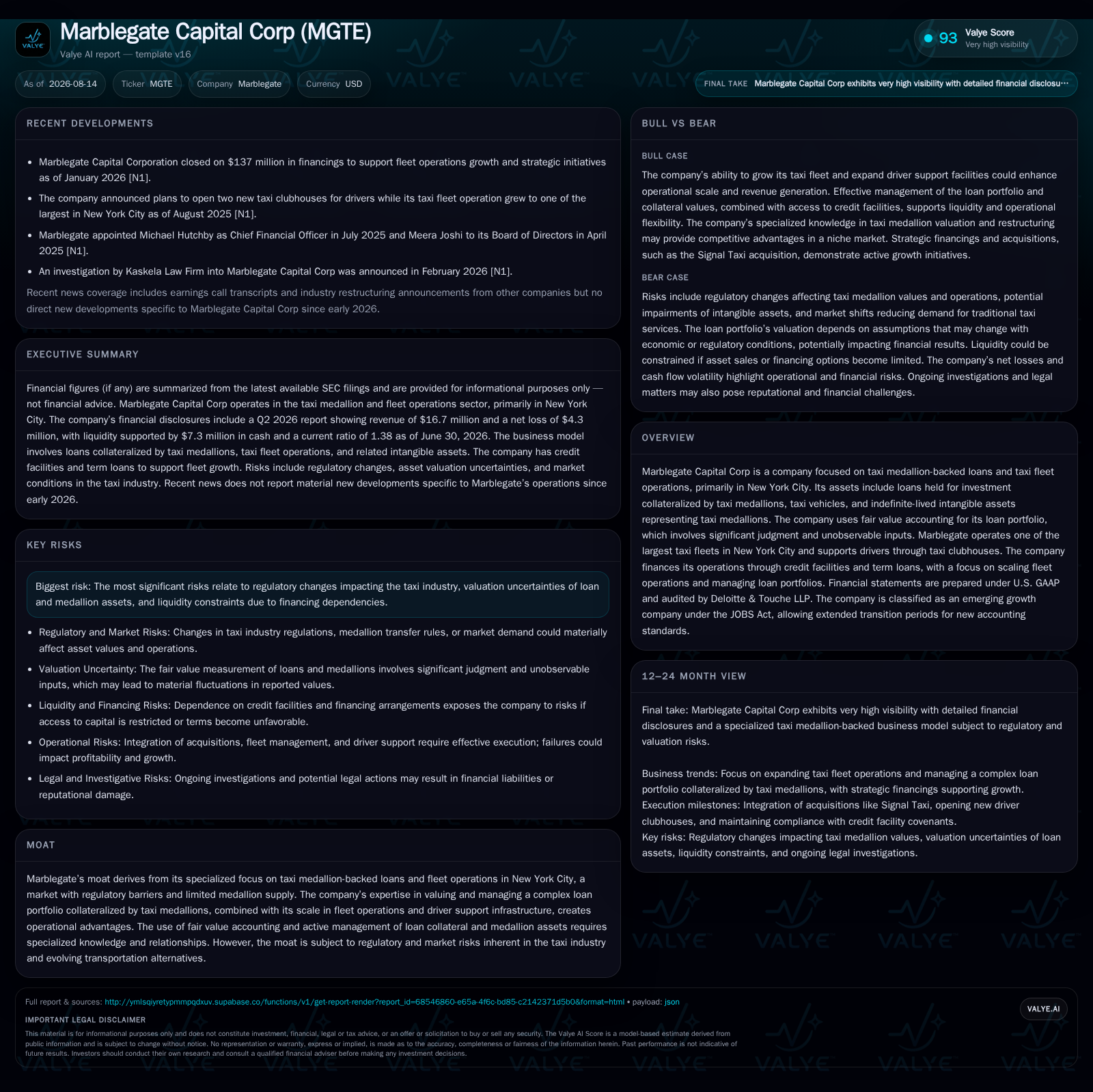
Marblegate Capital Corp, specializing in taxi medallion-backed lending and taxi fleet operations primarily in New York City, recently reported operational developments underscoring its focus on fleet expansion and credit portfolio prudence. The company continues to navigate complex fair value accounting for illiquid medallion assets while managing risks from regulatory uncertainty and competitive transport alternatives. Marblegate’s hybrid model of lending and fleet management provides advantages but also exposes it to cyclical and structural industry headwinds. Key upcoming markers include loan portfolio performance, fleet utilization metrics, and regulatory developments affecting medallion valuations.
Recent Operational Developments Highlight Fleet Expansion
Marblegate Capital’s latest quarterly report dated August 13, 2026, reveals significant capital deployment towards expanding its taxi fleet, primarily through a $37.8 million spend on vehicle purchases and a $15.9 million acquisition related to a taxi medallion leasing asset (S2). This reflects the company’s continuing commitment to scale operations in New York City’s highly regulated taxi market, where medallions remain essential licenses for street-level operation.
This addition of physical assets aligns with Marblegate’s dual business pillars: loan origination secured by taxi medallions and active taxi fleet management. The recent increase in vehicle count supports revenue growth from leasing fees and operational income derived from direct fleet services, which are critical to maintaining competitive presence against alternative transportation options.
Business Model Anchored on Asset-Backed Lending and Fleet Services
Marblegate generates revenue mainly through interest income on loans collateralized by taxi medallions—a scarce municipal asset—plus income from direct taxi leasing operations. Its loan portfolio composition involves lending to individual owners/operators and taxi fleet investors who often face limited access to traditional financing due to high credit risk profiles (S1). The scarcity and regulatory controls surrounding medallions create barriers to entry that underpin the company's moat.
The company employs fair value accounting for its loan portfolio and intangible assets related to medallions, which introduces complexity as valuations depend heavily on illiquid market inputs and managerial judgment. This accounting approach can cause earnings volatility, making close monitoring of fair value adjustments critical to understanding underlying performance impacts.
Fleet operations are supported by arrangements with third-party service providers managing garages, repairs, and operational logistics (S1). While outsourcing reduces capital expenditures and may improve focus on core competencies, it exposes Marblegate to risks should these providers fail to meet contractual or regulatory obligations.
Industry Context: Regulatory Barriers Amidst Evolving Transportation Alternatives
Operating primarily in New York City situates Marblegate within a unique niche defined by stringent regulation of taxi medallions—a finite resource creating natural scarcity for operators seeking street access. This regulatory framework supports collateral values for loans but also adds vulnerability; any regulatory policy shifts can materially alter asset valuations or restrict operational models.
Marblegate sits downstream of city government authorities that control medallion issuance but upstream of drivers relying on leased vehicles and audiences using taxis. It competes indirectly with ride-hailing platforms whose market penetration has grown substantially over the past decade, pressuring traditional taxi demand. While some competitors focus solely on financing or fleet operation, Marblegate’s integrated approach offers diversified revenue streams but also amplifies exposure to sector-specific risks.
Key operating KPIs such as loan delinquency rates, medallion valuation trends, fleet utilization rates, and cost per vehicle maintenance provide important signals about both credit risks and operational efficiency.
Growth Drivers: Fleet Scale-Up and Improved Loan Portfolio Management
Despite secular challenges faced by regulated taxi markets globally due to ridesharing competition, stable or recovering demand for regulated taxis in NYC sustains opportunities for incremental fleet expansion. The company’s recent vehicle purchase activity signals confidence in scaling operational capacity aimed at capturing this demand (S2).
In parallel, Marblegate continues refining credit risk management via diligent borrower vetting despite limited transparency inherent in individual operators’ financials (S1). Such underwriting discipline combined with active portfolio management can help contain loan loss provisions amid an otherwise speculative borrower base.
Technological adoption in driver support services—including digital dispatch or improved maintenance logistics—could enhance retention metrics for drivers affiliated through its clubhouses, indirectly benefiting fleet utilization rates.
Risks: Regulatory Uncertainty, Valuation Volatility, and Operational Dependencies
The fragility of Marblegate’s asset base lies largely in the valuation uncertainty of taxi medallions amid rapid urban mobility shifts (S1). Ongoing competition from autonomous vehicles and expansion of ride-hailing services could erode medallion values further if regulatory frameworks adapt accordingly.
Credit risk persists as borrowers typically lack audited financial records and exhibit opaque financial conditions; defaults or restructured loans could elevate loss provisions. Additionally, reliance on third-party garage facilities and repair vendors creates operational bottlenecks potentially impacting service continuity if these relationships are disrupted.
Cybersecurity remains a significant concern given dependencies on IT systems across both finance functions (loan processing) and operational control (fleet logistics). Breaches or network disruptions could lead to reputational harm or costly remediation efforts (S1).
Financial leverage must be managed carefully; as of June 30, 2026, total debt stood at approximately $14.6 million against cash reserves near $7.3 million yielding a net debt position around $7.3 million—reflecting moderate leverage but requiring vigilant liquidity monitoring due to concentrated asset classes [F1]
What to Watch Next: Execution Milestones and Market Signals
Upcoming quarters’ results should be scrutinized for trends in net interest income relative to portfolio size changes as well as loan loss reserve adequacy given inherent borrower risks. Monitoring operating income from fleet services will shed light on margins amid continued investment spending.
Regulatory announcements affecting NYC taxi licensing policies or fare structures will be material catalysts impacting medallion valuations directly tied to Marblegate’s collateral base.
Finally, any updates on third-party service provider arrangements or cybersecurity incident disclosures would significantly affect operational risk profiles.
Financial Profile Discussion
As of June 30, 2026, Marblegate reported cash equivalents totaling approximately $7.3 million against current liabilities near $15.7 million yielding a current ratio of roughly 1.38 [F1]. This ratio suggests reasonable near-term liquidity though not overly robust given working capital needs.
Total debt outstanding was about $14.6 million as compared with available cash leaving a net debt position near $7.3 million [F1]. This level of leverage appears manageable within the context of asset-backed lending against relatively stable collateral but calls for prudent capital allocation given industry cyclicality.
Operating income figures last reported at $0.8 million acknowledge modest profitability but highlight sensitivity due to non-cash fair value adjustments inherent in the valuation model [F1]. Net income reported a substantial loss predominantly influenced by such fair value considerations signaling cautious interpretation needed when assessing earnings sustainability.
Overall Marblegate maintains adequate liquidity sources via existing credit facilities complemented by operating cash flows; however, ongoing capital deployment into vehicles denotes sustained funding requirements necessitating close monitoring.
This analysis reflects information drawn exclusively from filings up through August 13, 2026 [S2], March 26 annual disclosures [S1], June event filings [S3], companyfacts snapshot data [F1], and corroborative industry understanding without subjective forecasting or investment advice.
Disclaimer: This is research-only, informational analysis and not investment advice. It may include AI-generated interpretation and general industry context. Always verify important details using primary sources.

Comments