
Forbright’s Q2 Shift Highlights Operational and Regulatory Pressure Tightening Middle Market Lending
Q2 2026 results underscore Forbright's strategic balance amid rising compliance costs and cautious credit growth in middle-market lending.
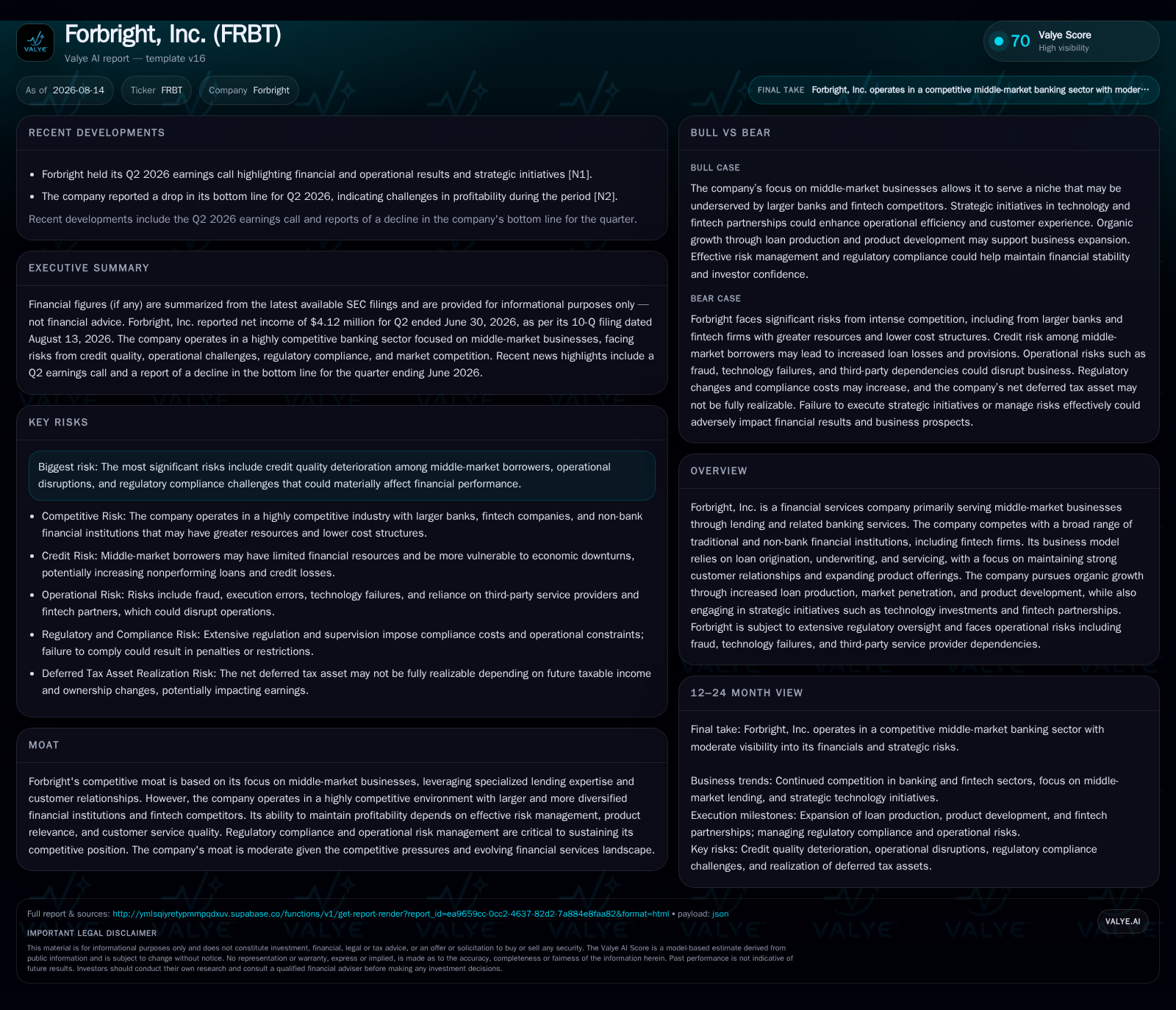
Forbright’s latest quarterly filing reveals modest loan origination growth tempered by heightened regulatory compliance and operational risk management demands. Credit quality pressures persist, particularly in specialized portfolios, necessitating vigilant underwriting and adequate loan loss reserves. Competition from fintech and traditional banks intensifies pricing and customer engagement challenges, with technology partnerships positioned as key to operational efficiency. The company faces material risks from regulatory enforcement trends and evolving operational complexities that could affect profitability and growth trajectory.
Q2 Operating Dynamics Reflect Juggling Growth With Heightened Risk Controls
Forbright reported a net income of $4.1 million for Q2 ended June 30, 2026, reflecting an operating environment marked by cautious growth tempered by rising expenses related to regulatory compliance and risk management [F1][S2]. Loan origination volumes expanded modestly but did not accelerate sharply, underscoring a deliberate approach to underwriting standards intended to mitigate credit risk amid uncertain economic conditions. This strategy aligns with observed trends of maintaining disciplined lending practices while carefully growing the middle-market loan portfolio.
Credit quality remains a focal point, especially given the company's significant exposure to healthcare finance loans—accounting for approximately 30% of the portfolio—which inherently carries concentration risk due to sector-specific regulatory and reimbursement volatility [S26]. These factors contribute to an increased non-performing loan ratio risk profile that necessitates continued vigilance in monitoring borrower repayment capabilities. The adequacy of the allowance for credit losses (ACL) is therefore a critical operating metric; any shortfall in reserves could materially impact earnings and capital levels [S2][S24].
How Forbright’s Lending Platform Addresses Middle-Market Credit Demand Amid Rising Competition
Serving predominantly middle-market businesses that fall between small enterprises and large corporates inaccessible to capital markets directly, Forbright operates primarily as a lender providing customized credit solutions including term loans, revolving lines of credit, asset-based loans, and specialized financing such as healthcare working capital loans. Revenue derives principally from interest income earned on the loan portfolio along with fees from underwriting services and loan servicing operations. This focus leverages specialized expertise to build customer relationships which form a moderate competitive moat against diversified traditional banks and fintech lenders vying in this segment.
Middle-market borrowers typically require tailored financing structures along with attentive underwriting due diligence to account for differing cash flow patterns and collateral types relative to larger corporate clients. Consequently, Forbright’s ability to deliver effective credit risk assessments through stringent underwriting standards directly impacts portfolio performance and margin sustainability.
Competitive Pressures From Fintechs and Banks Shape Pricing and Customer Engagement
The industry landscape features significant competition from both regional/community banks—such as CIT Group or SVB Financial Group—that offer broad middle-market lending alongside fintech platforms like OnDeck Capital that emphasize speed and convenience via technology-driven underwriting. These competitors exert pressure on traditional pricing models by leveraging scale advantages or technology efficiencies that can reduce operational costs.
Fintech entrants challenge incumbents’ pricing power by offering automated approval processes or alternative data usage, necessitating Forbright’s investment in fintech partnerships aimed at enhancing borrower engagement and streamlining origination workflows. Nonetheless, these alliances come with regulatory scrutiny risks that must be carefully managed alongside integration challenges.
Technology Integration and Partnerships: Enhancing Origination and Servicing Efficiency?
Forbright has strategically targeted fintech collaborations to improve underwriting accuracy through advanced data analytics while also optimizing loan servicing capabilities. Technology investments enable faster decision-making processes, potentially increasing loan origination volumes without proportionally inflating operational risk.
However, such partnerships impose new compliance obligations under banking regulations relating to third-party service provisions—especially concerning anti-money laundering (AML) controls—and necessitate robust oversight frameworks capable of managing elevated operational risks associated with outsourced functions [S12][S18]. Ultimately, this technology-driven efficiency aims to bolster customer retention rates by improving client experience though it must be balanced against increased complexity in risk governance.
Tightening Regulatory Environment Increases Operational Complexity and Compliance Costs
Recent SEC disclosures highlight several heightened regulatory risks impacting Forbright’s operating model: intensified enforcement actions targeting AML compliance; evolving fair lending consumer protection rules; coordinated reviews by federal banking agencies; and expanding requirements around third-party relationship oversight [S4][S5][S6][S7]. Failure in these areas can trigger severe consequences including civil money penalties, consent orders restricting business activities or even curtailment of expansion plans.
Smaller institutions like Forbright face disproportionate compliance cost burdens since fewer economies of scale exist relative to larger peers such as JPMorgan Chase. Regulatory guidance increasingly demands sophisticated systems for transaction monitoring, suspicious activity reporting, ongoing due diligence of borrowers alongside stringent governance controls over fintech partners [S17][S18]. Such investments elevate operating expenses but are indispensable for maintaining licensing status and reputational trust.
Credit Quality Trends Spotlight Non-Performing Loans And Loan Loss Reserve Adequacy
As economic headwinds test borrower resilience within the middle-market segment—particularly in concentrated sectors like healthcare services—early signs point toward incremental increases in non-performing assets requiring careful reserve calibration [S20][S24]. The quarter's disclosures underscore management's emphasis on timely identification of at-risk credits backed by granular financial statement analysis during the underwriting process
Allowance for credit losses must reflect conservatively estimated impairment likelihoods given potential adverse scenarios including borrower fraud or collateral valuation declines. Any under-reserving could significantly erode quarterly profitability metrics as well as capital adequacy ratios monitored under banking regulations [S29]. The company's reliance on modeling techniques introduces inherent uncertainty around risk estimates demanding continuous refinement.
Risks From Regulatory Enforcement And Operational Failures Demand Vigilant Management
Operational vulnerabilities extend beyond credit concerns into cyber threats, fraud risks, system processing errors, and dependencies on third-party service providers—all documented as material exposures in recent filings [S2][S17]. Sustained cybersecurity breaches or significant fraud incidents not only inflate remediation costs but also damage customer confidence materially impacting retention rates.
Furthermore, expanded use of outsourced fintech platforms introduces layered risks where control failures could culminate in regulatory sanctions or reputational harm exceeding direct financial loss magnitude. Robust internal control environments coupled with proactive supervisory engagements are thus critical pillars supporting ongoing business continuity.
What Next: Monitoring Execution Milestones And Market Signals For Trajectory Clarity
Investors should track several key indicators for clarity on Forbright’s execution efficacy: quarterly updates on loan origination volume growth indicating market penetration success; shifts in non-performing loan ratios demonstrating credit quality trends; progress reports on fintech integration projects revealing operational scalability; detailed disclosures regarding regulatory examination outcomes highlighting compliance posture; alongside capital adequacy maintenance signaling financial resilience under evolving banking rule frameworks [N1][S3]
Timely communication around these variables will provide insights into whether the company can sustain its moderate moat amidst intensifying competitive pressures and growing regulatory demands without eroding profitability or incurring capital constraints.
This analysis synthesizes Forbright's second quarter 2026 disclosures within the context of the highly regulated middle-market lending environment characterized by mounting compliance complexity, concentrated credit exposure in specialized sectors, competitive dynamics involving traditional banks and fintech lenders alike, plus strategic deployment of technology partnerships aimed at maintaining operational relevance. The firm’s continued ability to calibrate these competing priorities will dictate its near-term financial performance trajectory.
Disclaimer: This report is for informational purposes only. It does not constitute investment advice or research views regarding the purchase or sale of securities.
Disclaimer: This is research-only, informational analysis and not investment advice. It may include AI-generated interpretation and general industry context. Always verify important details using primary sources.

Comments