
Karbon Capital Partners Corp. Reports Stable Liquidity While Progressing in SPAC Lifecycle
Karbon Capital Partners maintains a solid liquidity position after its recent IPO, preparing for a potential business combination within typical SPAC timeframes.
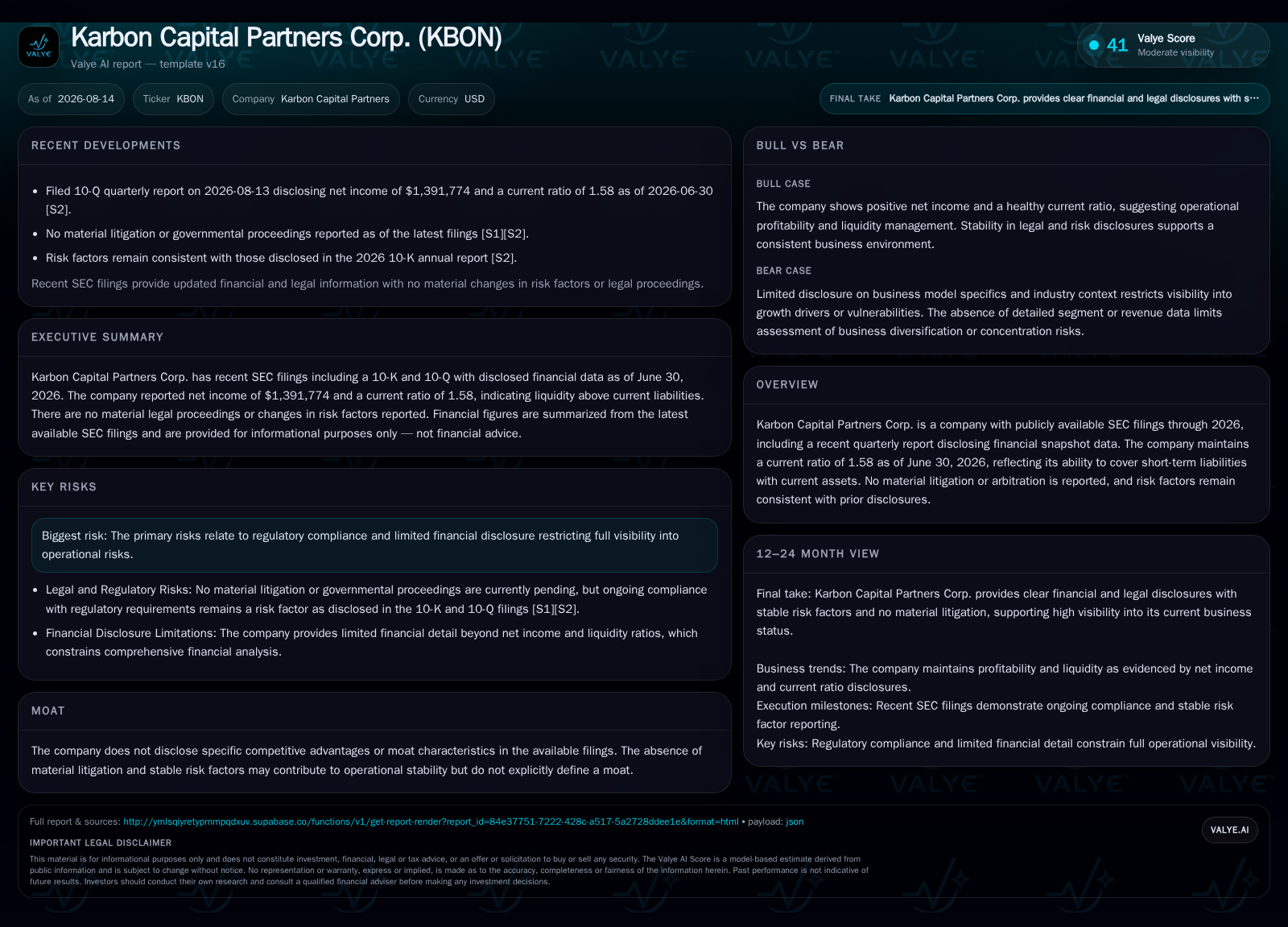
Karbon Capital Partners Corp., a Special Purpose Acquisition Company (SPAC), completed its IPO in late 2025, raising gross proceeds of $345 million placed in a trust account. As of June 30, 2026, the company exhibits a strong current ratio of 1.58, reflecting prudent liquidity management typical for SPACs awaiting business combinations. No material litigation surfaced in recent filings, and risk factors remain consistent with prior disclosures. The company’s unit structure includes Class A ordinary shares and redeemable warrants exercisable at $11.50 per share, aligning with standard SPAC sponsorship frameworks designed to balance investor upside and sponsor incentives.
Recent Operating Update
Karbon Capital Partners Corp.'s most recent quarterly filing dated August 13, 2026, underscores stability in key operating metrics amid the typical SPAC phase preceding an initial business combination. The company reported total current assets of approximately $554,000 against current liabilities near $350,000 as of June 30, 2026, yielding a solid current ratio of 1.58 that reflects ample liquidity to cover immediate expenses without engaging trust account principal resources [F1][S2]. There are no new material legal proceedings reported, confirming an absence of litigation risk that might disrupt planned acquisition activities [S2][S13]. Importantly, risk factors remain aligned with those outlined at IPO without fresh concerns emerging this quarter [S2], indicating steady operational footing during this interim stage.
Business Model
Karbon Capital Partners operates as a Special Purpose Acquisition Company (SPAC), which fundamentally differs from traditional operating firms by functioning as a capital-raising vehicle. Its revenue prospects hinge not on direct sales or services but on completing a business combination—merging with or acquiring a private target company—thereby offering shareholders access to equity appreciation tied to the chosen target's future performance post-merger [S1]. This model entails selling units during an initial public offering where each unit contains one Class A ordinary share plus a fraction (one-fourth) of one redeemable warrant. In Karbon's case, these warrants provide holders the right to purchase shares at an exercise price of $11.50, incentivizing long-term participation and offering potential upside if the post-merger stock appreciates above this threshold [S6][S20].
The sponsor plays a key role by purchasing Private Placement Units identical in economic exposure but subject to transfer restrictions and lacking redemption rights common to public investors. This strategy aligns sponsor incentives with shareholders' interests towards successfully completing a value-generative business combination while managing dilution inherent in warrant exercises and sponsor promotes [S20][S23]. The capital raised ($345 million gross) is locked in a trust account until deployment for acquisition or returned to shareholders upon failure to complete within the prescribed timeframe (usually up to 24 months from IPO) [S20], providing security against premature capital erosion.
Industry Structure and Competitive Position
Karbon operates within the burgeoning SPAC sector characterized by shell entities formed solely to negotiate mergers with private companies seeking public listings without the lengthy traditional IPO process. Competitors include other SPAC sponsors known for aggregating capital pools to target attractive sectors or geographies; notable peers include Pershing Square Tontine Holdings (PSTH) and Social Capital Hedosophia Holdings (IPOA), both distinguished by scale and sponsor prominence.
The company’s clear adherence to standard SPAC governance practices—including structured underwriting agreements with reputable investment banks like Citigroup—positions it within mainstream SPAC market channels benefiting from established channels for deal execution and regulatory compliance.
Growth Drivers
Growth for Karbon Capital Partners hinges primarily on successfully executing a business combination before mandated deadlines expire. Factors promoting growth include strong initial capital raise enabling robust deal financing options and standard warrant structures offering shareholder participation in potential post-merger equity upside. Enhanced market sentiment toward alternative public listing vehicles can accelerate acquisition discussions and pipeline development across sectors where private companies seek expedited liquidity paths.
Moreover, innovations in SPAC sponsorship models—including flexible unit trading initiated since early 2026 allowing separate trading of shares and warrants—might increase market interest and liquidity for these securities via narrower spreads or better pricing transparency [S8][S12]. Availability of PIPE financing complements this dynamic by providing additional transaction financing from institutional investors alongside trust account funds once merger terms align.
Regulatory clarity regarding disclosure requirements contributes positively by reducing execution uncertainty that previously clouded some post-merger performance outcomes across peer SPACs. Collectively these elements support potential transactional growth catalyzing shareholder returns contingent upon effective deal sourcing and integration execution.
Risks and Growth Constraints
Key risks stem from potential failure to consummate an initial business combination within regulatory time limits (generally two years post-IPO), which would force liquidation distributions triggering total loss of future upside beyond trust funds minus expenses [S13][S2]. Market volatility can further depress share prices below redemption levels incentivizing shareholder redemptions; elevated redemption rates reduce cash available for acquisitions prompting necessity for sponsor PIPE commitments or reduced deal sizes.
Dilution risk also persists through warrant exercises or sponsor promote shares issued post-business combination potentially exerting downward pressure on earnings per share (EPS) post-merger if not offset by underlying portfolio growth.
Additionally, evolving SEC scrutiny toward more comprehensive SPAC disclosures may increase compliance costs or elongate transaction timelines constraining agility versus purely private M&A competitors.
Conflicts between sponsors' fees/incentives versus public shareholders' interests represent structural misalignment risk common in this industry segment absent adequate governance frameworks.
Lastly, absent precise disclosure on targeted sectors or timeline milestones from Karbon imposes visibility constraints; tracking upcoming proxy statements disclosing proposed mergers will be important indicators moving forward.
What to Watch Next
Investors and analysts should monitor announcements regarding definitive agreements for initial business combinations as critical milestones signaling transition from blank-check status toward operational revenue generation under consolidated ownership structures. Proxy filings enabling shareholder votes will reveal approval rates illustrating market confidence levels.
Watch for:
- Filing of proxy statements outlining target companies’ profiles and deal terms,
- Redemption election statistics during shareholder votes affecting transaction funding,
- Warrant exercise patterns potentially impacting capitalization structure post-merger,
- Management commentary on PIPE financing commitments indicating deal robustness,
- Regulatory developments updating disclosure standards impacting deal execution timelines.
Improved granularity on these KPIs will better contextualize Karbon's positioning relative to peers pursuing transactions within similar calendar constraints.
Disclaimer: This is research-only, informational analysis and not investment advice. It may include AI-generated interpretation and general industry context. Always verify important details using primary sources.

Comments