
Fifth Era Acquisition Corp I's Race to Close a Tech Deal Before Deadline
With less than eight months remaining before its mandatory business combination deadline, Fifth Era Acquisition Corp I faces increasing urgency to leverage its management’s tech-centric network and trust-account capital to secure a value-accretive merger.
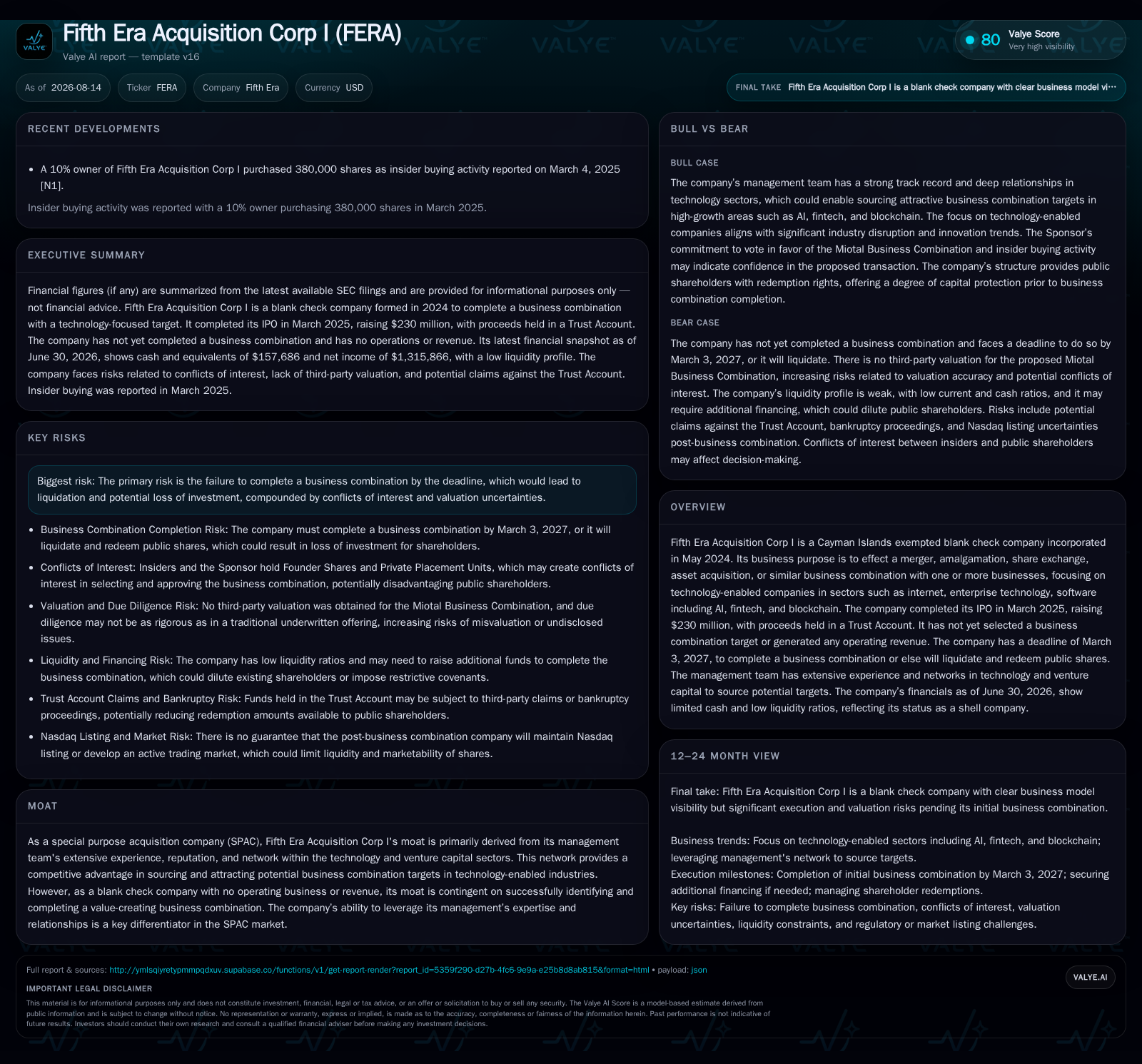
Fifth Era Acquisition Corp I, a Cayman Islands blank check company focusing on technology-enabled sectors, completed its IPO in March 2025, raising $230 million held in a trust account. As of its latest quarterly report in August 2026, the company has not announced any business combination despite an approaching March 3, 2027 deadline that triggers liquidation if unmet. The company's core value proposition lies in its experienced management team's reputation and network within AI, fintech, blockchain, and enterprise technology sectors to source attractive deals. However, operational liquidity outside the trust is minimal, emphasizing reliance on deal closure timing. Risks include potential conflicts of interest, shareholder redemptions reducing deal viability, and regulatory scrutiny. Monitoring deal announcements, shareholder votes, and redemption activity through late 2026 and early 2027 will be critical indicators of execution progress.
Quarterly Filing Highlights Status and Urgency of Business Combination Timeline
Fifth Era Acquisition Corp I remains a blank check company with capital effectively frozen in its trust account pending consummation of a business combination. Its latest quarterly filing dated August 13, 2026 reaffirms prior disclosed risk factors but underscores escalating pressure as the firm approaches the mandatory March 3, 2027 deadline to complete a merger or acquisition [S2]. To date, no formal announcements of any target transactions have been made despite substantial elapsed time since its March 2025 IPO. The absence of substantive deal disclosures amid shrinking runway signals heightened urgency. Failure to close by deadline would trigger liquidation procedures returning funds to public shareholders per share based on trust account assets [S1]. This timing constraint imposes an operational imperative to accelerate negotiations or amend governance terms potentially requiring shareholder approval.
SPAC Capital Structure: Trust Account Funds, Units Outstanding, and Sponsor Stakes
The company raised gross IPO proceeds of $230 million through issuance of units each comprising one Class A ordinary share plus one-tenth warrant (share right), plus $6 million from private placement units purchased by the Sponsor and Cantor Fitzgerald at IPO pricing $10/unit — these funds were deposited into a U.S.-domiciled Trust Account segregated under strict limitations on permissible investments primarily short-duration U.S. government securities or regulated money market funds [S1][F1]. Such structuring aligns with typical SPAC mechanics to safeguard public investors’ capital while enabling targeted acquisitions. Interest accrued within this Trust Account can be partially released only for tax obligations or limited dissolution expenses. Meanwhile, the company maintains minimal working capital outside the Trust Account (~$158k cash & equivalents) against current liabilities totaling approximately $4.3 million as of June 30, 2026 resulting in a markedly weak current ratio near 0.07 — indicative of tight operating liquidity reliant on external sponsor funding or timely business combination closure [F1]. This capital structure underscores the necessity for efficient deployment or return of capital consistent with shareholder rights including redemption provisions.
Management Expertise as a Differentiator in Technology-Focused Target Sourcing
Fifth Era’s value proposition centers heavily on its sponsor and management team’s deep knowledge and networks within technology-driven industries including internet platforms, enterprise solutions embedding AI capabilities, fintech innovations, blockchain applications, augmented reality among others. The team’s collective experience spans senior consulting roles at global strategy firms plus intense venture capital engagement providing proprietary access to emerging growth companies seeking public market entry [S1][S18]. This strategic focus seeks to carve competitive differentiation compared with more generalized SPAC sponsors by concentrating on high-growth sectors driven by compounding innovation cycles often characterized by rapid disruption and capital scarcity post-private rounds. While no target companies have been publicly identified yet — common among SPACs pending formal announcement — this management network quality is expected to critically influence deal sourcing efficiency amid intense market competition from other specialized SPACs and traditional IPO alternatives.
Operating Risks Centered on Deadline, Sponsor Conflicts, and Redemption Rights Dynamics
The prominent structural risk remains failure to consummate an initial business combination within the prescribed timeframe which would enforce liquidation according to trust account net asset values plus accumulated interest thereby extinguishing shareholder equity exposure [S1][S2]. Moreover, disclosed documentation reveals potential conflicts between sponsors’ interests versus those of public shareholders specifically relating to governance powers permitting amendments to key agreements without shareholder approval — raising fiduciary duty concerns especially where no third-party fairness opinion was procured for proposed mergers such as with Miotal SPAC HoldCo under active negotiation [S2]. The absence of independent valuation combined with sponsor voting commitments introduces valuation uncertainty potentially detrimental to minority shareholders.
Additionally, shareholder redemption rights create dual challenges: while intended as protective mechanisms allowing outflows for dissenters prior to deal approval they can simultaneously jeopardize transaction financing by reducing available cash upon elevated redemption rates following announcement disclosures — a phenomenon seen broadly in technology-focused SPAC transactions facing volatile valuations and skeptical investor sentiment.
Regulatory risks inherent in recent SEC guidance around SPAC structures emphasize compliance vigilance concerning disclosures related to conflicts, valuation processes and sponsor incentives which remain evolving [S1][S2]. These factors underline the criticality of transparent governance processes ahead of upcoming voting milestones.
Growth Opportunities from Market Appetite for Tech Deals Despite Regulatory and Valuation Headwinds
Despite inherent risks Fifth Era stands positioned within an environment characterized by considerable investor interest for alternative public listing vehicles particularly within transformative technology verticals encompassing AI acceleration, fintech innovation cycles and blockchain infrastructure deployments. Such thematic market enthusiasm drives availability of growth-stage companies eager for liquidity solutions beyond traditional IPO routes which can be more prolonged and costly due diligence intensive processes [S1]
This macro tailwind complements Fifth Era’s specialized sector focus allowing it potential access to high-quality proprietary targets sourced via its seasoned venture-centric management team indirectly validated through historical deal flow patterns visible across leading peers like Pershing Square Tontine Holdings or Social Capital Hedosophia known for targeting disruptive tech domains.
However elevated valuation multiples characterizing late-stage technology enterprises represent headwinds necessitating disciplined underwriting standards amid increasingly careful investor appetite reflected in redemption behaviors. Additionally ongoing regulatory scrutiny shapes deal structuring flexibility requiring adept legal advisory alignment.
What Investors Should Monitor Next: Deal Announcements, Shareholder Votes, and Redemption Activity
Looking ahead key milestones investors should track include prospective announcement timing which could concentrate in Q4 calendar year 2026 or early Q1 2027 given proximity to deadline pressures [S2]. Following any transaction reveal proxy solicitation materials filed with regulatory bodies will set the stage for shareholder vote decisions incorporating redemption options available immediately post-announcement creating liquidity windows impacting transaction feasibility.
Watchfulness toward redemption volumes serves as critical barometer signaling market reception; elevated redemptions may precipitate renegotiations or increase probability of deadline-triggered liquidation scenarios. Nasdaq listing compliance rules mandate that SPACs generally finalize combinations within set periods (36 months from IPO effectiveness), though extensions can be petitioned subject to shareholder consent — such procedural filings if initiated will be important disclosure events reflecting timeline stress points.
Additionally transparency regarding governance amendments relating to sponsor rights or letter agreement modifications must be viewed through fiduciary lenses signaling management’s willingness to navigate internal conflicts toward completion.
Financial Profile Discussion: Liquidity Snapshot Anchored by Trust Account Balance
From a financial standpoint at quarter-end June 30, 2026 Fifth Era reported cash & equivalents standing at approximately $158k with total current assets near $312k contrasted against current liabilities exceeding $4.3 million resulting in a severely strained current ratio around 0.07 — indicative that working capital available for operational expenses excluding trust account capital is effectively depleted [F1]. Operating expenses primarily relate to G&A costs necessary for maintaining corporate existence pending combination.
By design substantial liquidity supporting both share redemptions upon liquidation triggers or merger funding resides within the U.S.-based Trust Account holding approximately $230 million initially deposited after IPO plus accumulated interest reinvested conservatively meeting SEC mandated custody standards [S1][F1]. This arrangement ensures principal safety but restricts use absent qualifying transaction milestones limiting flexibility.
This analysis avoids speculative projections or unsupported claims while synthesizing Fifth Era Acquisition Corp I’s latest financial disclosures alongside established industry norms governing blank check companies executing transformational deals into technology-enabled businesses. Monitoring progress against milestone timelines coupled with evolving investor sentiment around emerging tech valuations will determine ultimate success navigating this high-stakes juncture.
Disclaimer: This is research-only, informational analysis and not investment advice. It may include AI-generated interpretation and general industry context. Always verify important details using primary sources.

Comments