
Applied Energetics Confronts Funding and Supply Chain Headwinds While Advancing Directed Energy Tech
The company’s Q2 2026 filing reveals acute liquidity challenges exacerbated by geopolitical supply disruptions amidst ongoing investments in specialized military laser technologies.
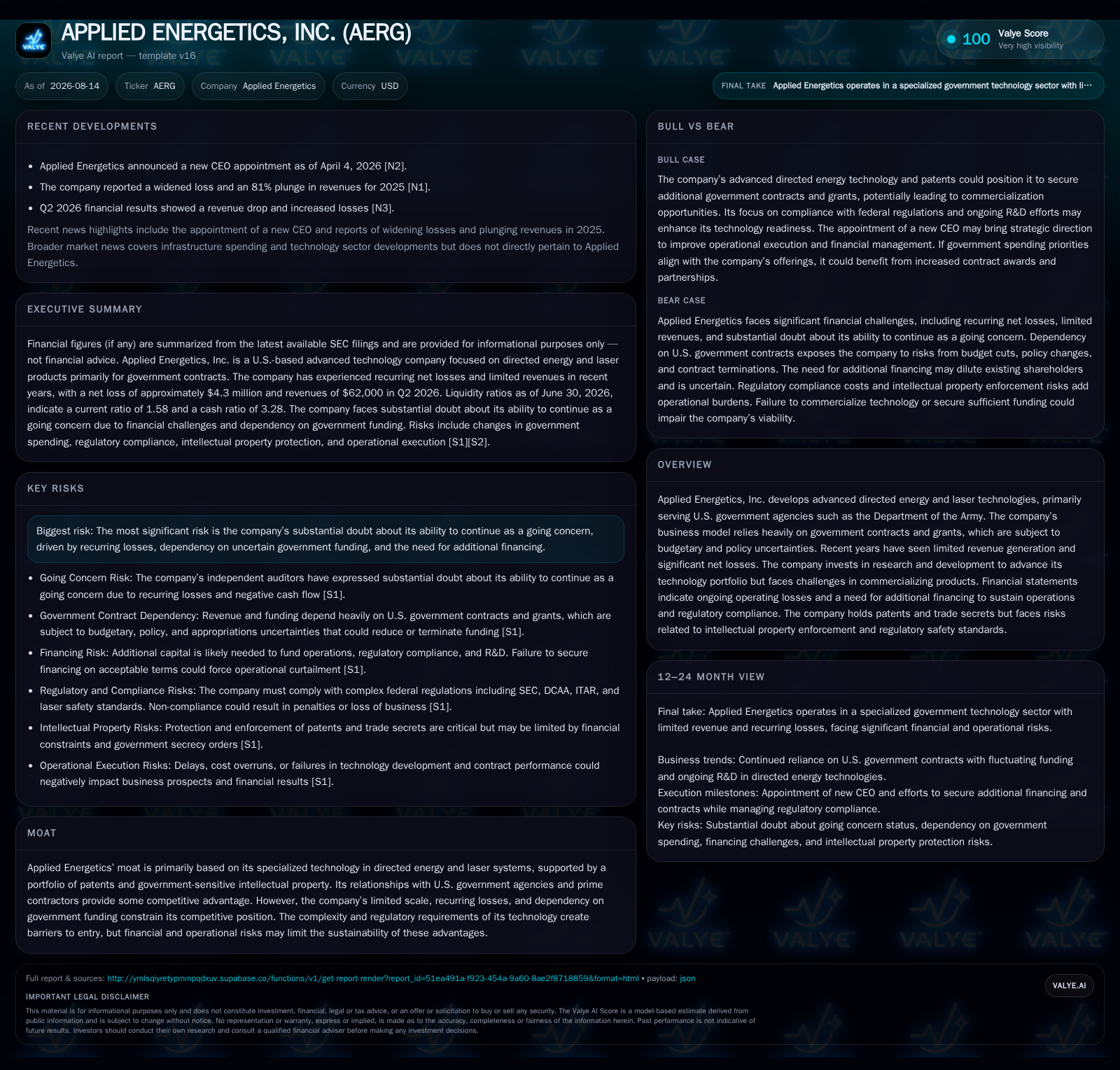
Applied Energetics, Inc. remains heavily dependent on milestone-based government contracts centered on directed energy and laser technology development. Its latest quarterly filing underscores heightened going concern risks driven by operating losses, limited contract volume, and uncertainty in supply chains due to geopolitical conflicts. While the company’s R&D efforts continue to advance its niche technology portfolio under strict regulatory oversight, commercializing these solutions and sustaining financial viability hinge on securing additional funding amid a volatile defense budget environment.
Q2 2026 Filing Highlights Supply Chain and Financing Pressures Pointing to Going Concern Risks
Applied Energetics’ most recent quarterly report for the period ended June 30, 2026, explicitly flags severe uncertainties arising from global geopolitical events materially affecting its supply chain. The firm attributes disruptions to fluctuations in tariffs combined with ongoing conflicts such as Russia's military action in Ukraine and escalating tensions in the Middle East, alongside resultant economic sanctions worldwide [S2]. These macro factors create a precarious operating environment for sourcing specialized components and equipment essential for developing advanced directed energy systems. This dynamic exacerbates an already fragile liquidity position noted by the auditors’ substantial doubt regarding the company’s ability to continue as a going concern [S9]. With net losses exceeding $8 million over the first half of 2026 and negative operating cash flows over $5 million in this period [S9], Applied Energetics confronts an urgent financing imperative amid volatile military procurement conditions.
"Specialized Military Tech Model Tested by Contract Uncertainties and Regulatory Burdens"
Applied Energetics operates within a quintessential early-stage defense technology archetype where revenues depend largely on government contracts that disburse milestone payments tied to technology development phases [S1]. This milestone-based revenue recognition introduces a lumpy top-line pattern that complicates forecasting stable income streams. The company's tight integration within the intricate web of federal oversight requires scrupulous compliance with guidelines enforced by the Defense Contract Audit Agency (DCAA) and adherence to International Traffic in Arms Regulations (ITAR), which govern export controls for sensitive technologies [S1]. Maintaining these compliances is not only mandatory for contract eligibility but also contributes significantly to G&A expenses, reflecting an inherent dilution of scaling economies common in small defense contractors.
Additionally, intellectual property protection remains a pivotal element underpinning Applied Energetics' competitive moat. They hold patents related to directed energy and laser technologies critical for military applications; however, the effectiveness of such IP protection is always shadowed by enforcement challenges that add another layer of operational risk [S1]. The combination of these regulatory complexities with uncertain government budget allocations imposes formidable barriers both operationally and financially.
"Government Contracts Fuel R&D but Cap Revenue Growth Amid Concentration Concerns"
The company's business model emphasizes heavy investment into research and development—spending over $1 million annually as per recent disclosures—to progress its proprietary laser weapon systems despite generating minimal revenues from these efforts [F1][S21]. This spending profile results in pronounced operating losses; for example, reported operating loss nearly doubled year-over-year reaching approximately $8.1 million for the first half of 2026 [S21]. The concentration of government contracts reflects a narrow customer base primarily consisting of Department of Defense agencies or prime contractors serving those agencies [S23]. Such customer concentration elevates execution risk since any reduction or delay in contract awards could severely impair the firm's cash flows.
Consequently, while government funding sustains R&D initiatives that preserve technological relevance, it simultaneously caps revenue growth potential due to its constrained scale and milestone-linked payments rather than steady large-volume production or diversified customer acquisition.
"Peer Context: High R&D Intensity Contrasted With Limited Scale Limits Commercial Viability"
When contrasted with large publicly traded defense primes such as Lockheed Martin or Raytheon Technologies—entities boasting extensive contract diversification across multiple platforms and significantly larger backlogs—Applied Energetics operates at a markedly smaller scale with commensurately limited financial resources. Its high R&D-to-revenue intensity reflects an early-stage technology developer profile typical of specialized directed energy startups struggling to prove commercial viability beyond initial prototypes or demonstrations [S1][F1]
Without substantial strategic partnerships or subcontracts from established prime contractors providing secured revenue streams, Applied Energetics’ capacity to absorb extended development cycles while managing cash burn remains a critical challenge. Peers often counterbalance these hurdles with broader product portfolios or government relationships that facilitate smoother contract renewals or cross-program financing.
"Growth Catalysts Restricted by Political Climate and Capital Availability"
The defense sector's gradual pivot toward modernization programs incorporating emerging directed energy weapons offers a theoretically robust market tailwind for Applied Energetics’ core competencies. Increasing governmental prioritization of advanced laser systems under military modernization budgets could unlock new contracts or extensions supporting longer-term growth. However, these opportunities remain tempered by political volatility impacting defense budgets and contract award timings. The company's own acknowledgment that near-term revenues depend heavily on uncertain government procurement—even amid increasing allocated funds—highlights this foundational constraint [S1][S2].
Furthermore, Applied Energetics faces intrinsic capital availability limitations due to operational losses and resultant liquidity strains obligating frequent equity raises or bridge financings which dilute shareholder value. This capital scarcity restricts scaling beyond initial R&D phases or exploration into adjacent markets such as homeland security applications without forming strategic alliances.
"Risks Linger from Financial Fragility, Compliance Costs, and Geopolitical Volatility"
Persistent operating losses amounting to nearly $15 million in 2025 alone emphasize structural fragility [F1], compounding management’s challenge in maintaining operational continuity absent substantial external funding. These financial pressures coexist alongside growing compliance burdens related to DCAA audits ensuring contractual cost accountability plus ITAR regulatory adherence governing export controls—a dual overhead increasing G&A expense composition even before commercialization can begin at scale [S1].
Geopolitical developments further exacerbate risk layers by disrupting supply chains essential for production of sophisticated hardware components integral to directed energy systems, potentially delaying milestone completions critical for payment recognition [S2][S9]. Moreover, ongoing legal proceedings concerning former counsel malpractice inject additional uncertainty vis-à-vis contingent liabilities that could adversely affect balance sheet stability should unfavorable outcomes materialize ahead of resolution planned for late 2026 [S17].
"Near-Term Watchpoints: Contract Milestones, Capital Raises, Regulatory Approvals"
Key indicators for monitoring Applied Energetics’ trajectory include timely achievement of specific government contract milestones which unlock progressive payments crucial for mitigating cash burn pressures [S2]. Any delays here would magnify liquidity constraints given the firm’s stated dependence on milestone-based revenue inflows.
Securing additional equity injections through private placements or bridge financings remains imperative in replenishing working capital; tracking discussions with investment bankers or announcement of financing closings will be central to assessing survival prospects near term [S2][S9]. Completion of outstanding litigation ahead of its scheduled December trial may influence investor sentiment positively if resolved without material damages.
Regulatory approvals facilitating product deployment or international sales opportunities could enhance commercial potential yet remain subject to stringent ITAR controls restricting export scope until cleared—thus representing both upside catalysts and operational gatekeepers.
Financial Profile Discussion: Operating Losses Demand Continued Funding Support
As of June 30, 2026, Applied Energetics reported cash and cash equivalents totaling approximately $1.12 million against current liabilities nearing $1.4 million resulting in a current ratio around 1.58—accordingly maintaining minimal short-term liquidity buffer [F1][S22]. The company holds roughly $1.86 million in fixed assets underpinning its research labs but carries total liabilities approaching $1.88 million inclusive of lease obligations reflecting operational commitments extending beyond immediate cash balances [F1][S22].
The preferred stock issued remains a focal point indicating prior recapitalization efforts yet further equity raises appear necessary given ongoing negative cash flow trends exceeding $5 million over six months ending June 2026 combined with net losses above $8 million during the same period [F1][S9][S21]. This financial structure demonstrates typical vulnerability among early-stage defense technology firms whose long development cycles clash with capital market pressures demanding faster returns.
In sum, while Applied Energetics advances intriguing niche directed energy technologies supported by patented innovations protected under rigorous regulatory frameworks, its immediate outlook hinges critically on managing supply chain shocks amidst geopolitical upheavals while securing indispensable capital infusions required to sustain operations through continuing milestone-driven contract developments.
Disclosure: This analysis is based solely on publicly available SEC filings dated August 13, 2026 ([S2], [S9]), companyfacts as of June 30, 2026 ([F1]), latest annual report from March 30, 2026 ([S1]), industry context knowledge layers exclusive of speculative forecasts or unverified competitive claims.
Disclaimer: This is research-only, informational analysis and not investment advice. It may include AI-generated interpretation and general industry context. Always verify important details using primary sources.

Comments