
Ares Acquisition Corp III Faces Milestone Pressures with Elevated Redemption Rates and Sponsor Stakes
Recent quarterly disclosures for Ares Acquisition Corp III highlight mounting liquidity challenges and approaching deadlines that complicate its SPAC completion prospects.
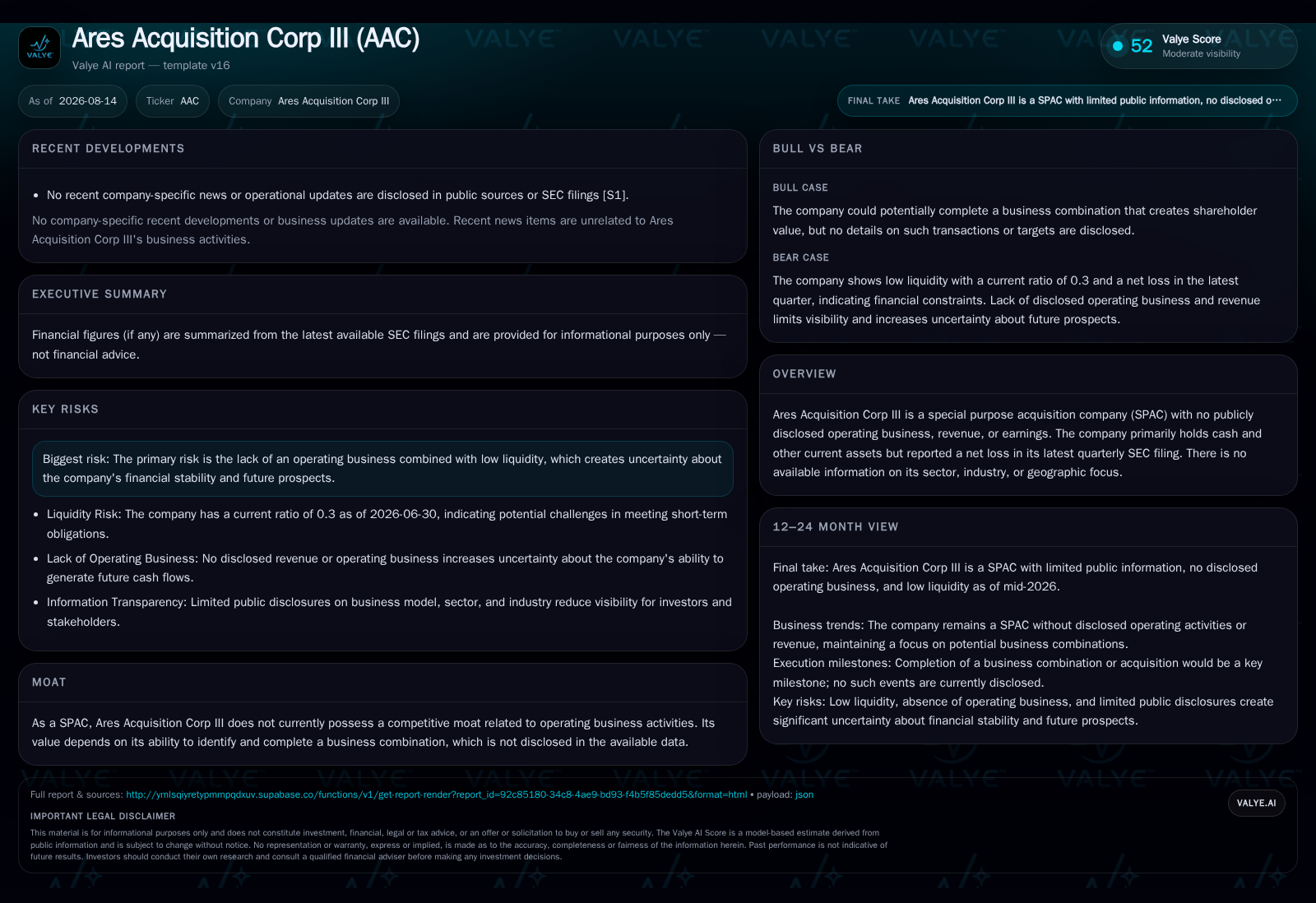
Ares Acquisition Corp III remains a shell company focused on completing a business combination within regulatory timeframes, with no operating revenues to date. Its latest 10-Q reveals a stretched liquidity position evidenced by a low current ratio and net loss, underscoring risks from potential shareholder redemptions that could significantly reduce acquisition capital. The structure of outstanding redeemable warrants and sponsor incentives creates complex dilution dynamics, while looming merger deadlines intensify execution pressure. These factors collectively frame the precarious path AAC must navigate to consummate a de-SPAC transaction successfully.
Latest Quarterly Filing Illuminates Liquidity Position and Risk Exposure
Ares Acquisition Corp III’s most recent Form 10-Q filed on August 13, 2026 confirms its operational status as a special purpose acquisition company (SPAC) without revenue-generating operations but posting a net loss of $12,218 for the quarter ended June 30, 2026 [S2][F1]. This reflects ongoing administrative and operational expenses consistent with maintaining the public shell structure while searching for a business combination target. The absence of any commercial activity means all valuation depends on successful de-SPAC transaction execution.
Balance sheet metrics reveal heightened liquidity strain: current assets stood at approximately $3.31 million against notably higher current liabilities near $10.93 million at quarter-end [F1]. Meanwhile, total debt reported was modest at about $148,000, indicating leverage is not yet a material factor but presents some fixed financial commitment [F1].
These figures frame the financial tightrope AAC walks—where ordinary liabilities exceed immediate assets but trust-account cash buffers provide essential collateral backing any acquisition effort.
Cash Held in Trust Versus Redemption Demands: Capital Availability Headwinds
Core to all SPAC structures is capital raised via an initial public offering (IPO) placed into a trust account specifically intended to finance a future business combination. This trust account functions as both collateral and an investor safeguard, promising to return invested funds should no qualifying deal complete within an allowed timeframe.
However, this vehicle’s effectiveness hinges on shareholder behavior—most notably redemption rights allowing investors to redeem shares for their pro-rata portion of trust assets before deal closure.
As AAC approaches critical timeline milestones defined under regulations governing SPAC life cycles—typically around 18 to 24 months post-IPO—the risk that shareholder redemptions deplete trust resources rises sharply [S2][F1]. Excessive redemptions diminish capital available for acquiring businesses, forcing reliance on potentially dilutive PIPE (Private Investment in Public Equity) funding or jeopardizing deal feasibility entirely.
AAC’s reported current ratio of approximately 0.3 signals underlying asset-liability mismatch without factoring in trust cash; this metric implicitly warns that operational expenses or other liabilities could pressure liquidity absent deal closure or external financing [F1]. Therefore, monitoring redemption patterns through subsequent quarterly reports will be crucial in assessing the integrity of AAC’s acquisition war chest.
'Warrants and Units': Dilution and Incentives Shaping Shareholder Alignment
Further complexity arises from the securities structure typical of SPAC IPO units comprising one Class A ordinary share and one-tenth of a redeemable warrant exercisable after business combination completion.
For AAC, these redeemable warrants carry an exercise price fixed at $11.50 per share as disclosed in the July 8, 2026 Form 8-K filing detailing offering proceeds [S3]. If the merged company’s stock exceeds this level post-merger, warrant holders have strong incentive to exercise—leading to dilution through increased outstanding shares.
While warrants attract investor interest during the SPAC IPO for their embedded optionality, they present longer-term dilution risk for public shareholders if warrant overhang expands post-merger without commensurate accretive earnings growth. Additionally, sponsor-level lockups often restrict warrant liquidation timing, affecting stock market float rather than outright issuance numbers immediately upon closing.
Sponsor promote agreements typically allot founders or sponsors roughly 20% equity stake post-deal to incentivize successful transaction origination; however, this feature also comes with tradeoffs by diluting non-sponsor investors’ interests if not offset by substantial value creation.
In AAC’s case, details about exact sponsor stakes are not publicly disclosed within filings but generally follow established industry norms balancing alignment with excessive dilution concerns.
'Business Combination' Timeline Pressure: Countdown Toward De-SPAC Deadline
Time operates as an unforgiving variable in the SPAC lifecycle. Regulatory mandates usually enforce an expiration window—often between 18–24 months from IPO date—by which point failure to announce and consummate an approved business combination triggers mandatory liquidation or return of proceeds to investors.
AAC’s latest filing reiterates this timeline constraint though does not specify remaining duration nor explicitly reveal targeted sectors or pipeline status [S2]. Industry benchmarks suggest that as the deadline approaches,
- Increased urgency from sponsors with diminishing runway heightens risk-taking or acceptance of suboptimal terms;
- Rising redemption rates compound capital availability problems;
- Public investor skepticism grows due to accelerated announcements earlier in cycle failing to close.
Thus, absent definitive disclosures on target identification or signed merger agreements from AAC’s SEC filings as of mid-2026 leaves uncertainty regarding both timing and probability of de-SPAC completion.
'Sponsor Promote' Structures and Stake Dynamics Post-Merger
Sponsors’ equity stakes commonly arise from founder shares initially acquired cheaply subject to vesting post-business combination completion. These stakes serve dual purposes: aligning sponsor incentives towards completing deals within deadlines while rewarding execution expertise.
However, sponsor promotes also dilute public shareholders’ ownership percentage post-merger—a structural tension intrinsic to many SPACs. Without specific data for AAC’s arrangement disclosed publicly yet as of mid-2026 filings [S2][S3], it remains standard practice that promotes total roughly 20% post-transaction ownership.
This concentration may influence governance dynamics and can affect market reception post-merger depending on sponsor reputation and perceived alignment. Investors typically scrutinize these dynamics when evaluating projected returns during PIPE financing rounds or secondary market trading following consummation.
'Redemption Rights' Impact on Transaction Viability: Peer Comparisons Reveal Challenges
Redemption rights provide powerful downside protection but simultaneously create execution risk when redemption rates spike high relative to initial IPO proceeds—for many SPACs eroding available acquisition war chest below thresholds necessary for targeted deals.
Industry data suggests median redemption rates surge disproportionately late into SPAC cycles once initial enthusiasm cools or market volatility dampens appetite—amplifying reliance on dilutive PIPE inflows or increasing liquidation probabilities.
While AAC’s precise redemption levels are not publicized in these particular filings [S2], balance sheet signals imply stress consistent with elevated redemption risks. In contrast, peer SPACs exhibiting lower redemption rates typically benefit from better pipeline visibility or stronger sponsor reputations facilitating greater investor retention through deal announcements.
Such comparative context frames AAC’s challenges—not unique but emblematic—highlighting the criticality of minimizing shareholder redemptions through timely deal announcements supported by credible valuation narratives.
Market Context Influencing AAC’s Capital Raising Prospects and Deal Pipeline
Overall market sentiment toward SPAC issuance remains cyclical; by mid-2026 regulatory scrutiny intensifies alongside investor caution born from previous waves’ uneven outcomes. Favorable macroeconomic conditions including low interest rates or buoyant equity markets historically broadened investor risk tolerance benefiting capital raises via SPAC IPOs and PIPE transactions alike.
Successful SPAС sponsors employed networks rich in private equity relationships enabling rapid deal sourcing and robust PIPE syndicates ensuring sufficient funding on attractive terms despite redemptions. Conversely, or less well-known sponsors faced headwinds attracting quality targets or institutional PIPE demand amid growing competition among numerous blank-check vehicles competing for viable merger candidates.
Without explicit information regarding AAC’s management team pedigree or prospective target sectors disclosed so far [S2][S3], its ability to marshal compelling deal flow remains unverified but critically influential on ultimate success probabilities.
What Investors Should Watch Next: Key Milestones and Execution Signals
Monitoring future SEC filings will be instrumental for gauging AAC’s trajectory toward de-SPAC success:
- Announcements related to definitive merger agreements would concretely shift valuation from speculation toward fundamentals;
- Quarterly updates revealing shareholder redemption statistics will elucidate changes in acquisition funding availability;
- Disclosures concerning PIPE financing arrangements illustrate external investor confidence supporting deal completion;
- Communications indicating sponsor commitment level offer soft signals regarding transaction readiness or pipeline robustness.
Given de-SPAC completion deadlines inexorably approach based on typical timelines implicit within its IPO vintage embedding, visible progress along these markers is essential to validate market optimism surrounding AAC’s potential transition from shell company toward operating entity delivering tangible enterprise value.
Disclaimer: This is research-only, informational analysis and not investment advice. It may include AI-generated interpretation and general industry context. Always verify important details using primary sources.

Comments