
Gemini Space Station Shifts Focus to U.S. Core amid Market Volatility and Regulatory Pressure
Gemini updates on asset contraction, platform integration, and regulatory compliance amidst challenging crypto market conditions.
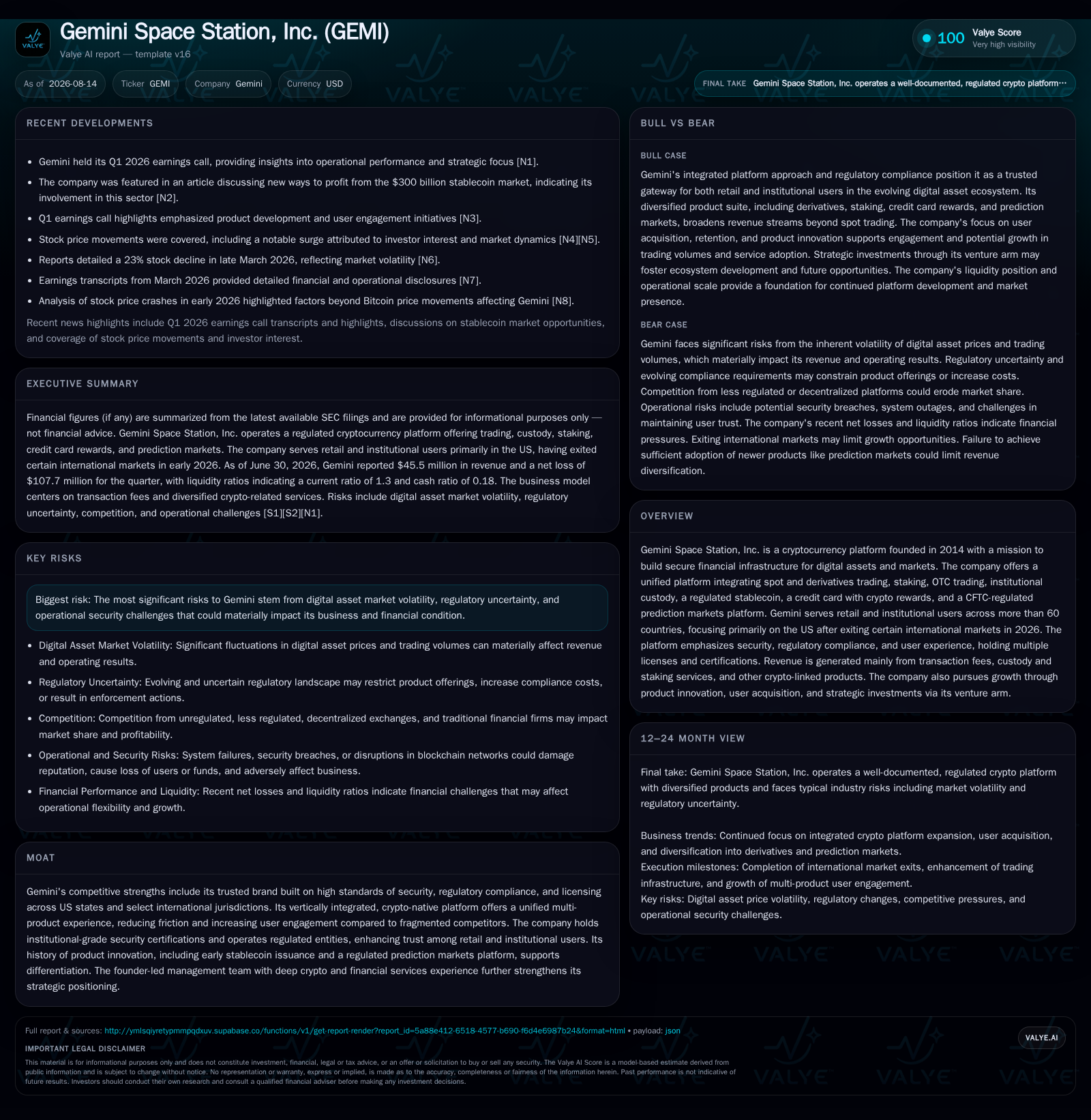
In its latest quarterly filing, Gemini Space Station, Inc. reported a strategic exit from multiple international markets to concentrate resources on the U.S., alongside ongoing investments in product innovation including the launch of U.S. stock trading and prediction markets. The company’s revenues remain heavily dependent on transaction fees tied to volatile crypto trading volumes, while regulatory compliance and operational security are key focal points amid an evolving oversight landscape. Despite increased expenses from stock-based compensation and legal matters, Gemini’s liquidity remains solid with a current ratio of 1.3 as of mid-2026.
Recent Operating Update: Strategic refocus and platform diversification
Gemini Space Station’s latest 10-Q for Q2 2026 reflects pivotal strategic decisions aimed at navigating the complex cryptocurrency financial services landscape during heightened regulatory scrutiny and volatile market conditions. Most notably, in February 2026, Gemini announced plans to exit operations in multiple international markets including the UK, EU jurisdictions, and Australia [S1]. This decision signals a deliberate shift toward consolidating resources onto its U.S. operations where it holds full money transmitter licenses (MTLs) across all states and direct access to fiat banking rails — foundational for its regulated platform model which differentiates it from less regulated competitors [S1,S2]. While this contraction narrows geographic reach, it could improve regulatory alignment and operational efficiency.
Simultaneously, Gemini has been expanding its product suite beyond traditional crypto spot trading to include a U.S.-regulated derivatives exchange (launched prediction markets platform in December 2025), staking services, an institutional OTC desk, a NYDFS-regulated stablecoin (GUSD), a credit card with crypto rewards, spot margin trading services, and most recently—in July 2026—U.S. equities trading available to certain licensed states’ customers [S2,S15]. These moves reflect a broader industry trend where central players seek diversified revenue streams beyond volatile crypto spot fees by integrating traditional financial instruments under regulated entities.
Business Model: Fee dominance tempered by market cyclicality
Gemini generates most of its fee-based revenue from transaction commissions on both retail and institutional trading activity across spot and derivatives markets plus OTC venues [S1,S2]. The revenues scale with metrics such as monthly active users (MAUs), monthly trading volume—highly correlated with underlying cryptocurrency prices—and assets under custody (AUC).
Adding U.S. stocks expands addressable markets but remains nascent given licensing limitations across states [S15,S19]. Custody fees based on AUC provide some revenue stability but fluctuate with asset valuations.
Pricing power is partly anchored by Gemini’s brand trust associated with its security standards and comprehensive regulatory licenses nationwide — critical factors influencing institutional client retention in this tightly regulated sector where compliance failures can cause customer flight or enforcement action.
Industry Structure and Competitive Position
Operating within the cryptocurrency financial services industry’s centralized exchange segment places Gemini amid intense competition from global platforms like Coinbase (regulated U.S.-focused), Binance (broad global reach), Kraken (compliance-oriented), alongside emerging decentralized exchanges (DEXs) that feature no KYC barriers but face scalability or regulatory challenges themselves.
Gemini's competitive moat partially derives from its vertically integrated technology stack combining exchange functions with custody solutions under strict regulatory supervision—differentiating it versus fragmented competitors that either focus narrowly on exchange functions or custody alone. Additionally, its recent launch of regulated event prediction markets sets it apart as one of few offering fully compliant event-contract derivatives governed by a federal regulator (CFTC).
However, growing competition from DEXs or crypto-native DeFi protocols—often faster innovators—poses a threat where trading fees are lower or non-existent but where regulatory clarity is lacking.
Growth Drivers: Innovation amid regulatory navigation
Key growth vectors include expansion of tradable assets through onboarding emerging blockchain protocols supporting staking/yield generation features; broadening customer acquisition across retail investors seeking integrated multi-product platforms spanning crypto to traditional equities; innovation in product complexity such as derivatives expansions; and pursuit of institutional accounts requiring custody-grade security plus regulatory assurances [S15,S18]
Enhancement of core infrastructure aiming for low latency/high throughput alongside compliance automation supports scaling user onboarding efficiently while mitigating risks associated with adding new cryptocurrencies or securities products.
Strategic investments via Gemini Frontier Fund targeting promising early-stage blockchain projects further augment potential pipeline growth opportunities.
Risks and Growth Constraints
Gemini’s fortunes remain tethered tightly to persistent digital asset price volatility which directly affects transaction volume-based fee income—a primary short-term growth constraint that impinges cash flow visibility [S19]. Concentration risk on major coins like bitcoin also limits resilience should those markets contract unexpectedly.
Regulatory uncertainty remains acute despite robust licensing: interpretations around digital assets classification could prompt enforcement actions affecting product availability; evolving compliance requirements heighten operational costs; litigation risks abound—including pending securities class actions—that threaten reputational integrity and impose costly legal defenses; cross-border operational mandates add complexity especially after international market wind-downs [S4,S11,S20]
Operational security vulnerabilities inherent in handling digital assets expose the company to hacking/theft risks whose realizations could materially erode user trust.
Competitive pressures from both highly capitalized global exchanges able to offer deeper liquidity pools—and nimble DeFi alternatives able to innovate unencumbered by regulations—pose continuous challenges especially if Gemini’s pace of innovation lags or costs escalate disproportionately.
What To Watch Next
Investors should monitor MAU trends relative to historical cycles amid the firm’s narrowed geographic scope post-international exit announcement; progress ramping adoption for new products like U.S stocks trading across licensed states; development milestones expanding derivative offerings beyond binary contracts; changes in total assets under custody as an indicator of investor confidence; regulatory developments especially any new state/federal actions affecting product shelf or licensing; litigation outcomes particularly securities-related lawsuits; adjusted EBITDA trajectory reflecting operating leverage versus stock-based compensation expense run-rate post-IPO grants; and liquidity metrics such as cash burn rate relative to operating losses.
Net income remained negative at $(107.7) million for Q2 alone due mainly to non-cash charges including stock compensation ($20.3 million), interest expense ($2.6 million), depreciation/amortization ($7.3 million), legal contingencies, plus restructuring costs related to headcount reductions effectuated earlier in the year [S2,S14]. The company fully repaid legacy debt facilities during late 2025 reducing interest burden going forward.
Overall finance positioning shows preparedness for continued product investment while maintaining required capital reserves dictated by regulators though losses highlight profitability challenges common among scale-up firms competing in regulated crypto financial services spaces.
This analysis focuses strictly on disclosed data without interpreting future performance or investment implications beyond documented facts sourced from recent filings dated between March and August 2026.
Disclaimer: This is research-only, informational analysis and not investment advice. It may include AI-generated interpretation and general industry context. Always verify important details using primary sources.

Comments