
Gesher Acquisition Corp. II’s SPAC Lifecycle Progresses with Israeli Tech Focus and December 2026 Deal Deadline
Gesher Acquisition Corp. II, a Cayman Islands SPAC targeting Israeli tech businesses, advances through its Combination Period amid mounting time pressure.
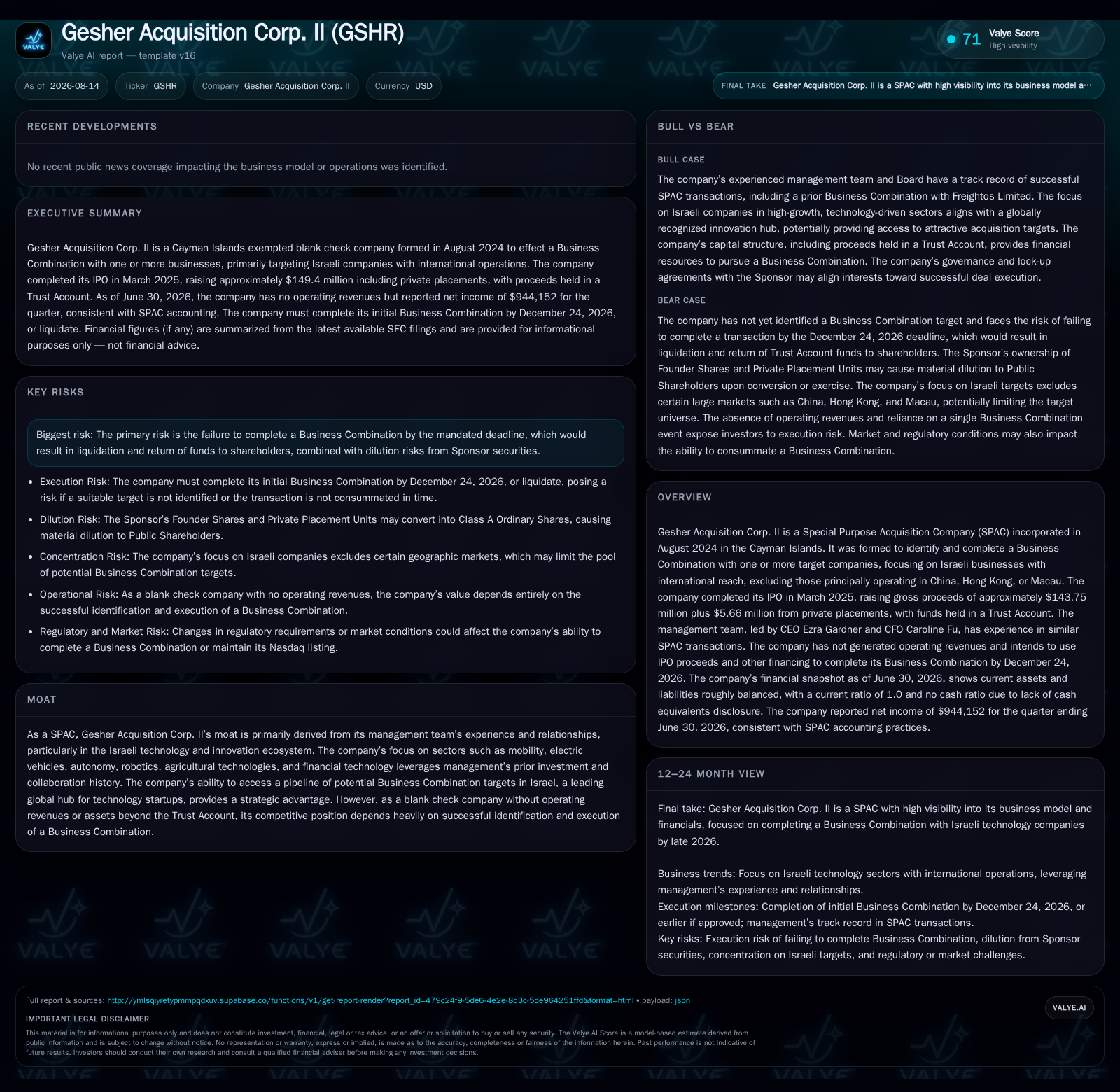
Gesher Acquisition Corp. II is a blank-check company formed in 2024 and completed an IPO in March 2025, raising nearly $150 million held in trust pending a business combination. The SPAC is focused on identifying an initial Business Combination with Israeli technology companies outside China, Hong Kong, and Macau, leveraging management’s network expertise. As of the latest quarterly filing ending June 30, 2026, the company remains in search mode without a finalized deal but approaches the mandated December 24, 2026 deadline to consummate a combination or liquidate. Key risks include deal sourcing competition, shareholder redemptions, and dilution from Sponsor securities. The outcome hinges on management’s ability to source and execute a transaction meeting investor approval before expiration of the Combination Period.
Recent Operating Update: Approaching Critical Business Combination Deadline
Gesher Acquisition Corp. II’s latest quarterly filing dated August 13, 2026 [S2] lays bare the continuing challenge faced by the company—a pure blank-check entity formed in August 2024—of concluding its inaugural Business Combination before the December 24, 2026 deadline stipulated in its governing documents [S1][S26]. As of June 30, 2026, the company holds approximately $144 million in its Trust Account derived from IPO net proceeds and private placements finalized in March 2025 but has yet to announce any definitive business combination target or transaction [F1][S1]. This positions Gesher II well within the typical risk window for SPACs: substantial capital under management but no operating revenues or substantive acquisition finalized with roughly four months remaining to meet the mandatory closing date.
SPACs live or die by their ability to source attractive targets that meet investor expectations for valuation, growth profile, and strategic fit within limited time windows set by their charters and stock exchange regulations. Failure results in liquidation and return of capital net of fees—an outcome this SPAC aims to avoid.
Business Model Specificity: A Cayman-Exempted Blank Check Vehicle Focusing on Israeli Innovation
Gesher Acquisition Corp. II’s structure is archetypal of modern Special Purpose Acquisition Companies: it conducts an Initial Public Offering (IPO) to raise capital exclusively for the purpose of acquiring one or more private businesses via merger or acquisition (a "Business Combination"), thereby taking those enterprises public without them undergoing a traditional IPO process [S1][S9]. Proceeds from selling approximately 14.4 million public units during the IPO at $10 each yielded gross proceeds of $143.75 million plus roughly $5.66 million from private placement units sold concurrently primarily to Sponsor entities [S1]. Such funds are held in a segregated Trust Account managed by Continental—as mandated regulation ensuring investor protection until deal consummation or liquidation [S1].
Unlike operating companies with direct revenue streams from customers or end-users, Gesher II generates value solely through execution of an impactful De-SPAC transaction that enhances combined entity value beyond trust-account capital less dilution and fees. Management's monetization mechanics involve negotiating equity stakes (shares issued to target shareholders), cash consideration drawn from trust proceeds adjusted for shareholder redemptions, and potential debt or PIPE financing structures to finance acquisitions exceeding stand-alone cash resources [S4][S21]. Post-combination success depends heavily on selecting targets with scalable technology-oriented business models capable of navigating public markets.
Founder Shares and Private Placement Units owned by Sponsors carry standard lock-up provisions restricting share transferability until after initial Business Combination closure—even though amendments can be made if deemed necessary pre-deal approval to align incentives or inject liquidity [S1][S5]. Warrants issued provide potential upside participation but simultaneously pose dilution risks if exercised.
Industry Structure & Competitive Position: Targeting Israeli-Tech Amid Crowded Deal Landscape
Gesher II situates itself explicitly within the highly active SPAC ecosystem focusing on high-growth Israeli private companies with international operations outside mainland China regions—a deliberate geographic and regulatory distinction reflecting both risk appetite and opportunity set boundaries adopted by management [S1][S9]. This aligns with Israel's global reputation as an innovation hub, ranking top globally in R&D intensity (~6% GDP) with thousands of active startups across verticals including mobility solutions, robotics/autonomy platforms, agtech innovations powered by advanced biotechnologies, and fintech intermediaries leveraging blockchain or AI technologies [S9].
This focus leverages management's prior experience deploying capital via Gesher Acquisition Corp I (which closed deals involving over $100 million), their extended network within Israeli venture ecosystems, and validation of sector themes supported by Israel’s government innovation incentives such as incubators and R&D grants [S7][S9]. Peers include high-profile tech-focused blank-check companies like Social Capital Hedosophia Holdings or Reinvent Technology Partners that seek similarly disruptive tech verticals but often lack Gesher’s localized regional domain expertise.
Nonetheless, competition for compelling targets is intense as other SPACs with deeper pockets or strategic corporate investors compete aggressively; additionally traditional private equity firms offer alternative capital routes requiring careful deal structuring within constrained timeframes imposed on listed blank-check entities like Gesher II [S20][S26]. Moreover, redemption rights granted to public shareholders can compound capital allocation complexity—exerting pressure on available cash post-redemption which limits leverage capacity for larger transactions [S5][S24].
Growth Drivers: Network Access to Premier Israeli Tech Startups & Alternative Public Listing Demand
Despite the inherent execution risks associated with SPACs generally—and specifically this early-stage blank check model—several structurally favorable growth drivers underpin Gesher II’s approach:
Proprietary Pipeline via Experienced Management: The CEO Ezra Gardner and CFO Caroline Fu helm a team with proven track records executing successful SPAC mergers primarily sourced through long-term relationships cultivated across multiple cross-border capital markets channels connecting Israel-startups to global institutional investors seeking exposure outside conventional IPO routes [S1][S9].
Israeli Innovation Ecosystem: Israel’s standing as one of world's leading startup hubs—with highest startups per capita globally—provides robust deal flow concentrated in high-margin sectors exhibiting structural growth fueled by deep R&D investments supported by government tax policy benefits and incubator initiatives fostering commercialization [S9][S7]
Investor Appetite for De-SPAC Transactions: With traditional IPO windows experiencing volatility due to macroeconomic cycles or regulatory scrutiny changes, private companies increasingly view SPAC mergers as efficient paths to liquidity offering quicker timelines than typical underwritten offerings while broadening investor bases once public combined entity emerges [industry knowledge layer).
Flexible Transaction Structures: The ability to leverage cash proceeds alongside issuing equity securities or debt instruments enables tailoring deal economics optimally aligning with target company preferences while mitigating post-combination capital constraints—vital in curbing dilution impact despite typical Sponsor warrant overhang concerns common in the space [S4][industry knowledge layer).
Risks & Watchpoints: Time-Limited Window Raises Execution Tension
Key risk factors identified around Gesher II’s business include:
Failure to Complete Agreement Before December 24 Deadline: With limited time left until contractually enforced liquidation should no Business Combination be consummated creates highly tangible existential threat amplifying urgency for swift identification while avoiding suboptimal deals justifying delays amending firm's charter requires shareholder approval risking further uncertainty and possible share price volatility around vote outcomes [S1][S2][S26]
Dilution Risks: Sponsor founder shares plus warrant exercise rights can materially dilute public shareholders’ ownership if transaction structures require significant issuance beyond trust account holdings especially where additional external financing vehicles must be employed
Competitive Pressure: Other well-capitalized SPACs targeting overlapping sectors could constrain access to best-fit targets inflating valuations or elongating diligence cycles as sellers pit bidders against one another reducing pricing power.
Redemption Rights Impact: Public shareholder redemption elections at merger closing reduce available cash consummation resources potentially forcing re-pricing negotiations leaving unsettled how dynamic locked-in cash pool will affect final deal terms at or near completion.
Regulatory & Market Uncertainty: Evolving SEC guidance on valuation disclosures during de-SPAC processes introduces procedural delays; broader market sentiment shifts may influence sponsor willingness or capacity for supporting backstop arrangements customary in such deals limiting financial engineering flexibilities post-announcement.
What To Watch Next: Milestones Toward Transaction Announcement Or Liquidation
With less than half a year remaining before forced wind-down absent deal closure:
Public Announcements Of Letter of Intent Or Definitive Agreements: A binding Transaction announcement sets clear timeline markers triggering proxy/disclosure processes along with detailed target segment KPIs financially evaluated per Nasdaq minimum valuation rules ensuring shareholder protections ahead of votes.
Shareholder Meeting Notices For Merger Approval: Proxy solicitations incorporating redemption mechanics enable market gauging of investor acceptance which directly impacts net available consideration pool sizing around expected redemptions rate.
Possible Amendments To Charter Extending Combination Period: Though requiring majority shareholder approval adding time buffer signals negotiation complications but can preserve strategic optionality if consensus supports longer runway.
Transactions Financing Securitization Updates: Indicative PIPE fundraises or forward purchase agreements will provide clues about transaction scale feasibility relative to Trust Account plus external liquidity harnessing capabilities.
Sponsor & Insider Stock Activity Disclosures: Purchases/sales under Rule 10b5-1 plans might reveal confidence levels toward outcome probabilities while warrant exercise patterns may signify anticipated post-merger upside funding intentions.
Absent clear developments soon expect growing market skepticism given rising existential uncertainty compounded by sector-wide headwinds impacting comparable tech-focused de-SPAC vehicles fueling trade volatility risk.
Financial Profile Discussion
Gesher Acquisition Corp. II exhibits typical pre-combination financial characteristics reflective of a blank check entity focused exclusively on its acquisition mandate rather than operational activities. As of June 30, 2026 balance sheet data shows current assets near $435 thousand closely matching current liabilities just over $436 thousand producing a neutral current ratio at about one indicating balanced short-term liquidity aligned mainly with administrative expense accruals rather than substantive operating cash flow generation [F1]
Liquidity is predominantly held within segregated Trust Accounts funded at IPO constituting secure collateral backing Redemption Rights protecting public investors’ principal minus fees emphasizing sponsor/management reliance on successfully closing their targeted acquisition near term before liquidation conditions activate returning residual funds pro rata absent any value accretion beyond initial capital commitment stake ultimately governed by shareholder voting outcomes required under Nasdaq listing standards managing governance exposure risks pertaining transaction approvals [F1][S12]
In summation Gesher Acquisition Corp. II stands at a pivotal inflection point typical across sector peers: it controls meaningful invested capital uniquely focused on Israeli tech driving future growth amid known operational inertia inherent until De-SPAC close yet must resolve transactional uncertainties intensified by looming cut-off deadlines presenting concentrated event risk ambits determining ultimate pathway forward.
This analysis is based solely on publicly available information derived from regulatory filings dated through August 13, 2026 and does not constitute investment advice or research views regarding buying or selling securities.
Disclaimer: This is research-only, informational analysis and not investment advice. It may include AI-generated interpretation and general industry context. Always verify important details using primary sources.

Comments