
ContextLogic Transforms into US Salt Producer with $908 Million Acquisition and Integration Challenges
Following its exit from e-commerce, ContextLogic Holdings refocused on salt production via US Salt acquisition, shifting operational and financial dynamics.
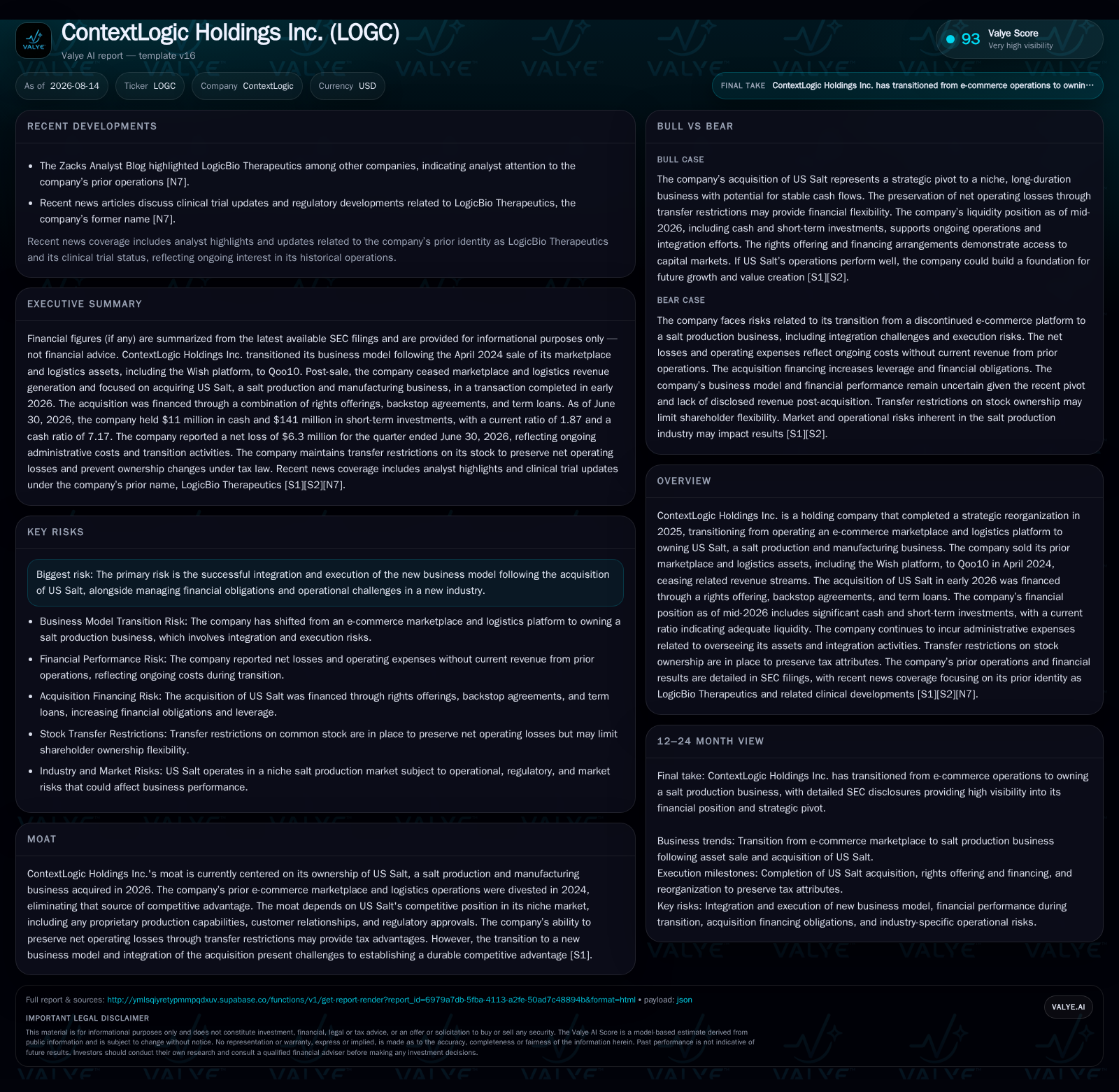
ContextLogic Holdings Inc. completed a strategic pivot by divesting its e-commerce marketplace in 2024 and acquiring US Salt, a salt mining and manufacturing company, in early 2026 for approximately $908 million [S1]. The acquisition was funded through a mix of equity rights offerings, backstop agreements, and secured term loans, placing leverage and integration execution at the core of the company's near-term priorities [S1], [F1]. The latest quarterly results indicate stable revenue but reveal volume declines due to planned maintenance and transportation constraints, underscoring operational integration risks in this capital-intensive commodity business [S29]. ContextLogic's future performance hinges on managing production capacity utilization, regulatory compliance costs, and customer contract renewals amid commodity price volatility typical for salt producers.
Recent Operating Update and Strategic Shift
ContextLogic Holdings Inc., previously known for its e-commerce marketplace operations including the Wish platform, completed a pivotal business transformation over the past two years. The company divested its marketplace and logistics assets to Qoo10 in April 2024, effectively ending that revenue stream and repositioning itself away from digital marketplaces [S1]. In early 2026, ContextLogic strategically acquired US Salt for approximately $908 million – a move that transitioned the company definitively into the basic materials sector focused on salt production and manufacturing [S1].
This acquisition was financed through a combination of financial instruments: an initial term loan of $215 million maturing in 2033 along with a revolving credit facility of $25 million; equity financing involving a rights offering yielding about $3 million supplemented by backstop agreements generating roughly $112 million; collectively amounting to $115 million from equity sources [S1], [S8], [F1].
Business Model Analysis
Post-acquisition, ContextLogic’s revenue model revolves around operating US Salt’s salt extraction and manufacturing facilities—primarily serving industrial clients requiring bulk rock salt, evaporated salts for food-grade use, chemical feedstock providers, agricultural customers needing mineral inputs, and municipal buyers purchasing de-icing salts during winter months. The firm generates sales mostly on contract pricing terms linked to volumes shipped and product mix increments (industrial vs specialty salts) impacting average selling prices per ton.
Operational success depends heavily on throughput measured as production volume in tons and maximizing capacity utilization rates in capital-intensive mining environments. Key variable cost drivers include energy consumption per unit produced (energy-intensive mining & processing), labor productivity, equipment maintenance schedules influencing downtime (as seen this quarter), regulatory compliance costs relating to environmental standards especially concerning brine management and waste disposal.
Distribution logistics pose critical bottlenecks due mainly to dependency on trucking networks for bulk shipments - disruptions can materially delay deliveries thereby impacting inventory turnover rates at customer sites and delaying cash collection cycles.
Margins are challenged by inherent commodity price volatility coupled with fluctuating energy prices which directly influence operating costs per ton produced. Contract renewal rates will also reflect customer satisfaction regarding consistent delivery timing and quality of salt products amid growing competition from established peers like Compass Minerals International or Morton Salt within similar value chains.
Industry Structure and Competitive Position
US Salt operates within the upstream segment focusing on extraction (salt mining) predominantly using solar evaporation or rock salt methods combined with downstream processing like purification to produce evaporated salt suitable for various end-markets. Market demand drivers span winter de-icing programs increasing seasonally regionally; global expansion in chemical manufacturing fueling industrial mineral consumption; food processing requiring certified food-grade salts; while infrastructure development drives steady demand for construction-related mineral inputs.
ContextLogic’s shift aligns it against major integrated players such as Compass Minerals International or Tata Chemicals who balance diverse product portfolios across geographies offering scale advantages. While lacking scale comparative with more entrenched players currently limits bargaining power with some large corporate customers or municipal contracts leading potentially to narrower margins initially; US Salt’s niche competitive moats could derive from localized resource ownerships or specialized production capabilities if proven sustainable post-integration.
Growth Drivers
Growth prospects hinge principally on ramping up capacity utilization following recent maintenance shutdowns optimizing production yield improvements through operational excellence initiatives post-acquisition integration efforts. Selling price increases reflect inflationary pressures possibly translating into improved nominal revenues barring volume setbacks.
Broader industry trends supporting expansion include rising demand from chemical feedstock manufacturing utilizing processed salts input; growth in regulated winter road maintenance programs increasing bulk de-icing purchases; advancements in extraction technologies reducing unit energy consumption enhancing cost competitiveness; alongside potential geographic market expansions addressing unmet regional demand pockets.
US Salt’s market penetration into specialized food-grade salt verticals may offer margin enhancement opportunities differentiating from commoditized bulk salt sales constrained by price competition.
Strategic acquisitions akin to US Salt itself remain an option for ContextLogic should capital markets conditions permit further consolidation moves strengthening competitive positioning.
Risks and Watchpoints
The foremost risk lies in successfully integrating US Salt’s operations into ContextLogic’s framework transforming governance structures while improving operational efficiency without escalating cost bases excessively. Planned maintenance cutbacks contributed materially to recent volume declines exposing sensitivity to downtime scheduling impacting revenue timing.
Commodity price volatility presents exposure risk depressing contract renewal rates if downstream customers face margin squeezes themselves causing volume contraction. Additionally, unpredictable weather patterns influencing seasonal de-icing demand create cyclicality complicating forecasting accuracy.
Logistics constraints evidenced currently underline supply chain fragility necessitating contingency planning particularly where trucking availability impacts shipment cadence causing inventory build-ups or unfulfilled orders.
Financially, the company holds approximately $11 million in cash and equivalents supported by current assets totaling about $39.7 million against current liabilities near $21.2 million delivering a current ratio around 1.87 indicative of sound near-term liquidity positioning despite recent operational disruptions [F1]. Nonetheless net debt stands elevated close to $204 million driven primarily by the recently drawn term loans financing the acquisition stressing reliance on operating cash flow generation enhancements ahead [F1].
Regulatory compliance burdens associated with environmental permits concerning mining waste discharges or site reclamation could increment costs unpredictably affecting profitability absent forward-looking mitigation strategies.
What To Watch Next
Key milestones include metrics evidencing improved capacity utilization approaching pre-maintenance levels likely driving incremental volume recovery corroborated by shipment log data documenting resolution of trucking constraints bolstering delivery performance records.
Contract renewal announcements particularly from recurring municipal de-icing buyers or strategic chemical industry customers will signal validated pricing power crucial under cyclic commodity market conditions.
Progress updates on environmental permits renewal or any regulatory changes will spotlight compliance risk trajectories shaping operating cost outlooks.
Furthermore, monitoring quarterly earnings releases for shifts in gross margin trajectory reflecting improved cost efficiencies or adverse inflationary cost impacts remains essential alongside interest coverage ratio trends illuminating financial leverage sustainability.
Financial Profile Discussion
As of June 30, 2026, ContextLogic held approximately $11 million in cash and equivalents supported by current assets totaling about $39.7 million against current liabilities near $21.2 million delivering a current ratio around 1.87 indicative of sound near-term liquidity positioning despite recent operational disruptions [F1]. Net debt stands elevated close to $204 million driven primarily by the recently drawn term loans financing the acquisition stressing reliance on operating cash flow generation enhancements ahead [F1].
Operating loss from continuing operations remained substantial at a reported negative $31 million end-2025 reflecting investment phase costs associated with acquisition integration before expected profitability materializes post-acquisition closure; meanwhile accumulated deficit hovers near $3.4 billion reflective largely of historic e-commerce operations carryover losses now transitioning out under new strategy parameters [F1], [S1].
The preservation of significant net operating losses was structurally supported through transfer restrictions preventing ownership concentration exceeding IRS Section 382 thresholds maintaining valuable tax shields promoting deferred tax asset realizations subject to successful ongoing profitable operations after US Salt assimilation completes fully [S22], [S1].
Continued emphasis on disciplined capital allocation balancing debt servicing requirements against incremental investment needs will dictate medium-term financial health alongside prudent cost containment enabling sustainable EBITDA margin improvements fundamental to transitioning into positive free cash flow generation status characteristic of mature basic materials producers.
This analysis integrates comprehensive SEC filings alongside contextual industry frameworks relevant to the company’s transformation from tech-based e-commerce marketplace operator towards a specialized basic materials producer underpinned by US Salt’s operational footprint within the salt production domain. The strategic shift introduces both opportunities tied to established commodities supply chains as well as execution risks embedded within capital-intensive mining industries requiring diligent operational management post-acquisition.
Disclaimer: This is research-only, informational analysis and not investment advice. It may include AI-generated interpretation and general industry context. Always verify important details using primary sources.

Comments