
Alpha Cognition Drives Commercial Launch of ZUNVEYL Targeting Alzheimer’s Long-Term Care Market
Following FDA approval and commercial launch of its novel acetylcholinesterase inhibitor ZUNVEYL, Alpha Cognition focuses on specialized commercialization in long-term care settings amid manufacturing and reimbursement challenges.
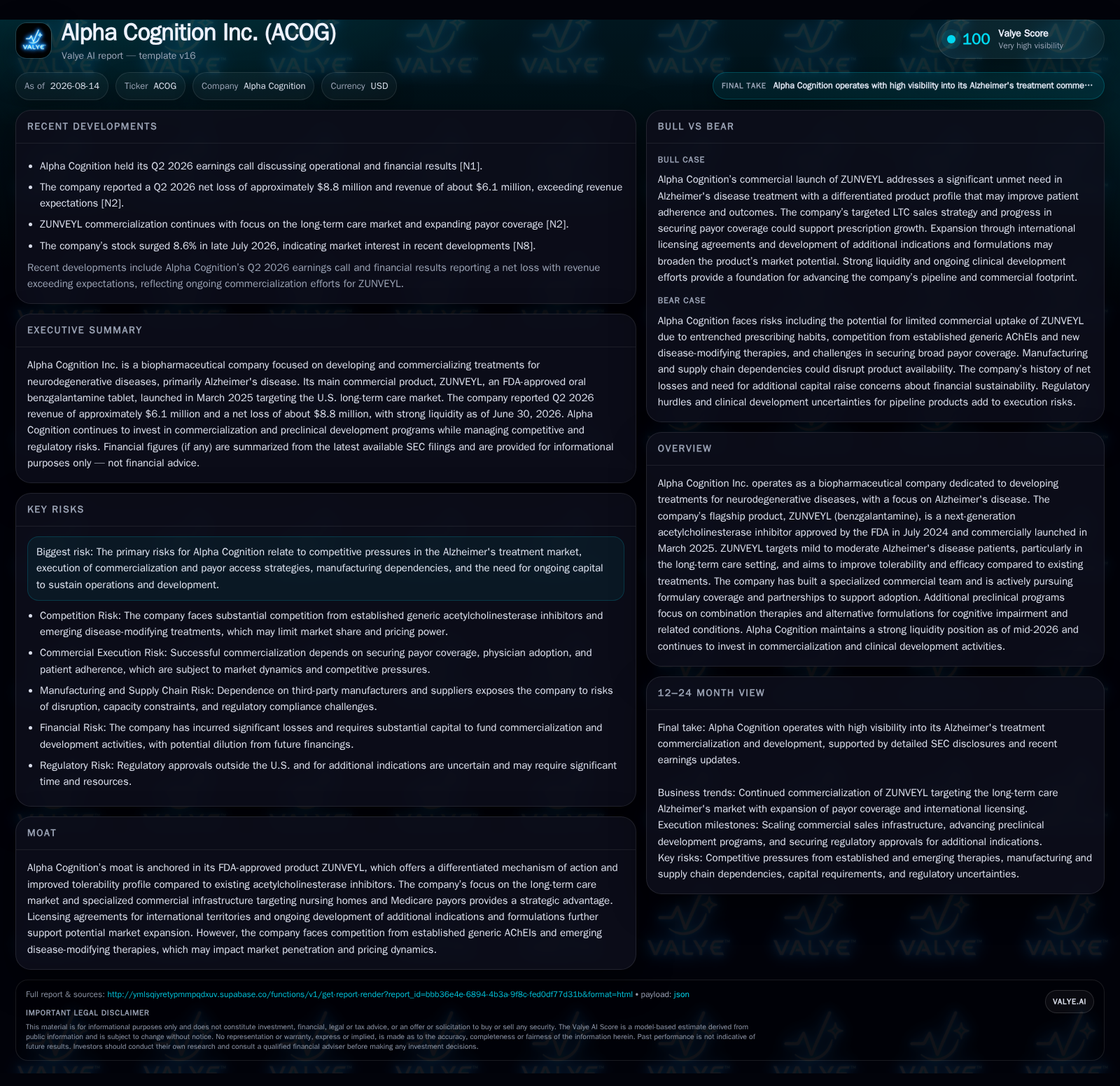
Alpha Cognition Inc. has transitioned from development to commercialization with the launch of ZUNVEYL, a next-generation acetylcholinesterase inhibitor approved in mid-2024 for mild to moderate Alzheimer's disease. The company targets the long-term care market through a specialized salesforce and strategic payor partnerships, seeking formulary access that will be critical for adoption and revenue growth. While Alpha Cognition benefits from a differentiated product profile with improved tolerability, challenges remain around scaling manufacturing, navigating competitive generics and emerging therapies, and securing reimbursement. As of June 2026, Alpha Cognition maintains a solid liquidity position that supports ongoing commercial efforts and pipeline advancement.
Recent Operating Update
Alpha Cognition’s latest quarterly filing dated August 13, 2026 confirms continued steps to expand commercial traction for ZUNVEYL following its initial launch in March 2025 [S2]. Since receiving FDA approval for ZUNVEYL—a delayed-release oral tablet indicated for mild to moderate Alzheimer's dementia—in July 2024 [S1], the company has prioritized building a specialized salesforce dedicated to serving major nursing home chains within the U.S. long-term care (LTC) segment. This strategy aligns with the company’s positioning that Alzheimer’s patients in LTC require targeted clinical support distinct from broader outpatient populations due to differing treatment adherence challenges and payor dynamics.
The August quarter update does not detail specific sales volumes but reiterates investing heavily in commercial infrastructure while balancing capital efficiency. Alpha Cognition reported revenue totaling approximately $10.2 million as of December 31, 2025 [F1], implying early-stage product uptake consistent with its recent launch timeline. Operating losses persist due to upfront commercial expenses inherent in introducing a novel therapeutic into a complex payor landscape.
A significant corporate governance event was recorded earlier in June 2026 with the election of six directors during the annual meeting, fortifying executive oversight during this critical commercial scale-up phase [S3]
Business Model
Alpha Cognition operates as a biopharmaceutical company centered on developing proprietary treatments for neurodegenerative diseases—principally Alzheimer’s disease—with its flagship FDA-approved therapy ZUNVEYL (benzgalantamine). Its revenue generation hinges on direct commercialization of ZUNVEYL via prescription drug sales primarily within long-term care settings where patient volumes are dense but prescribing behaviors require tailored medical education.
The company sets the Wholesale Acquisition Cost (WAC) for ZUNVEYL at $820 per month [S1], strategically priced to position competitively against entrenched acetylcholinesterase inhibitors (AChEIs) while aiming to maintain sustainable unit economics. Patient out-of-pocket costs vary depending on insurance coverage duration and formulary status. Monetization is therefore sensitive not only to prescription volume but also payer formulary inclusion—making successful reimbursement negotiations pivotal.
Operationally, Alpha Cognition invests heavily in building its account-based sales team who engage directly with nursing home operators, consultant pharmacists specialized in LTC, and long-term care pharmacies [S1]. This specialization is crucial since adoption depends on navigating institutional formularies and Medicare Advantage plans unique to this setting rather than typical retail outpatient pharmacies.
Beyond ZUNVEYL’s core oral tablet formulation commercialized currently, Alpha Cognition pursues several preclinical development lines: combination therapy of benzgalantamine with memantine targeting moderate-to-severe Alzheimer’s; sublingual formulations addressing dysphagia common among LTC patients; and indications extending into mild traumatic brain injury-related cognitive impairment [S1]. These pipeline assets aim to leverage platform intellectual property while expanding potential patient populations.
Manufacturing is outsourced to third parties located primarily in Taiwan—a point of operational risk due to geopolitical uncertainties—which requires rigorous regulatory compliance oversight [S1]. Commercial manufacturing scale-up efforts remain ongoing given that prior production operated at clinical trial scale.
Industry Structure and Competitive Position
The neurodegenerative pharmaceutical market is defined by prolonged R&D cycles, stringent FDA regulatory requirements, and increasingly complex reimbursement environments influenced by government healthcare programs like Medicare. Alpha Cognition’s niche focus on next-generation AChEIs places it alongside established generic treatments such as donepezil (Aricept) and rivastigmine but seeks differentiation based on improved patient tolerability through its novel binding affinity for neuronal nicotinic alpha-7 receptors—a mechanism linked to enhanced cognitive effects beyond cholinesterase inhibition alone [S1].
Competition arises both from these entrenched generics renowned for cost-effectiveness but impaired by side effects leading to patient discontinuation—and from emerging disease-modifying therapies that could reshape treatment paradigms if broadly approved. As Alpha Cognition is early-stage commercially relative to giants like Biogen or Eisai who have broader Alzheimer’s portfolios including monoclonal antibodies targeting amyloid beta pathology, protecting market access requires sustained clinical differentiation complemented by payor-backed pharmacoeconomics demonstrating value versus cost.
Formulary placement in Medicare Advantage plans controlling LTC patient access is particularly competitive; thus, Alpha Cognition’s strategy emphasizing account-based engagement tailored for LTC pharmacy channels aims to build durable switching incentives among prescribers struggling with current AChEI GI adverse effect burdens [S1]. However, pricing at $820 monthly WAC necessitates clear value demonstration amid generic pricing pressures.
Growth Drivers
Key growth catalysts hinge on:
- FDA approvals: The initial approval secured FDA endorsement validating safety/efficacy; future supplemental approvals especially for combination therapies or new formulations could broaden indication scope.
- Long-term care market penetration: With an estimated $2 billion annual spending on Alzheimer's treatments within LTC facilities [S1], successful formulary negotiation coupled with scaling specialized sales outreach is expected to drive patient adoption rates.
- Enhanced reimbursement: Active effort by market access leadership seeks increased Medicare Advantage plan coverage alongside collaborations with consultant pharmacists aiding formulary acceptance.
- Pipeline advancement: Preclinical work on memantine combinations and sublingual options taps unmet needs enhancing patient convenience or extending treatment relevance beyond mild/moderate dementia stages.
- International licensing partnerships: Agreements granting rights across Asia-Pacific regions under CMS International Development & Management Limited signal diversification potential beyond U.S. constraints [S18].
Though early commercial revenues remain modest relative to operating costs as expected during product launch phases [F1], these drivers collectively underpin medium-term growth prospects contingent upon execution success.
Risks / Watchpoints / Growth Constraints
Several risks warrant close monitoring:
- Market adoption risk: Conversion of prescribers accustomed to established AChEIs may be slower without compelling head-to-head evidence or textured pharmacoeconomic analyses validating incremental benefit despite higher pricing [S1].
- Manufacturing scale-up: Reliance on external suppliers based in Taiwan exposes supply chains to geopolitical disruption risks; plus achieving efficient commercial-scale production poses inherent technical hurdles potentially delaying inventory availability [S1].
- Reimbursement uncertainty: Payer decisions are fragmented requiring frequent plan-by-plan negotiations risking inconsistent coverage that curtails patient access [S9].
- Competitive pressure: Established low-cost generics exert relentless pricing pressure; meanwhile novel disease-modifying approaches gaining traction may reduce overall AChEI prescription demand over time [S6].
- Capital intensity: Continued losses necessitate additional capital infusion; failure to raise funds timely could impede marketing expansion or pipeline development activities given current early stage financial profile [S1].
- Regulatory & compliance risks: Evolving healthcare laws governing drug promotion, anti-kickback statutes affecting sales practices, healthcare data privacy mandates could increase operational complexity [S13],[S14],[S15],[S21].
What To Watch Next
Critical upcoming indicators include:
- Progression of key Medicare Advantage formulary additions or coverage expansions impacting volume ramp;
- Quarterly prescription growth trends within major nursing home accounts client base;
- Updates on preclinical candidate advancement toward clinical trial initiation;
- Milestone payments or royalty receipts tied to international licensing agreements;
- Manufacturing capacity upgrades announced or delays reported impacting supply chain reliability;
- Capital raise activities reflecting ability to sustain commercial investment ahead of reaching operating profitability targeted for 2027[S1];
- Additional regulatory filings seeking label expansions or new delivery formats enhancing clinical utility.
Financial Profile Discussion
Alpha Cognition's financial position as of June 30, 2026 shows cash and equivalents balance of approximately $41.4 million against nominal debt of about $0.3 million resulting in a net cash position supportive of ongoing operations through near term capital-intensive commercialization phases [F1]. The current ratio stands robustly at roughly 9.03 indicating strong short-term liquidity enabling the firm to meet liabilities without funding strain [F1].
Revenues remain nascent consistent with recent market entry timing—totaling around $10 million as of year-end December 2025—but operating losses persist due predominantly to SG&A investment required for frontline salesforce buildup alongside continuing R&D expenditures supporting pipeline maturation [F1]. Achieving operating profitability remains contingent upon reimbursement success driving accelerated prescription volume adoption balanced against fixed cost absorption efficiencies.
Overall liquidity metrics suggest adequacy for planned near-term activities absent unforeseen disruptions; however substantial additional capital may be requisite over a multi-year horizon if organic revenue scales below expectations or accelerated R&D investments materialize.
This analysis is based solely on publicly available filings dated through August 2026 without any predictive claims or investment advice offered herein. It incorporates detailed business model scrutiny contextualized within neurodegenerative drug development sector knowledge emphasizing operating KPIs critical to early-stage biopharmaceutical commercialization success.
Disclaimer: This is research-only, informational analysis and not investment advice. It may include AI-generated interpretation and general industry context. Always verify important details using primary sources.

Comments