
Binah Capital Group Advances Advisor-Centric Models Despite Net Asset Outflows
Binah Capital Group leverages flexible operating models and a diversified platform to navigate challenging asset trends in the retail wealth management segment.
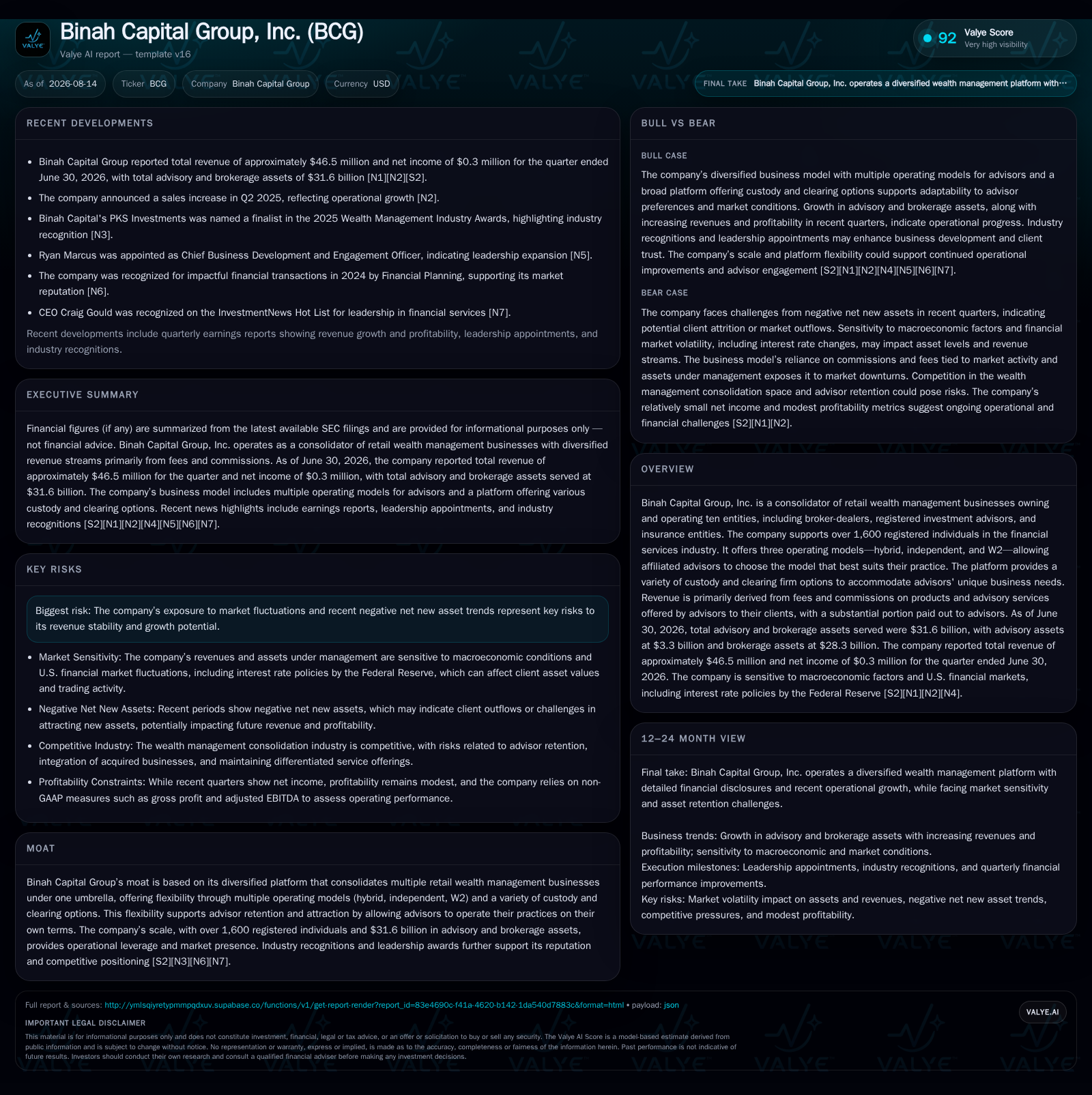
Binah Capital Group, Inc. reported improved revenue and net income in the first half of 2026, driven by growth in advisory and brokerage assets despite negative net new asset flows. The company’s hybrid, independent, and W2 advisor models paired with multiple custody options support a broad network of over 1,600 registered individuals. While brokerage assets increased to $28.3 billion and advisory assets to $3.3 billion, net new assets remained negative due to market dynamics affecting brokerage inflows. Binah’s strength lies in its platform flexibility and scale, but it faces risks from market volatility and asset outflows that pressure revenue stability. The company maintains moderate leverage with a $16.7 million term loan and focuses on strategic acquisitions and advisor retention to drive future growth.
Recent Operating Update: Mixed Asset Flows with Revenue Growth
Despite these gains in top-line revenue and bottom-line results, Binah experienced continued negative net new asset flows totaling $(2.2) billion for Q2 2026 alone and $(1.7) billion for the half-year period ended June 30, down from less pronounced outflows the previous year [(Q2 $(0.9)B; H1 $(1.1)B)] [S2]. The drag largely came from brokerage net outflows of $(1.7) billion over six months even as advisory assets showed stability in net flows (flat at zero for H1), highlighting the dichotomy within their asset base [S2]. This suggests ongoing market or client behavior headwinds primarily impacting transactional brokerage segments rather than fee-based advisory mandates.
Business Model: Flexible Advisor Platforms Driving Scale
Binah Capital consolidates retail wealth management operations across ten entities segmented into four broker-dealers, three registered investment advisors (RIA), and three insurance firms under one umbrella [S2]. This multi-entity structure allows it to cater comprehensively across investment products, brokerage services, and insurance solutions.
Central to its model is offering affiliated financial advisors choice among three distinct operating frameworks: hybrid (combining independence and support), independent (self-directed practice ownership), and W2 (employee/advisor roles). This variety permits financial professionals to select arrangements aligned with their business preferences while accessing Binah’s shared resources including compliance oversight, technology infrastructure, back-office support, and product access [S1][S2].
Revenue predominantly stems from fees and commissions generated on financial product sales (e.g., mutual funds, variable annuities), advisory services fees (often fee-based or wrap accounts), securities commissions on transactional activity, plus insurance premium commissions [S1]. A meaningful portion of gross revenue is paid out as compensation to advisors under their respective business models.
A key differentiator lies in Binah’s open-architecture custody strategy providing advisors access to multiple custody and clearing providers rather than relying on exclusive relationships that can constrain advisor choice or economics [S2]. Such custody flexibility aligns with growing industry trends favoring platforms that empower advisor autonomy while preserving operational scale.
With over 1,600 registered individuals supported across its entities as of mid-2026—a figure indicative of scale comparable to mid-sized independent broker-dealer peers—Binah leverages this network breadth for cross-selling opportunities and operational leverage despite evolving market headwinds impacting transaction volumes [S2]
Industry Structure & Competitive Positioning
The wealth management landscape where Binah competes is marked by intense competition among independent broker-dealers (IBDs), large RIAs networks, wirehouses like Morgan Stanley or Merrill Lynch, insurance distributors, fintech-enabled advisors platforms (e.g., LPL Financial), and custodial firms offering integrated solutions. Key pressures center on attracting/retaining advisors amid rising bargaining power demands for economic terms; fee compression driven by passive investing trends; regulatory complexity; market volatility affecting AUM growth; plus technology-driven expectations for seamless digital client service.
Binah’s competitive moat derives principally from its flexible hybrid business model offerings supporting autonomous practice management combined with scale-enhancing multi-custody options facilitating advisor-tailored operational architectures—the latter increasingly critical as advisors seek best-of-breed technology partners without platform exclusivity lock-ins.
Peer benchmarks include firms such as Advisor Group or Cetera Financial Group who similarly provide multiple advisor operating models alongside expansive networks exceeding several thousand advisors but at varying scales of AUM concentration and technology sophistication.
While Binah's asset base ($31.6 billion AUM + brokerage assets) remains modest relative to larger incumbents like LPL Financial (over $900 billion AUM), its platform diversification across broker-dealer/RIA/insurance segments positions it well for niche growth opportunities particularly as more advisors shift away from traditional wirehouse employment toward hybrid or independent practices requiring robust administrative support but operational freedom.
Growth Drivers: Network Expansion & Business Mix Shift
Management emphasizes organic growth through two principal levers: expanding advisor headcount via both targeted recruiting/lift-outs—and increasing advisory-oriented accounts commanded by fee-based recurring revenue rather than brokerage commission reliance—to stabilize long-term earnings visibility amidst fluctuating transaction volumes [S1][S18]
Acquisition remains an important element as Binah actively integrates smaller boutique firms into its platform consolidating regional operators who benefit from Binah’s back-office scale advantages.
The shifting client demand toward fiduciary advice raises the strategic importance of growing advisory AUM which commands higher margins compared to brokerage assets typically subject to price competition impacting gross profit rates [S1]. Binah’s reported advisory asset growth (+20.5% YoY) contrasts favorably against brokerage asset hikes (+12.7% YoY), signaling potential traction consistent with broader industry migration toward fee-based advisories.
Monitoring metrics such as advisor retention rate, revenue per advisor (reflecting productivity gains or business mix changes), average fee rates on advisory portfolios measured in basis points (bps), as well as net new asset flow trajectories remain vital KPIs confirming execution success amid external headwinds.
Risks & Constraints: Market Volatility & Regulatory Complexity
Market sensitivity poses a fundamental risk given that Binah’s fees tied to AUM/brokerage assets render revenues vulnerable to capital market downturns reducing client balances or trading activity levels resulting in commission declines [S17][S8]. Prolonged negative net new asset flows illustrate this exposure detracting from organic growth metrics despite stable absolute assets levels bolstered by positive market movements earlier.
Complex regulation governing broker-dealer subsidiaries imposes capital adequacy requirements that may constrain business agility or necessitate incremental financing depending on asset risk profiles maintained by PKSI, CLS, PKSS, WEG entities within the group [S4][S19]. Disruption or termination risks related to reliance on third-party clearing brokers also present operational vulnerabilities affecting transaction processing continuity.
Competitive landscape pressures toward fee compression could erode gross profit margins especially if rivals aggressively price fee-based service offerings or dilute commission splits enticing advisors away.
Additionally, compliance supervision challenges arise due to non-employee status of most advisors complicating oversight efforts raising reputational/legal risk exposure around misconduct allegations or regulatory sanctions [S17].
What To Watch Next
Key milestones include updates on:
- Quarterly net new asset trends segregated by advisory vs brokerage segments indicating whether shifts toward advisory fees sustain momentum;
- Advisor count changes reflecting recruitment effectiveness plus retention stability within different business models;
- Strategic acquisitions funded or closed underpinning inorganic growth;
- Potential changes or expansions in custody/clearing relationships that impact platform flexibility;
- Gross profit margin evolution evidencing successful cost management amid pricing pressures;
- Compliance regulatory developments impacting broker-dealer capital requirements and internal control enhancements;
- Debt metrics including term loan amortization progress balancing leverage headroom versus liquidity needs.
Financial Profile Discussion
Liquidity policies prioritize meeting operational demands alongside stringent regulatory capital thresholds particularly applicable to its regulated broker-dealer components ensuring ongoing compliance under stress scenarios [S4][S5]. Parent company liquidity relies mainly on dividends and management fees funneled up from subsidiaries maintaining decentralized cash pools useful for strategic deployment without immediate external capital raises noted recently.
Gross profit rose in line with revenue increases implying stable underlying margin discipline though risks remain if net new asset attrition persists reducing future earnings bases [S13]. Cash flow generation improved sequentially translating into higher operating cash inflows supporting debt servicing obligations comfortably amid steady financing cash outflows aligned with known debt amortization schedules.
Overall financial posture appears balanced for current operating scale yet depends fundamentally on reversing recent negative asset inflow trends coupled with sustained advisor network growth driving volumetric revenue gains that can spread fixed costs enabling margin expansion going forward.
Disclaimer: This is research-only, informational analysis and not investment advice. It may include AI-generated interpretation and general industry context. Always verify important details using primary sources.

Comments