
Cyngn’s Vehicle-Agnostic Autonomous Software Navigates Industry 5.0 Opportunities Amid Capital Constraints
Cyngn advances its modular autonomous driving software integrated with OEM industrial vehicles, targeting scalable deployments despite ongoing financial losses.
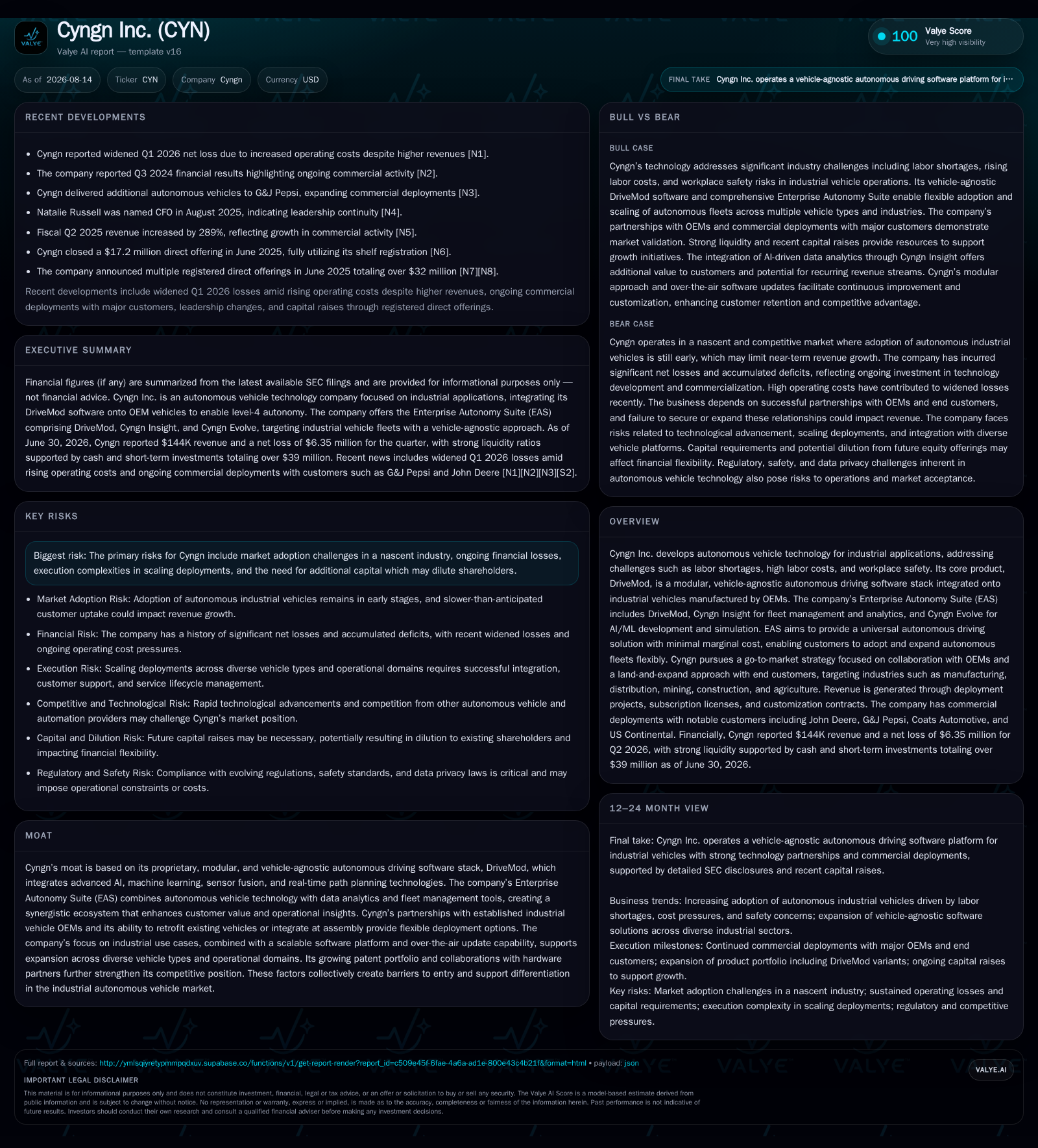
Cyngn Inc. develops and licenses its modular, vehicle-agnostic autonomous driving software suite—DriveMod and Enterprise Autonomy Suite (EAS)—to industrial vehicle OEMs and end customers, aiming to enable flexible, scalable automation across diverse sectors like manufacturing and logistics. The company’s latest quarterly filings reflect continued product validation and customer expansion alongside persistent operating losses and modest liquidity. Cyngn’s focus on partnerships with OEMs and data-driven fleet management tools align it with evolving Industry 5.0 trends but market adoption remains challenged by upfront costs, evolving regulations, and the technology’s relative immaturity. Key near-term indicators include expansion of autonomous vehicle deployments, customer retention, and successful scaling of product customizations.
Recent Operating Update: Scaling Autonomous Deployments during Market Validation
In its latest quarterly filing for the period ending June 30, 2026,[S2] Cyngn reports steady advancement in deploying its DriveMod autonomous driving software across a growing range of industrial vehicles through partnerships primarily with established OEM suppliers such as BYD (electric vehicles) and Motrec (tuggers). The company’s recent event filings emphasize that commercialization efforts remain focused on expanding production deployments after achieving early commercial releases dating back to early 2023.[S3][S12] These deployments span diversified vehicle classes – including forklifts, tuggers with towing capacities ranging up to 12,000 lbs,[S12] stand-on floor scrubbers, shuttles,[S11] and tow tractors – demonstrating DriveMod’s extensibility enabled by its modular design.
Despite progress in product validation and customer adoption within manufacturing and distribution use cases that benefit from shorter deployment timelines,[S9] Cyngn continues to face operational losses reflecting a typical early-stage industrial technology lifecycle. The firm reported a net loss of approximately $23.5 million for fiscal year 2025,[F1] underscoring sustained investment in R&D to enhance the platform’s capabilities while attempting to grow recurring revenue streams.
Business Model: Modular Industrial Autonomy Fueled by OEM Collaboration
Cyngn monetizes its offerings primarily through three revenue streams: project-based deployment fees charged per new client site installation; recurring licenses for its Enterprise Autonomy Suite (EAS)—which bundles vehicle autonomy software (DriveMod), fleet management analytics (Cyngn Insight), and AI/ML development tools (Cyngn Evolve); and DriveMod customization contracts tailored to specific industrial vehicle types or operational domains [S9][S13]
DriveMod serves as a modular autonomous driving software stack compatible with a broad set of sensors and hardware from third-party providers.[S11] This openness enables seamless integration into existing industrial vehicles manufactured by OEMs or retrofitted for legacy fleets—a strategy lowering barriers for incremental AV adoption by diverse customers. Cyngn complements this with Cyngn Insight dashboards that provide real-time fleet management data—the analytical spine that enables predictive maintenance insights and operational optimization—thus enhancing customer value beyond pure autonomy.[S15]
Crucially, Cyngn emphasizes collaboration over competition with adjacent technology suppliers,such as sensor manufacturers and connectivity providers.[S13] This ecosystem-oriented approach aims to leverage incumbent dealer networks and service infrastructures of OEM partners like BYD or Motrec—accelerating sales cycles via trusted distribution channels instead of building direct end-customer relationships alone.
Industry Structure & Competitive Positioning: Industrial Autonomy at the Intersection of AI & Operational Challenges
Operating at the software systems layer within the industrial autonomous vehicle value chain, Cyngn navigates a fast-evolving but nascent sector characterized by several entrenched challenges: labor shortages driving increased interest in automation; escalating workplace safety mandates; complex regulatory oversight varying by jurisdiction; high upfront cost hurdles discouraging all-or-nothing automation bets;and granular requirements unique to each industry vertical from mining to agriculture.
Cyngn's closest peer set includes companies like Aurora Innovation specializing in autonomous vehicle software development, Clearpath Robotics offering industrial robotics platforms, or Vecna Robotics focusing on autonomous material handling solutions. Compared to peers focusing narrowly on one vehicle category or robotic form factors tied strictly indoors or outdoors,Cyngn’s core competitive moat lies in its proprietary DriveMod stack built for broad 'vehicle agnosticism' enabling seamless transitions across indoor/outdoor ODDs and vehicle platforms.[S11]
This universality is an important advantage given the fragmented industrial vehicle landscape dominated by many small players producing highly specialized equipment. By integrating deeply at the OEM assembly level yet retaining retrofit flexibility,Cyngn mitigates switching costs for customers wary of large-scale fleet overhauls.[S9][S13]
Growth Drivers: Leveraging Industry 5.0 Trends & Labor Market Pressures
Demand growth is structurally supported by macro trends including rising labor costs coupled with acute shortages in sectors reliant on material handling vehicles such as manufacturing plants or distribution centers. Safety is also a key driver as companies strive to reduce workplace injuries related to human-operated heavy machinery.
Technological advances fueling growth encompass improvements in AI/ML algorithms improving object recognition durability,sensor fusion allowing robust perception in mixed indoor/outdoor environments,and real-time dynamic path planning which adapts safely across varied operational design domains.
The emergence of Industry 5.0 ideation — human-machine collaboration enhanced by smart robotics — aligns well with Cyngn's platform which can operate vehicles autonomously while enabling remote override or partial autonomy modes as needed.
High upfront capitalization needed for project-based deployments can deter cautious customers reluctant to commit without clear ROI demonstrated over multi-year horizons typical among "robot-in-a-box" solutions requiring full overhaul strategies.[S1]
Regulatory uncertainty persists especially as frameworks mature globally addressing liability issues,safety standards,and cybersecurity risks associated with connected autonomous systems.[S7]
Capital constraints are material: despite current assets substantially exceeding liabilities giving a strong reported current ratio (~16x), cash and equivalents totaled only around $2.2 million as of June 30, 2026,[F1] exposing vulnerability given ongoing operating cash burn exceeding $20 million annually previously reported.[F1][S4]
What to Watch Next: Deployment Scale-Up & Financial Sustainability Milestones
Key near-term milestones include expanding commercial production deployments beyond marquee partners like US Continental and Arauco,[S12] progression toward handling complex operational edge cases improving reliability metrics,[S1]and broadening-drive modulation across new vehicle models within existing customers’ fleets demonstrating land-and-expand success.
Tracking cyclical KPIs such as software license revenue growth reflecting uptake of subscriptions, increasing customer retention rates confirming solution stickiness,and declining average integration time per new vehicle model will signal execution momentum.
Additionally,milestones around financing events addressed through enhanced capital raises,warrants conversion or partnerships will be critical so as to alleviate liquidity pressures restraining scale-up investments long term.
Financial Profile Discussion
As of June 30, 2026, Cyngn holds approximately $2.2 million in cash and equivalents against current liabilities under $2.7 million, resulting in a robust current ratio near 16.34x driven largely by $44 million in current assets primarily comprising receivables or short-term holdings.[F1] The company carries notable net debt approximating $30 million calculated against available cash reserves,[F1] signaling reliance on future financing rounds for sustained operations absent break-even achievement. This capital intensity aligns with typical patterns seen among comparable early-stage peers developing complex AV software solutions targeting multi-industry ecosystems where scaling requires sustained investment before normalized margins emerge.
Consequently, strong execution delivering accelerating revenue growth coupled with disciplined capital management will be crucial levers dictating Cyngn's ability to transition toward profitability while supporting continuous product enhancement necessary for competitive positioning.
Disclaimer: This analysis is based solely on publicly filed documents as cited (,[F1]) without making investment research views. It aims to provide informed internal research perspective grounded strictly on verified disclosures relating to Cyngn Inc.’s business model, industry environment, operational performance risk factors, growth prospects, competitive landscape analysis, operating metrics relevance,and financial condition status.
Disclaimer: This is research-only, informational analysis and not investment advice. It may include AI-generated interpretation and general industry context. Always verify important details using primary sources.

Comments