
Intapp Advances AI Integration in Professional Services SaaS with Mixed Financial Signals
Intapp extends its vertical SaaS foothold in regulated professional sectors through advanced AI workflows amid persisting financial losses and liquidity challenges.
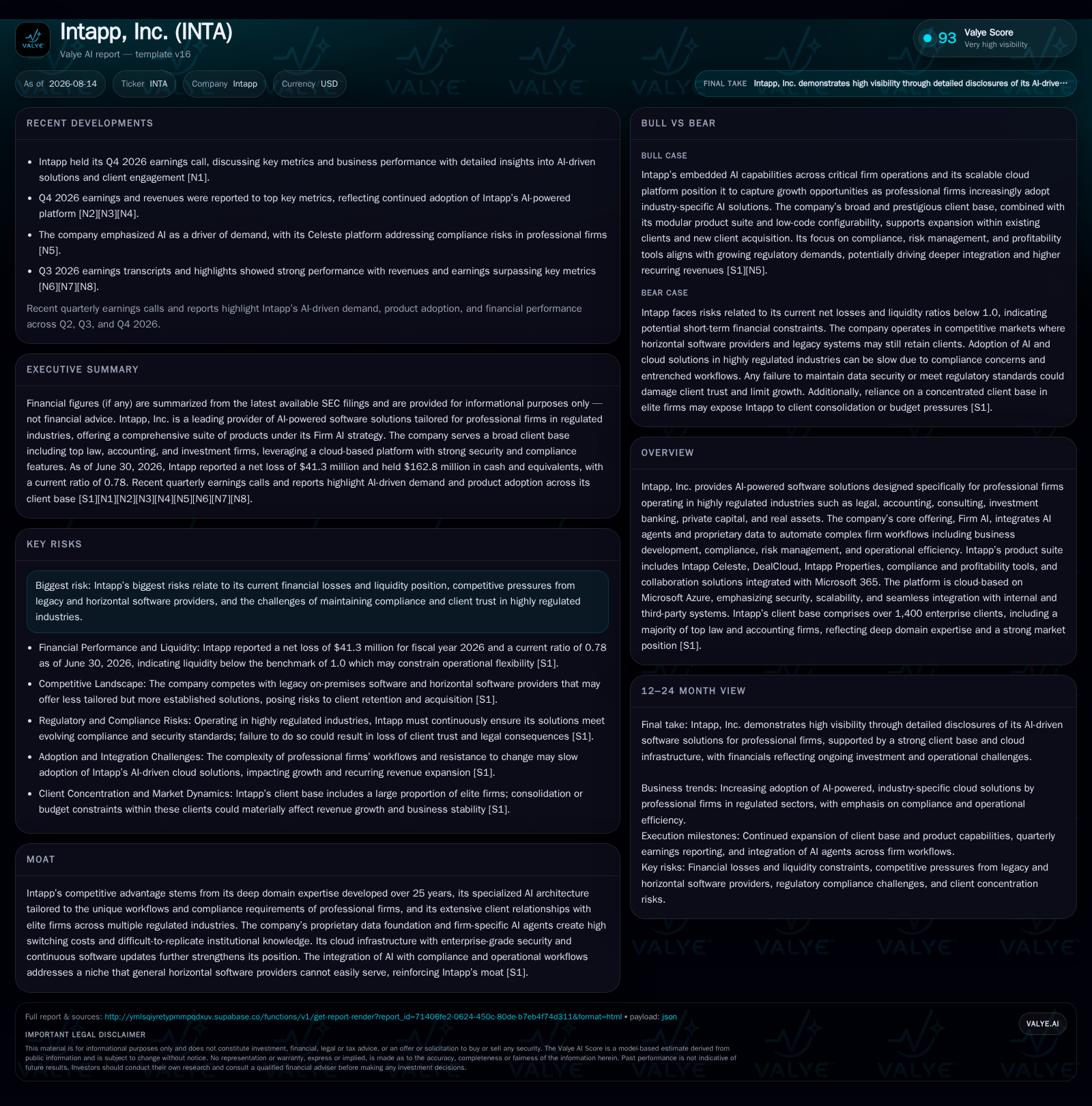
Intapp continues to deepen its industry-specific AI-powered SaaS capabilities, notably with Intapp Celeste enhancing workflow automation for elite legal, accounting, and financial firms. While the company has grown its enterprise client base by 10% to over 1,400 customers, it faces ongoing losses driven by heavy R&D and sales investments and a current liquidity mismatch reflected in a sub-1.0 current ratio. Intapp’s moat stems from domain expertise and proprietary data integration, yet long sales cycles and competitive pressures from horizontal SaaS providers present headwinds. Near-term milestones around AI adoption and subscription revenue growth will signal execution on growth strategies within complex, highly regulated professional services ecosystems.
Renewed AI Push Drives Workflow Innovation but Financial Losses Persist
In its Q3 FY2026 filing dated May 5, 2026, Intapp highlighted advancements in its Firm AI strategy with particular emphasis on Intapp Celeste—a generative and agentic AI platform designed to automate multi-step workflows by orchestrating firm data and proprietary business rules [S2][N1]. This platform offers no-code customization enabling clients to adapt AI agents easily without technical bottlenecks. Such innovations underscore Intapp’s push to embed AI deeply into complex professional service workflows spanning business development through compliance monitoring
However, this product innovation sits alongside continued financial headwinds. The latest annual results recorded an operating loss of approximately $40 million driven by sustained R&D spending targeting AI capabilities and expanding go-to-market scalability [F1][S1]. Despite the losses, revenue growth remains fueled by subscription traction within existing clients as well as new logos.
This dual narrative—encouraging strategic investment into differentiated AI products combined with near-term unprofitability—mirrors sector norms where SaaS firms scaling advanced AI face upfront costs before achieving leverage.
Vertically Specialized SaaS Model Harnesses Trusted Client Relationships for Growth
Intapp operates a vertically focused Software-as-a-Service model delivering subscription-based AI software exclusively designed for elite professional firms in highly regulated industries such as law (including 97 Am Law 100 firms), top accounting firms (17 of top 20), investment banking, consulting, private capital, and real assets [S1][F1]. These organizations rely heavily on partner-level decision-making embedded in complex non-linear relationship networks requiring customized workflow orchestration.
The Firm AI framework applies proprietary knowledge graphs derived from each client's institutional data to create tailored workflow agents that unify operational processes critical to growth and compliance management. This deeply embedded domain expertise forms a competitive moat since replicating this institutional context represents a high barrier to entry for generalist horizontal SaaS providers that often require costly customization or fail to meet nuanced regulatory needs [S20][S21].
Long-term contracts underpin recurring subscription revenue streams with annual contract values often exceeding $50K per client [S7][S24]. The strategy emphasizes customer lifetime value maximization through cross-selling additional modules such as DealCloud for deal management or compliance tools like Intapp Terms. Yet the model faces challenges from typical long sales cycles characteristic of partner-led decision-making in these sectors—delaying new contract signings and affecting quarterly revenue visibility
Competitive Landscape: Vertical Expertise Against Horizontal Giants and Legacy Systems
Intapp competes against large software incumbents including Thomson Reuters—which offers specialized legal and financial solutions—and horizontal platforms like Salesforce expanding CRM capabilities into verticals traditionally served by niche providers. Moreover legacy on-premises software vendors still command considerable presence due to customer inertia within professional services firms reluctant to migrate sensitive operations to new cloud platforms.
Despite these pressures, Intapp’s advantage rests firmly on decades of refined industry knowledge embedded into its technology architecture and its exclusive access to client-specific relationship maps inaccessible to others. These factors contribute to low churn among top-tier clients who value security compliance and precise domain fit over generic feature breadth. The company also leverages Microsoft Azure partnership for cloud infrastructure security—a critical competitive differentiator given the regulatory environment [S4][S7]. Confirming sustained low churn rates relative to peers would validate leadership despite resource disparities.
Growth Catalysts: Generative AI Adoption, Regulatory Complexity, and Cross-Vertical Expansion
Market demand is accelerating as generational workforce transitions increase openness toward agentic AI tools that offload administrative tasks while preserving control in regulated workflows. Firms face mounting complexity from evolving regulations necessitating sophisticated compliance management tooling embedded natively within operational software—precisely where Intapp specializes [N2][S21].
Expansion into adjacent buyer segments such as corporate legal departments or corporate development teams—which recruit professionals experienced with Intapp’s ecosystem—offers additional growth runway beyond traditional partners. Furthermore, geographic enlargement into EMEA/APAC regions targets global enterprises grappling with similar operational challenges.
Multi-year subscription contracts coupled with iterative product rollouts support scalable ARR expansion if adoption of recent AI releases like Intapp Celeste accelerates across existing clients alongside net new customer wins.
Headwinds: Long Sales Cycles, Pricing Pressures, and Legacy Customer Dynamics
The consensual nature of decision-making among elite professional firms invariably results in lengthy procurement timelines complicated further by rigorous security reviews characteristic of highly regulated industries [S1][S24]. These elongated sales cycles introduce revenue recognition lags impacting cash flow predictability.
In addition, market maturation invites pricing strategies refinement amid intensifying competition from both established horizontal SaaS incumbents embedding vertical features and emerging startups promising incremental innovation at aggressive prices [S6]. Such pressure may compress margins or necessitate experimentation with consumption-based or flexible subscription models for AI offerings like Celeste—a risk explicitly acknowledged by management
Legacy internal systems' persistence within certain clients poses retention risk if those firms delay upgrading or reverting post-deployment due to integration challenges or cultural resistance.
Upcoming Milestones: Product Adoption, ARR Trajectory, and Client Renewals
Equally important are renewal rates amidst partner-driven firms which serve as proxies for satisfaction levels tied to proprietary data integration depth; any sign of rising churn would warrant reconsideration of domain moat durability.
Close attention should also be paid to sales cycle duration changes which impact booking velocity.
Financial Position Supports Growth but Requires Careful Liquidity Management
As of June 30, 2026, Intapp held approximately $163 million in cash and equivalents with current assets of $315 million and current liabilities of $406 million, resulting in a current ratio near 0.78 [F1]. The company reported no outstanding debt as of the latest available data [F1].
Operating losses near $40 million reflect ongoing investments in R&D aimed at sustaining innovation leadership particularly around AI capabilities plus scaling sales efforts critical for enterprise client acquisition. This loss profile is common among mid-stage SaaS vertical specialists balancing growth acceleration against profitability milestones.
Tracking free cash flow burn alongside deferred revenue buildup will be essential metrics indicative of reaching sustainable scale over subsequent quarters.
Disclaimer: This analysis is based solely on public SEC filings and verified disclosures as well as general industry knowledge. It does not constitute investment advice or an offer to buy or sell any securities.
Disclaimer: This is research-only, informational analysis and not investment advice. It may include AI-generated interpretation and general industry context. Always verify important details using primary sources.

Comments