
Bruker’s Innovation-Fueled Growth Tempered by Margin Pressure and Supply Risks
Bruker Corporation’s expanding product portfolio and robust R&D underlie growth, while geopolitical and operational headwinds constrain profitability.
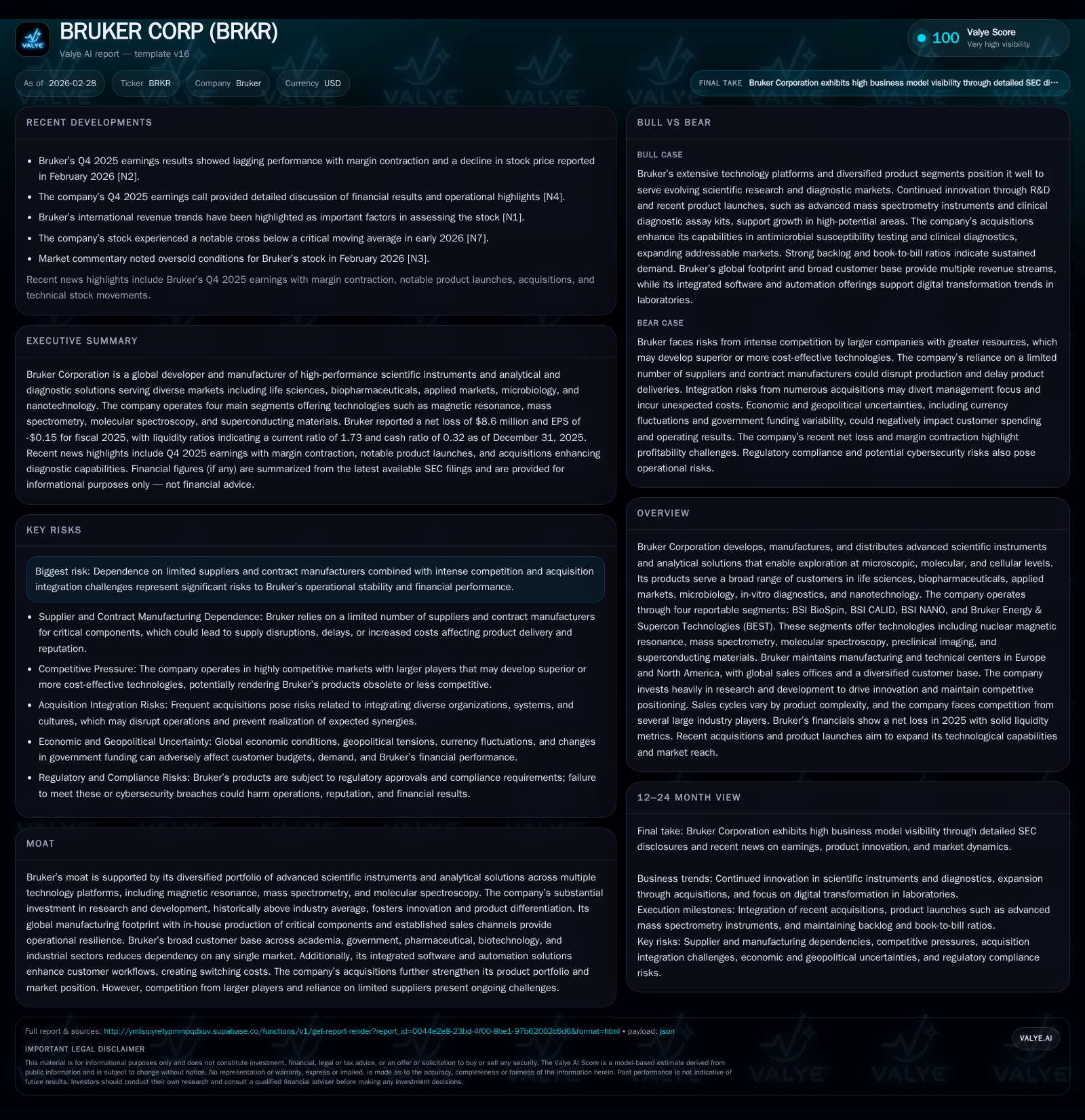
Bruker Corporation develops cutting-edge scientific instrumentation across multiple technology platforms serving diverse life science, pharmaceutical, and materials markets. Its historic revenue growth, driven by innovation and strategic acquisitions, resulted in record backlog entering 2026. However, 2025 saw a sharp contraction in operating income and a net loss amid rising costs, tariffs, and supply chain constraints. Heavy investment in R&D supports long-term competitive advantage but margins remain susceptible to inflationary pressures, trade uncertainties, and integration risks. The firm’s capital allocation maintains modest buybacks alongside disciplined capex to sustain technology leadership.
Company Overview
Bruker Corporation stands as a leading developer and manufacturer of high-precision scientific instruments used to analyze life sciences and material samples at microscopic to molecular levels [S1]. Its technologies span nuclear magnetic resonance (NMR), mass spectrometry, molecular spectroscopy, preclinical imaging modalities (MRI, PET), and superconducting materials [S1]. These platforms serve an extensive range of customers including academic institutions, biopharmaceutical companies, government research organizations, applied industrial markets, microbiology labs, and nanotechnology sectors.
Headquartered in Billerica, Massachusetts, Bruker operates through four key segments: BSI BioSpin (focused on magnetic resonance technologies), BSI CALID (chemicals, applied markets, life sciences), BSI NANO (nanotechnology tools), and BEST (energy and superconducting technologies) [S1][S4]. This breadth offers resilience via cross-market exposure across multiple advanced technology areas while also introducing operational complexity.
Bruker's highly diversified customer base reduces reliance on any single account with no customer exceeding 10% of revenues [S4]. Yet meaningful exposure remains to U.S. academic/government funding programs such as NIH grants which have faced recent cutbacks causing headwinds [S1]. International sales comprised nearly three-quarters of revenue in recent years but also introduce currency risk along with geopolitical tensions impacting supply chains especially involving China and Taiwan [S19].
Historical Performance
From the available financial data covering up to FY2018 as well as more recent snapshots into FY2025 results [F1], Bruker experienced healthy top-line expansion driven primarily by continuous innovation investment alongside a series of acquisitions enhancing its product mix and technological edge. Despite strong underlying demand, operating income exhibited considerable volatility with a sharp decline in latest fiscal periods.
Historical performance (annual)
| FY | Net ($mm) | CFO ($mm) | OpInc ($mm) | Capex ($mm) | Net YoY |
|---|---|---|---|---|---|
| 2025 | -9 | 134 | 68 | 91 | -107.6% |
| 2024 | 113 | 251 | 253 | 115 | -73.5% |
| 2023 | 427 | 350 | 437 | 107 | +44.0% |
| 2022 | 297 | 274 | 433 | 129 |
Source: SEC companyfacts cache [F1].
Capital returns and efficiency (annual)
| FY | Buybacks ($mm) | FCF ($mm) | ROE% |
|---|---|---|---|
| 2025 | 10 | 43 | -0.4 |
| 2024 | 0 | 136 | 6.3 |
| 2023 | 152 | 243 | 31.0 |
| 2022 | 263 | 145 | 26.6 |
Source: SEC companyfacts cache [F1].
The dramatic contraction in operating income from $253 million in FY2024 to $68 million in FY2025 despite modest revenue growth (+4.4%) signals significant margin pressure likely resulting from increased tariffs implemented during the year as well as elevated component costs due to supply chain disruptions documented [N2][S15][F1]. Net income turned negative after several years of profitability owing largely to these cost increases coupled with global economic uncertainty that softened demand from government-funded customers.
Operating cash flow fell nearly half year-over-year while capital expenditures were scaled back but remained substantial at nearly $91 million invested into infrastructure essential for maintaining technological leadership [F1][S20]. Buybacks recommenced on a very cautious scale given the earnings volatility.
Future Growth Prospects
Bruker's future growth prospects rely heavily on continual enhancement of its core technology platforms that remain integral to cutting-edge academic research and pharma development pipelines. Key drivers will include:
- Further advances in ultra-high-field NMR systems (>1 GHz class) expanding accessibility beyond major research centers [S20].
- Innovations within mass spectrometry focusing on sensitivity improvements such as timsTOF systems designed for complex proteomic workflows [S20].
- Automation software solutions improving throughput and workflow efficiency across its instrument ecosystem.
- Development of spatial/translational biology tools addressing emerging market needs like single-cell analysis and clinical phenomics [S1].
- Expansion within preclinical imaging applications involving multi-modality systems advancing drug discovery capabilities [S1].
- Strategic acquisitions supplementing organic R&D with complementary intellectual property or market access extension [S8].
Counterbalancing these opportunities are significant capping factors including:
- Supply chain dependencies on limited sources of critical components increasing vulnerability to disruptions or price escalations [S9][S18].
- Geopolitical tensions notably impacting manufacturing hubs in Asia-Pacific regions restricting operational flexibility [S19].
- The cost burden from evolving regulations such as compliance with EU IVDR standards by end of 2029 challenging the diagnostics segment [S14][S24].
- Ongoing tariff uncertainty that has already contributed materially adverse effects on margins during recent periods [S15][N2].
- Competitive dynamics featuring aggressive innovation from larger peers possessing greater financial resources especially in life sciences instrumentation [S28].
- Integration risk related to Bruker's extensive acquisition program that added over two dozen companies since early 2023 potentially diverting management focus [S8][S22].
Forecasts / Milestones / Expectations
While the company has not provided explicit forward-looking guidance within available disclosures up to early 2026 [N3][S24], several performance indicators merit close monitoring:
Order backlog rose markedly from approximately $2.09 billion at end-2024 to $2.57 billion at end-2025 indicating persistent demand momentum albeit intertwined with elongated sales cycles typical for advanced instrumentation contracts lasting up to two years or more [S24]. This backlog serves as a leading indicator for revenue recognition across multiple subsequent quarters.
Margins remain vulnerable; efforts to offset tariff cost inflation through price adjustments are underway but may be insufficient if macroeconomic headwinds endure.
Integration progress of recent acquisitions will be critical; failure here could erode expected synergies impacting near-term earnings.
Analysts following Bruker have noted the need for cautious stance given compressed profitability even if top-line continues growing modestly amid uncertain global funding environments for research institutions [N6]. Monitoring quarterly updates for margin trajectory improvement or further deterioration is advised.
Returns & Capital Allocation
Bruker currently exhibits low returns on equity reflecting recent net losses with approximate ROE being slightly negative (-0.4%) for FY2025 due to lack of net profits against a sizeable equity base [$2.46 billion] [F1]. Operating cash flows remain positive but have declined materially compared to prior periods, funneling toward continued product development investments.
Capital allocation priorities appear balanced between sustaining capital expenditures necessary for technological competitiveness (~$90M capex) while cautiously deploying free cash flow toward modest share repurchases ($10M in FY2025 resumed after pause) despite challenging earnings environment [F1]. No dividend payout details were provided indicating a potential preference for reinvestment over distribution currently.
Net cash position remains healthy with nearly $299 million in cash equivalents supporting liquidity alongside significant revolving credit capacity ($900 million) though debt levels are notable at about $1.9 billion requiring careful servicing amidst volatile earnings [F1][S7]. The company's debt covenants necessitate maintaining leverage ratios compatible with ongoing investments.
Industry Context & Strategic Considerations (Analysis)
Bruker's marketplace resides at the intersection of high complexity scientific instrumentation coupled with rapid technological change demanding continuous R&D expenditure—a barrier to entry supporting its moat alongside integrated software platforms creating switching costs for customers accustomed to its systems [valye_report_excerpt.moat].
Competitors range from specialized firms like JEOL and Oxford Instruments in magnetic resonance products to diversified life science conglomerates offering multiplexed analytical platforms possibly leveraging scale advantages [S28]. Consolidation activity remains vibrant hinting that Bruker’s aggressive acquisition strategy aligns with broader industry trends striving for technology breadth plus geographic reach.
The lengthening sales cycles intrinsic to capital-intensive analytical equipment purchases impose revenue recognition delays—especially influenced by customer budgeting policies inherent in academia/governmental accounts—contributing seasonal revenue swings historically favoring Q4 results over first quarters [S4][S11].
Risks from global macroeconomic volatility impact both procurement costs for key raw materials/metals essential for superconducting components as well as customer buying patterns under constrained government R&D budgets punctuate current cautionary themes embedded within company filings.[S18]
Conclusion Summary
Bruker Corporation leverages deep scientific expertise across magnetic resonance and associated measurement technologies combined with a diverse portfolio serving life sciences and applied industrial markets globally. Its historical growth was supported by consistent investment in innovation augmented by impactful acquisitions broadening its offering.
However, fiscal year 2025's financial results underscore the challenges posed by external cost pressures from tariffs/supply chains alongside geopolitical complexities adversely affecting margins despite modest revenue increases sustained by committed backlog orders.
Maintaining leadership depends critically on navigating these headwinds proficiently—managing supplier relationships rigorously—delivering breakthrough product advancements—and integrating acquired entities effectively while controlling costs.
Capital allocation balances retaining funds for R&D efforts necessary for product differentiation against shareholder returns through measured buybacks currently constrained by diminished profitability metrics.
Investors should track developments around global trade policies impacting component sourcing costs; evolving regulatory certifications toward full EU IVDR compliance; quarterly margin improvements signaling operational recovery; timing execution against backlog realization; plus competitive responses within dynamic scientific equipment markets.
This analysis is based solely on publicly available information provided through SEC filings up to February 27, 2026 ([F1],[S#]) and select news articles ([N#]). It contains no investment advice or price forecasts.
Disclaimer: This is research-only, informational analysis and not investment advice. It may include AI-generated interpretation and general industry context. Always verify important details using primary sources.

Comments