
Blackstone Real Estate Income Trust: Floating-Rate Debt, Risk Management, and the Profitability Hurdle
Blackstone Real Estate Income Trust, Inc.
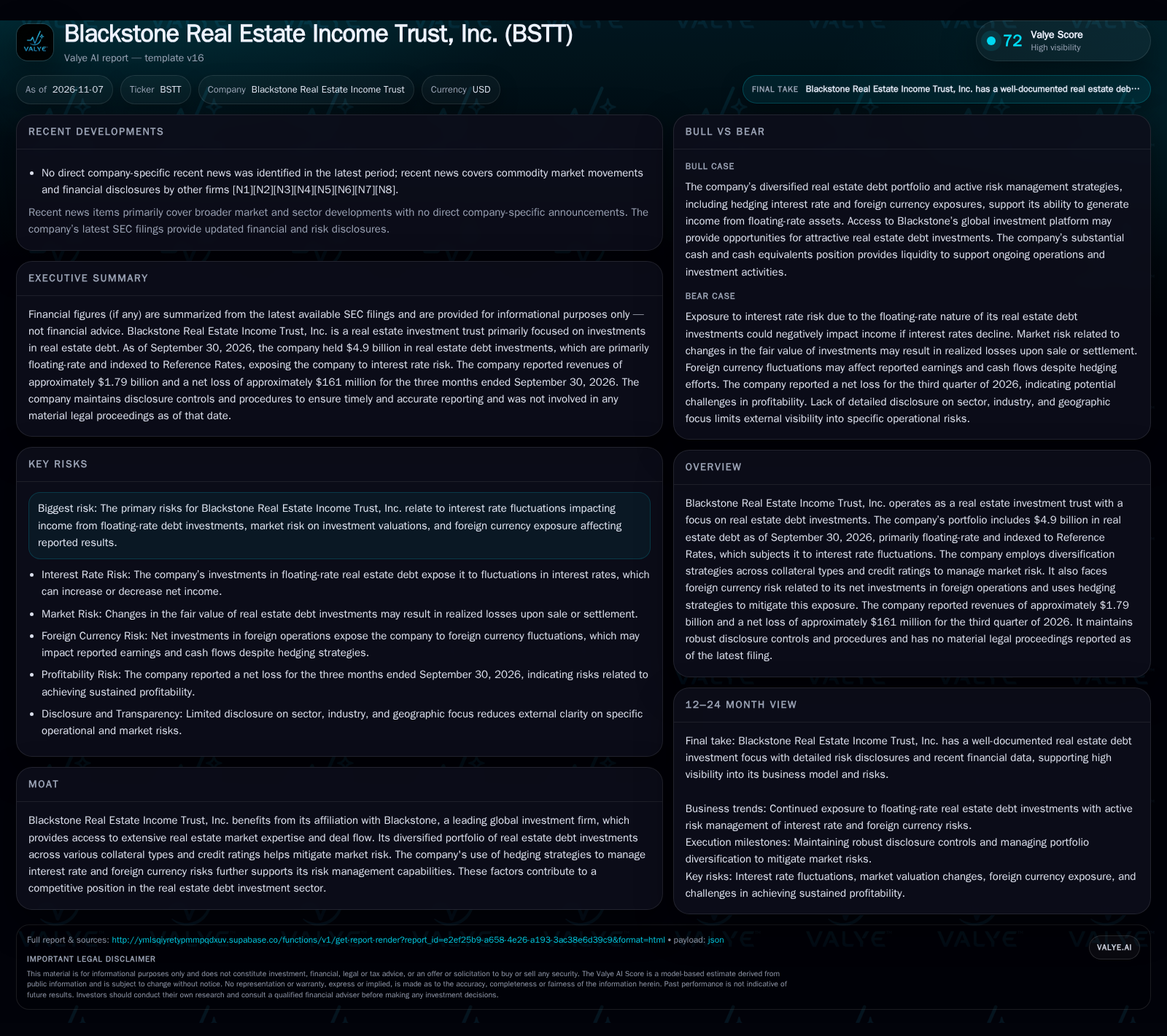
BSTT's $4.9 billion floating-rate real estate debt portfolio is designed for income upside in rising rates but exposes it to earnings volatility as interest rate cycles turn. Despite $1.41 billion in cash, a recent net loss raises concerns about credit risk, hedging effectiveness, and the challenge of sustaining profitability amid market shifts. Portfolio diversification and Blackstone's platform support are strengths, but transparency on sector allocation and underlying asset quality remains limited. The key question: Can BSTT translate its risk management and scale into consistent, positive earnings as macro conditions evolve? [S2]
Blackstone Real Estate Income Trust, Inc. (BSTT) exemplifies the complexities of modern real estate credit investing: a large, diversified, floating-rate debt portfolio designed for income generation in a rising-rate world, but now facing headwinds as macro conditions shift. With $4.9 billion in real estate debt investments and $1.41 billion in cash, BSTT’s scale and liquidity are clear. Yet, a recent quarterly net loss underscores the challenge of managing credit, market, and currency risks while sustaining earnings. As the cycle turns and transparency remains limited, investors must weigh whether BSTT’s risk management and Blackstone affiliation are sufficient to ensure durable returns.
Portfolio Scale, Revenue, and Losses: The Present State of Play
As of September 30, 2026, BSTT reported $4.9 billion in real estate debt investments, with the majority of these assets structured as floating-rate and indexed to reference rates. This portfolio composition directly links the company’s income to prevailing interest rate dynamics. In the third quarter of 2026, BSTT generated $1.79 billion in revenue but posted a net loss of $161 million, revealing a disconnect between top-line activity and bottom-line results. The company reported cash and liquidity metrics for the period; these figures do not by themselves establish operating runway, investment capacity, financial flexibility, or financing capacity. The combination of significant floating-rate exposure, recent net losses, and substantial liquidity defines the current risk-reward calculus for BSTT. [S2]
How BSTT’s Real Estate Debt Engine Works—and Where It Can Break Down
BSTT’s business model centers on originating and acquiring real estate-backed loans, earning spread income over funding costs. Floating-rate structures provide a natural hedge against rising short-term rates, as loan yields reset higher when reference rates increase, potentially lifting net interest income. However, this also means earnings can decline sharply if rates fall or credit spreads widen due to market stress, especially if funding costs do not move in lockstep with asset yields.
Portfolio diversification by collateral and credit rating is intended to reduce exposure to idiosyncratic defaults, but aggregate credit risk remains if real estate fundamentals deteriorate broadly. The use of derivatives and hedging instruments can moderate the impact of rate and currency swings but introduces basis risk and potential mark-to-market volatility. Operating leverage is moderate: while BSTT can scale assets, credit losses and fair-value changes can quickly erode net income, as seen in the recent quarterly loss.
The interplay between BSTT's floating-rate loan portfolio and its funding structure is crucial to understanding its earnings sensitivity. If BSTT's cost of funds rises faster than the interest income on its floating-rate loans—perhaps due to tightening credit spreads or increased borrowing costs—the net interest margin could compress, undermining profitability. Conversely, if loan repricing outpaces funding cost increases, the firm benefits from margin expansion. This dynamic underscores the importance of active liability management and the potential use of interest rate swaps or other derivatives to align asset and liability durations. Without effective alignment, earnings volatility may increase, especially during abrupt rate shifts.
Credit risk concentration is another critical factor. While diversification by collateral type and credit rating mitigates idiosyncratic default risk, systemic risks—such as a downturn in specific real estate sectors or geographic regions—could lead to correlated defaults and impairments. The sensitivity of BSTT's portfolio to macroeconomic variables like employment rates, commercial real estate vacancy trends, and capital availability can amplify credit losses. Stress testing the portfolio under various economic scenarios would provide insight into potential loss severity and the adequacy of loan loss reserves, an important consideration for sustaining earnings stability.
Platform Leverage, Peer Dynamics, and the Search for Sustainable Yield
BSTT’s affiliation with Blackstone gives it access to proprietary deal flow, real estate expertise, and potentially more favorable capital markets access than standalone peers. This platform advantage can translate into differentiated sourcing, underwriting, and risk management capabilities. However, the real estate debt sector is crowded: competitors include other real estate investment trusts, private debt funds, banks, and insurance companies, all seeking yield in a low-to-moderate rate environment.
Switching frictions for borrowers are modest, especially as capital becomes more widely available, but for investors, BSTT’s scale and Blackstone branding may offer perceived stability. Technology substitution is limited in this asset class, but the underlying real estate collateral is subject to secular changes—such as remote work’s impact on office demand or shifts in retail property economics. In a downturn, all players face asset quality stress, and platform advantages may be tested if market liquidity dries up.
BSTT's competitive positioning also depends on its ability to adapt underwriting standards and portfolio composition in response to evolving market conditions. In a rising rate environment, borrowers may face higher debt service burdens, increasing default risk, which necessitates more stringent credit evaluation and proactive risk mitigation strategies. The firm's scale and platform may facilitate access to proprietary data and analytics, enhancing risk assessment capabilities relative to smaller competitors. However, maintaining this edge requires continuous investment in technology and talent, as well as agility in capital deployment to sectors with resilient fundamentals.
Furthermore, the structural characteristics of BSTT’s loan portfolio—such as loan-to-value ratios, covenant protections, and amortization schedules—play a pivotal role in risk management and competitive differentiation. Loans with stronger covenants and lower leverage typically offer better downside protection but may limit yield potential. Balancing these factors is essential to attract yield-seeking investors while maintaining credit quality. Additionally, the firm's ability to negotiate favorable terms and manage workout processes efficiently can preserve asset values and reduce realized losses during downturns, reinforcing its competitive moat.
What Could Unlock a Positive Earnings Surprise for BSTT?
The most favorable outcome for BSTT is a ‘goldilocks’ environment: interest rates stay elevated or rise further, real estate credit performance remains robust, and capital markets stability supports asset valuations. In this scenario, floating-rate loans reprice upward, driving higher net interest income, while credit losses remain low due to strong tenant and borrower fundamentals. BSTT’s hedging strategies successfully limit downside from currency and rate volatility, and Blackstone’s sourcing advantage enables the firm to selectively rotate into higher-yielding or lower-risk assets.
Evidence for this scenario would include a return to consistent quarterly profitability, stable or improving asset valuations, and disclosure of low realized credit losses. Additional confirmation would come from management commentary highlighting new attractive investment opportunities and minimal portfolio impairments. This scenario would be challenged if interest rates fall, credit spreads widen, or macro stress tests the underlying real estate collateral.
A Mixed Macro Backdrop: Navigating Rate Volatility and Credit Cycles
The most plausible near-term path is one of continued earnings volatility as BSTT manages the crosscurrents of rate fluctuations, credit normalization, and periodic market shocks. Net interest income may remain positive but pressured by episodic asset impairments or valuation markdowns. Portfolio diversification and hedging reduce tail risks but cannot eliminate periodic losses, especially if certain real estate sectors underperform.
Falsification would come from either a sustained return to robust profitability or a pronounced and persistent loss pattern accompanied by asset sales or capital raises.
How a Credit Shock or Rate Reversal Could Pressure BSTT’s Model
In a more adverse scenario, a rapid decline in interest rates or a broad deterioration in real estate credit quality would hit BSTT on several fronts. Floating-rate income could drop as loan yields reset lower, while credit losses and impairments rise due to tenant or borrower distress. Hedging strategies may not fully offset these moves, particularly if basis risk materializes or derivatives prove less effective in volatile markets.
Persistent negative earnings might trigger credit rating downgrades or investor redemptions (if applicable), raising funding costs and further compressing margins. Evidence for this downside would include sequentially larger quarterly losses, rising portfolio impairments, and management commentary focused on defensive repositioning rather than new investment.
What Will Determine Whether BSTT Delivers Consistent Returns?
Quarterly net income or loss trajectory: Is the company returning to profitability, or do losses persist or deepen over multiple quarters?
Trends in realized credit losses and portfolio impairments: Are actual defaults and write-downs rising or contained relative to historical averages?
Disclosure (if provided) on sector and geographic allocation: Does the company provide more transparency on underlying exposures, enabling better risk assessment?
Asset yield versus funding cost: Is net interest margin stable, rising, or compressed as rates move and funding sources evolve?
Effectiveness of hedging strategies: Are derivatives and risk management tools offsetting rate and currency swings, or is there evidence of basis risk and volatility?
Management commentary on new investments or asset sales: Are capital deployment and portfolio rotation active and opportunistic, or reactive and defensive?
Disclaimer: This is research-only, informational analysis and not investment advice. It may include AI-generated interpretation and general industry context. Always verify important details using primary sources.

Comments