
Provident Financial Services: Earnings Resilience, Credit Risk, and the Levers of Bank Profitability
Provident Financial Services posted $69.2 million in Q3 2026 net income and ended the quarter with $266 million in cash, underscoring operational stability. The real test for future performance lies in margin management, credit discipline, and navigating an uncertain rate and regulatory environment.
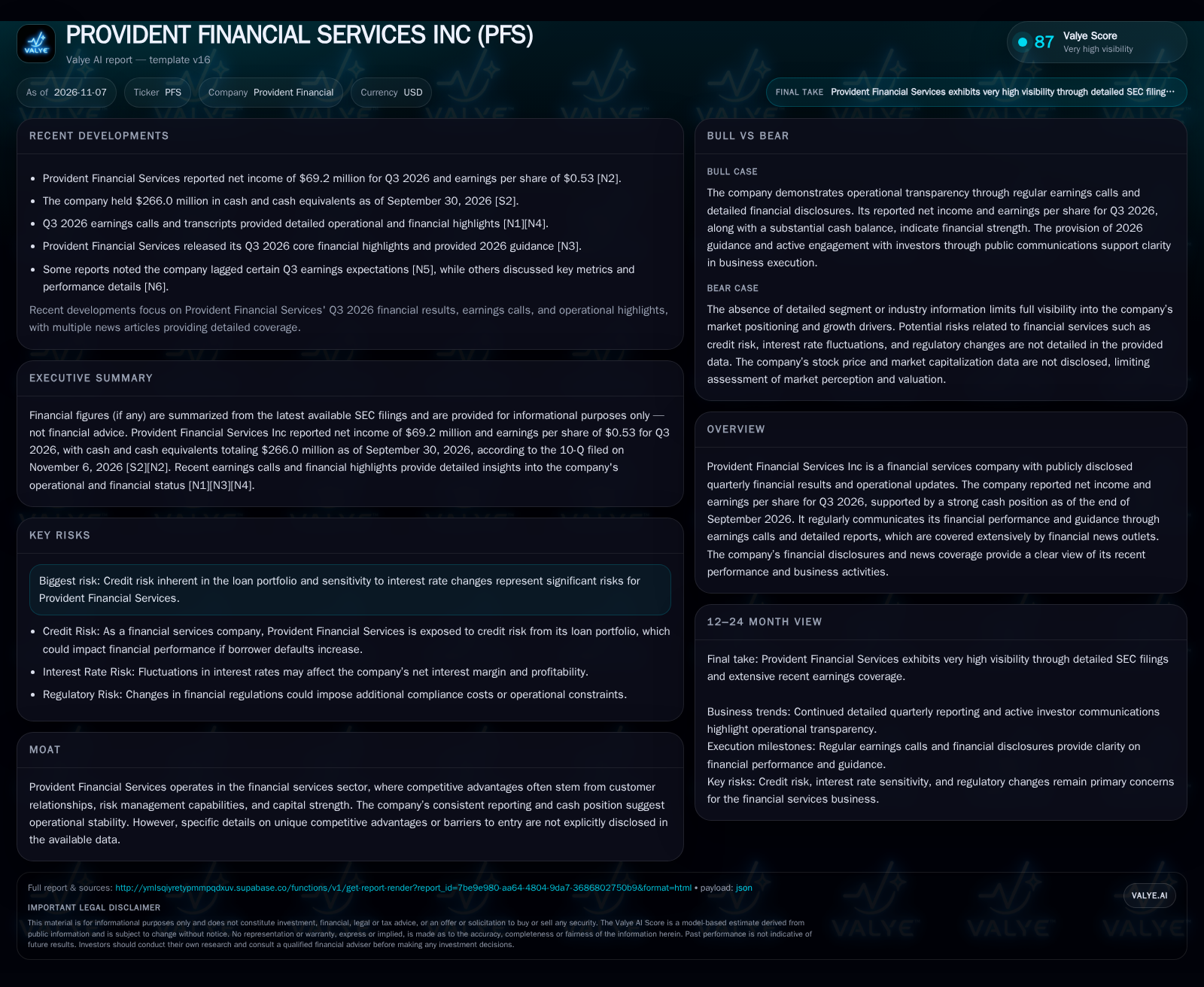
Provident Financial Services delivered solid Q3 2026 results, with $69.2 million in net income and $266 million in cash. While recent earnings calls stress operational transparency and 2026 guidance, future outcomes will hinge on credit quality, interest rate trends, and the company’s ability to defend its net interest margin. Competitive differentiation and risk management remain pivotal, especially as some reports flagged earnings shortfalls.
The company’s approach—anchored in regular earnings calls and detailed financial guidance—offers investors high visibility, but the underlying drivers of future earnings growth or resilience remain subject to sector-wide uncertainties. With some headlines noting earnings shortfalls and the absence of detailed segment breakdowns, the company’s ability to manage credit risk, defend its net interest margin, and adapt to changing rates and regulations will be central to its trajectory.
Recent Earnings and Balance Sheet: What the Latest Numbers Reveal
Provident Financial Services reported net income of $69.2 million for Q3 2026, with cash and cash equivalents of $266 million as of September 30, 2026 [S2] [N2]. This solidifies the company’s near-term financial footing, offering a buffer against short-term shocks. The company also issued 2026 guidance and continues to engage in regular earnings calls, emphasizing transparency and investor communication [N1] [N3] [N4]. However, some news coverage highlighted that Provident lagged Q3 earnings expectations [N5], raising questions about underlying margin trends or credit quality. The absence of detailed segment or product-level disclosures limits deeper analysis of revenue drivers and risk concentrations.
How Provident’s Core Banking Model Drives Returns—and Where Leverage Lies
Provident Financial Services operates a traditional banking model, with revenue streams likely dominated by net interest income—the spread between interest earned on loans and securities and interest paid on deposits and borrowings. The company’s reported profitability suggests a stable base of earning assets and sufficient scale to absorb fixed costs. However, margin compression remains a sector-wide risk: persistently higher funding costs or a flat/inverted yield curve could pressure net interest margins, while loan growth becomes harder to generate in a slowing economy.
Operating leverage in banking is typically driven by the ability to grow earning assets faster than expenses. Fixed costs—such as compliance, technology infrastructure, and branch operations—can be leveraged if asset growth resumes. Variable costs (like deposit interest and loan loss provisions) fluctuate with market conditions and credit quality. The company reported cash and liquidity metrics for the period; these figures do not by themselves establish operating runway, investment capacity, financial flexibility, or financing capacity. Capital adequacy, credit discipline, and prudent loan underwriting remain critical, especially if credit losses rise with economic headwinds.
The sensitivity of Provident’s net interest margin to changes in the interest rate environment is a critical factor in its profitability outlook. Given the typical lag between repricing of assets and liabilities, a flattening or inversion of the yield curve could compress margins if short-term funding costs rise faster than yields on longer-duration loans and securities. Conversely, a steepening curve could enhance margin expansion potential. The bank's ability to actively manage its asset-liability duration gap and deploy hedging strategies, if any, would be instrumental in mitigating adverse rate shifts. Additionally, the composition of the loan portfolio—such as the mix of fixed versus variable rate loans—will influence how quickly earnings respond to rate changes.
Credit risk management remains a pivotal lever for sustaining profitability, especially in a slowing economy. The underwriting standards and loan portfolio diversification across sectors and geographies determine the bank’s exposure to cyclical downturns. If Provident maintains disciplined credit evaluation and proactive monitoring, it can limit non-performing asset buildup and associated provisions. However, economic stress could still lead to higher charge-offs, which would erode earnings and capital buffers. The bank’s capital adequacy and loan loss reserves must therefore be sufficient to absorb potential shocks without constraining lending capacity or triggering regulatory concerns.
Defending Share and Margin in a Crowded, Regulated Landscape
In the financial services sector, competitive advantage is often built on customer relationships, local market knowledge, service quality, and risk management—rather than proprietary technology or product differentiation. Provident’s consistent reporting and cash position point to operational stability, but the lack of disclosed segment data leaves its core strengths and vulnerabilities less clear.
Regional banks face pressure from larger national players with scale advantages, as well as fintech entrants offering digital-first experiences and lower costs. Pricing power is limited by the commoditized nature of deposit and loan products. Switching frictions can arise from relationship banking, bundled services, and local market presence, but these are not always sufficient to secure above-peer returns. Regulatory compliance is both a barrier and a cost burden, potentially favoring larger or more efficient operators. Provident’s ability to manage credit risk and funding costs will determine its capacity to defend margins and preserve customer relationships in a competitive environment.
If Credit Quality Holds and Rates Stabilize, Earnings Momentum Could Follow
A favorable scenario would see Provident maintaining robust credit quality, with minimal increases in loan losses even as the broader economy slows. If interest rates moderate or the yield curve steepens, net interest margins could stabilize or improve, supporting earnings growth. The company could leverage its fixed cost base by growing loans and deposits, especially if local economic conditions remain resilient.
Confirmation would come from sequential improvement in net interest margin (if disclosed), low or declining non-performing assets, and steady or rising loan balances. Additional evidence might include positive guidance revisions on earnings calls and a lack of material increases in loan loss provisions. The upside could be amplified if Provident successfully differentiates itself through relationship banking or digital investments that drive customer loyalty.
Managing Through Margin Pressure and Credit Normalization
The most plausible outlook is that Provident continues to generate modest profits, with net income constrained by ongoing margin pressure and gradually rising credit costs. Loan growth could slow as economic uncertainty persists, while deposit costs remain elevated relative to recent years.
This scenario would be confirmed by flat or slightly declining net interest margins, stable but unspectacular loan and deposit growth, and manageable increases in loan loss provisions. Quarterly results and guidance would likely continue to emphasize operational discipline, but without evidence of breakout performance or significant competitive gains.
Credit Deterioration or Funding Stress Could Pressure Earnings and Capital
A more adverse outcome could materialize if credit quality weakens materially—either from a macro downturn or poor underwriting—leading to higher non-performing loans and increased loan loss provisions. If funding costs remain high or deposit outflows accelerate, net interest margin could compress further, eroding profitability and potentially pressuring regulatory capital ratios.
Confirmation would come from a spike in non-performing assets (if disclosed), sharp increases in provision expenses, or negative earnings surprises. Regulatory scrutiny could intensify if capital ratios fall or if there are signs of liquidity stress, such as heavy reliance on wholesale funding. Persistent misses on earnings expectations, as hinted in recent headlines [N5], would reinforce the downside case.
What Will Signal the Real Direction for Provident Financial’s Franchise Health?
Net interest margin trends (if disclosed), as a direct indicator of earnings power and sensitivity to rate and funding pressures.
Non-performing loan and charge-off rates (if disclosed), to assess credit risk and asset quality trajectory.
Loan and deposit growth rates, which would show whether Provident is gaining or losing share in its regional markets.
Provision expense levels and trends, as early warning signals of credit deterioration or management conservatism.
Quarterly management guidance revisions, which would reflect confidence (or caution) about near-term earnings drivers.
Capital adequacy ratios (if disclosed), to gauge capacity for absorbing losses and supporting future growth.
Deposit mix and composition (if disclosed), since reliance on higher-cost or less stable funding could threaten margins.
Any disclosures about digital banking initiatives or relationship banking efforts, which would illuminate potential sources of differentiation or customer retention.
Disclaimer: This is research-only, informational analysis and not investment advice. It may include AI-generated interpretation and general industry context. Always verify important details using primary sources.

Comments