
Chiron Real Estate’s Strategic Pivot: Seniors Housing, RIDEA Structures, and the Challenge of Operational Leverage
Chiron Real Estate is moving from a predominantly healthcare facility REIT to a direct operator of seniors housing communities, betting on demographic tailwinds and operational upside—but the transition exposes it to new cost structures and execution risks in a higher-rate, inflationary environment.
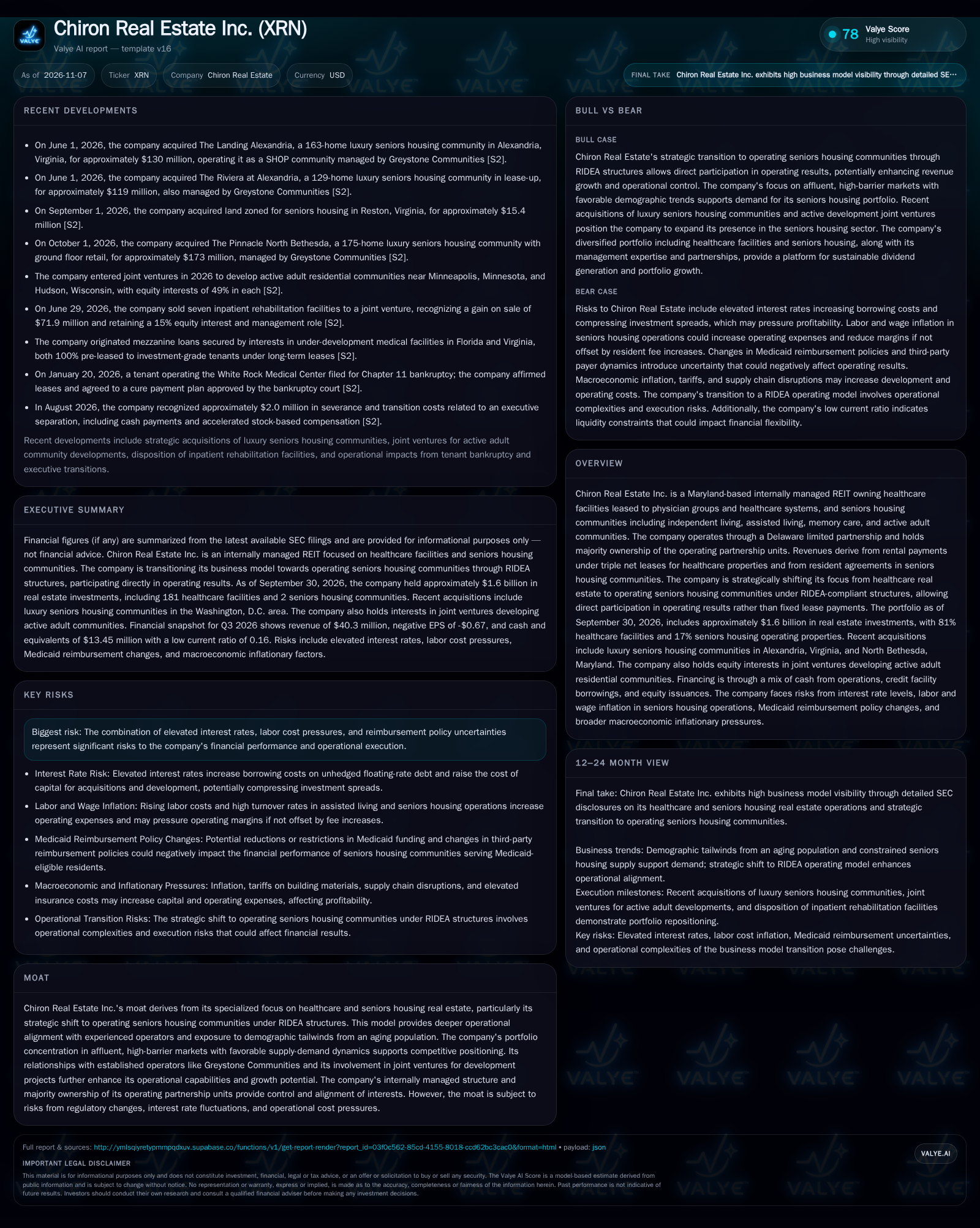
Chiron Real Estate is accelerating its transition to a seniors housing-focused REIT, shifting from triple net healthcare leases to direct operating models (RIDEA) in affluent markets. Execution on occupancy, rate growth, and cost management will determine whether the new model can deliver sustainable earnings and dividends. [S2]
Chiron Real Estate Inc. is undergoing a fundamental transformation, shifting its identity from a healthcare real estate landlord to an operator of seniors housing communities targeting affluent, supply-constrained markets. The move to RIDEA-compliant structures signals a desire to participate directly in the operating upside of seniors housing—a sector with powerful demographic tailwinds but also rising labor costs, regulatory complexity, and volatile reimbursement dynamics. [S2]
Recent Acquisitions and SHOP Segment Launch Redefine Chiron’s Earnings Mix
As of September 30, 2026, Chiron Real Estate’s $1.6 billion portfolio was weighted 81% toward healthcare facilities and 17% toward seniors housing operating properties (SHOP), with the remainder in joint ventures and other assets. The company’s 2026 acquisitions—The Landing Alexandria, The Riviera at Alexandria, and The Pinnacle North Bethesda—added over $400 million of luxury seniors housing in the Washington, D.C. area, all operated by Greystone Communities. Q3 2026 marked the first full quarter of SHOP segment operations, generating $6.2 million in revenue and $0.7 million in segment NOI, compared to $34.1 million in healthcare real estate revenue and $25.5 million in segment NOI. The company reported a current ratio of 0.16 for the period. [S2]
How the RIDEA Model Transforms Chiron’s Revenue and Risk Profile
The strategic shift from triple net leases to RIDEA-compliant seniors housing operations fundamentally changes Chiron’s business model. Under the legacy healthcare real estate approach, Chiron collected predictable rental income from medium- to long-term leases, with tenants responsible for most property-level costs and rent escalations providing modest growth. This structure offered stable, bond-like cash flows with limited upside but low operational risk.
By moving to direct operating models in seniors housing, Chiron now participates in both the upside and downside of community performance. Revenues are derived from resident fees and ancillary services, while operating expenses—especially labor, utilities, food, and insurance—are borne directly by the company. Segment margins for SHOP in Q3 2026 were materially lower than for the healthcare segment: $0.7 million NOI on $6.2 million revenue (about 11% margin), compared to $25.5 million NOI on $34.1 million revenue (about 75% margin) in healthcare real estate. This exposes Chiron to variable costs, occupancy swings, and wage inflation, but also creates operating leverage if occupancy and rate growth outpace costs.
Capital needs are significant: luxury seniors housing properties are capital-intensive to acquire and operate, with further investments required for development projects and repositionings. The company reported cash and liquidity metrics for the period; these figures do not by themselves establish operating runway, investment capacity, financial flexibility, or financing capacity.
Market Positioning in Affluent Seniors Housing: Advantages and Counterforces
Chiron’s focus on affluent, high-barrier-to-entry markets—such as the Washington, D.C. metro area—offers some protection from oversupply and price-based competition, as these locations tend to have stronger demand fundamentals and less new construction risk. The luxury positioning of recent acquisitions further targets demographics with higher willingness and ability to pay, potentially supporting higher occupancy and rate growth.
However, the company faces formidable counterforces. Labor and wage inflation is acute in seniors housing, particularly for specialized care (assisted living, memory care), and staffing shortages can impact service quality and margin. Regulatory risk is significant, with changes in Medicaid reimbursement and local policy affecting both revenue and compliance cost. Incumbent operators in the region—including large, national seniors housing REITs and private owner-operators—may have greater scale, operating data, and access to capital. The partnership with Greystone Communities brings operational expertise, but Chiron’s own direct operating history is limited, increasing execution risk during the transition.
Substitution risk is modest for luxury, need-driven seniors housing, but could grow if home healthcare or alternative senior living solutions become more competitive on price or quality.
If Chiron Scales SHOP Profitably, Demographic Tailwinds Could Drive Durable Growth
A favorable scenario would see Chiron successfully ramp occupancy and rates at its new and existing seniors housing communities, leveraging demographic growth in the 75+ age cohort and constrained supply in target markets. If property-level margins expand as communities stabilize, the SHOP segment could contribute a growing share of NOI, diversifying away from healthcare real estate and capturing operating leverage.
Successful execution would be evidenced by sequential improvement in SHOP occupancy, resident fee growth outpacing inflation, and expanding segment NOI margins. Additional confirmation would come from the ability to fund further acquisitions or development without dilutive capital raises, and from maintaining or increasing dividends as earnings grow. The development pipeline, if completed on budget and leased up quickly, could further accelerate NOI growth.
Transition Realities: Gradual SHOP Ramp, Margin Pressures, and Reliance on Asset Sales
The most plausible near-term outcome is a gradual ramp-up of SHOP performance, with occupancy and margins improving slowly as new properties stabilize, but continued pressure from labor costs, interest expense, and inflation. Healthcare real estate remains the core earnings driver, with SHOP contributing a modest but growing share. Liquidity remains tight, requiring periodic asset sales (such as the recent rehabilitation facility disposition) or joint ventures to fund growth and maintain leverage targets.
This scenario would be confirmed by incremental improvement in SHOP segment NOI and occupancy, but with overall company-wide margins constrained by rising expenses and limited pricing power in some communities. Dividend coverage could remain challenged until SHOP achieves scale and efficiency gains.
Execution Missteps and Macro Shocks Could Expose Chiron to Margin Compression and Funding Strain
The adverse scenario involves failure to stabilize new seniors housing acquisitions—due to weak lease-up, inability to raise resident fees, or persistent labor shortages—leading to sustained low SHOP segment margins or even losses. If interest rates remain high or rise further, borrowing costs could erode returns and limit acquisition/development capacity. Inability to offset wage inflation with fee increases, or negative policy changes in Medicaid reimbursement, could further compress margins.
Red flags would include declining or stagnant SHOP occupancy, negative segment NOI, increasing short-term borrowings, or covenant pressures disclosed in future filings.
Milestones That Will Define Chiron’s Transition to Seniors Housing Operator
Quarterly SHOP segment occupancy and average resident fee growth—if disclosed—would provide early evidence of successful operating execution and pricing power.
SHOP segment NOI margin trends, especially as new properties stabilize, would help test the scalability and profitability of the RIDEA model.
Cash flow from operations versus capital expenditures, highlighting whether internal cash generation is sufficient to fund growth or if external capital is required.
Changes in the company’s leverage ratio and any new debt or equity issuances, which would signal the sustainability of the current balance sheet.
Updates on the development pipeline (timelines, budgets, pre-leasing rates) for joint venture projects, as cost overruns or delays could impact returns.
Disclosure of wage and benefit inflation in SHOP communities, as this is a key determinant of margin pressure.
Any material changes in Medicaid or other reimbursement policies affecting seniors housing revenue streams.
Dividend coverage from recurring cash flows, as this is critical for REIT investors focused on income stability.
Disclaimer: This is research-only, informational analysis and not investment advice. It may include AI-generated interpretation and general industry context. Always verify important details using primary sources.

Comments